
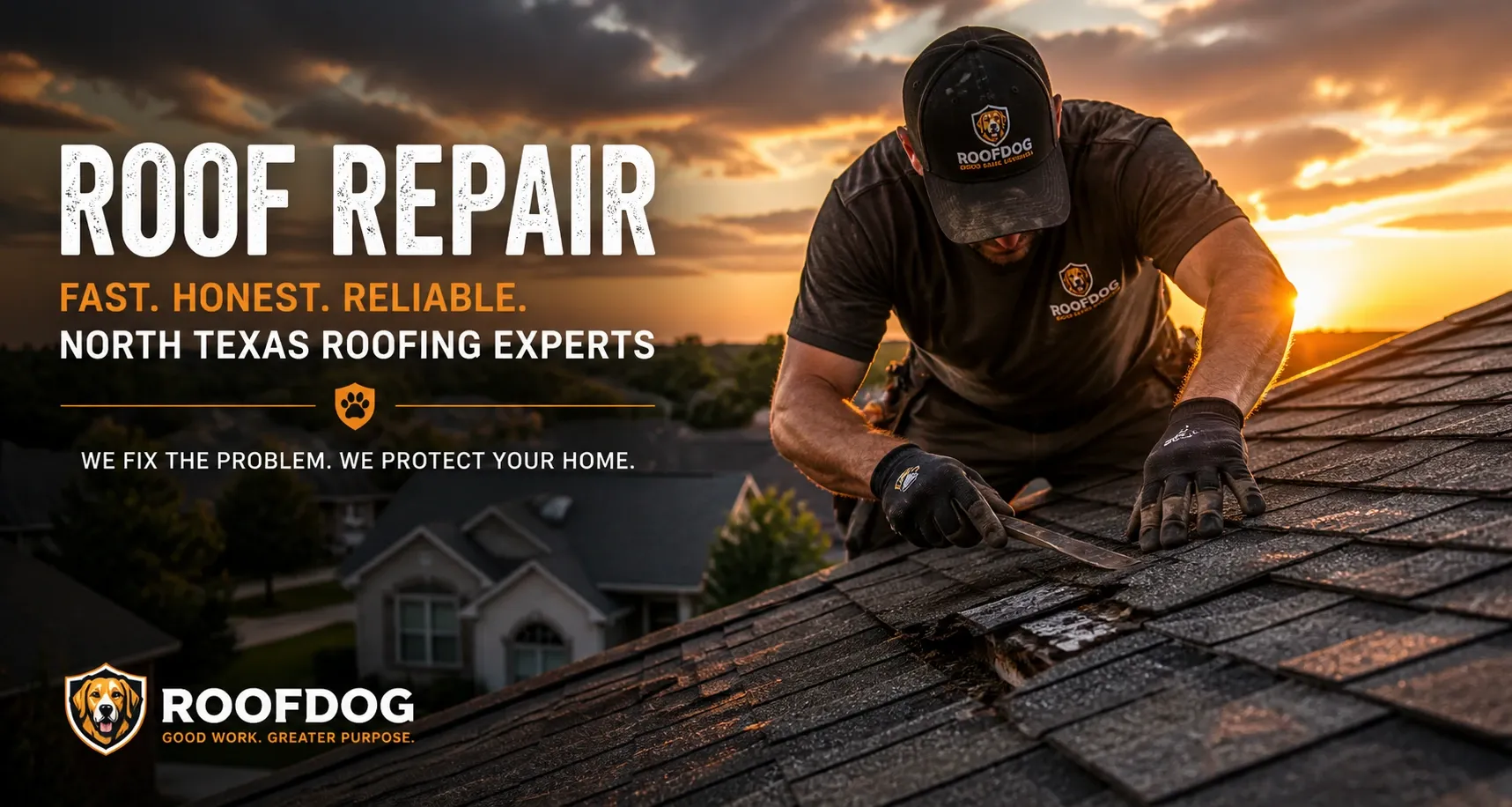
Roof Repair in North Texas
Fast, honest roof repairs for leaks, storm damage, missing shingles, flashing issues, and aging roofs — with no-pressure recommendations and workmanship-backed service.
10% of Every Roof Repair Goes to Local No-Kill Dog Rescues
North Texas Roof Repair Intelligence Report
What RoofDog inspection data reveals about the most common roof repair issues across DFW. Based on findings from 1,847 inspections across 28 North Texas cities.
Roofs Inspected
Across 28 North Texas cities
Avg Age at First Repair
Years before meaningful repair needed
Repairable Conditions
Of inspected roofs can be repaired
Repair Condition Breakdown
RoofDog Repairability Score
Not every damaged roof needs replacement, and not every leak can be solved with a patch. Our Repairability Score quantifies where your roof stands.
Highly Repairable
Repair Likely
Monitor Closely
Plan Replacement
Replace Likely
Factors That Influence Your Score
What We Check Before Recommending a Roof Repair
RoofDog diagnoses root causes instead of only treating visible symptoms. Here is what our inspection covers.
Based on 1,847 North Texas roof inspections, we know exactly where to look and what causes most failures in DFW.
Schedule Your Free InspectionCan This Roof Be Repaired? Decision Engine
Based on inspection data from 1,847 DFW roofs, here is how we determine repair viability.
Repair Likely Viable
- Single leak source identified
- Isolated pipe boot failure
- Localized flashing issue
- Limited shingle loss (under 10% of area)
- Roof under 15 years old
- Decking is dry and structurally sound
- No more than 1 prior repair on same area
Replacement Planning Recommended
- Multiple independent leak points
- Widespread granule loss across slopes
- Brittle or cracking shingles
- Repeated repair failures (2+ same area)
- Roof 18+ years old
- Storm damage across multiple slopes
- Decking deterioration across broad areas
- Repair costs approaching 40-50% of replacement
Roof Repair Conditions Across North Texas
How your city compares: health scores, roof ages, and storm exposure from 1,847 inspections.
| City | Health Score | Avg Roof Age | Storm Exposure | View Details |
|---|---|---|---|---|
| Fort Worth | 62/100 | 14.3 yrs | High | View → |
| Frisco | 72/100 | 8.8 yrs | Moderate-High | View → |
| McKinney | 70/100 | 9.6 yrs | Moderate-High | View → |
| Plano | 66/100 | 12.9 yrs | High | View → |
| Denton | 65/100 | 13.1 yrs | High | View → |
| Allen | 69/100 | 10.5 yrs | Moderate-High | View → |
| Lewisville | 66/100 | 12.7 yrs | High | View → |
| Flower Mound | 69/100 | 11.2 yrs | Moderate-High | View → |
| Little Elm | 71/100 | 9.2 yrs | Moderate-High | View → |
| Keller | 68/100 | 11.6 yrs | Moderate-High | View → |
| Southlake | 68/100 | 12.4 yrs | Moderate-High | View → |
| Rockwall | 66/100 | 12.8 yrs | High | View → |
Cities with High storm exposure show roof health scores 5-8 points lower on average than Moderate-High areas.
Can My Roof Be Repaired? A Complete Guide
The question every homeowner with a roof problem asks: do I need a repair or a replacement? The honest answer is: it depends on several specific factors. Here is exactly what determines whether your roof can be saved with a repair or needs full replacement.
Missing or Lifted Shingles
If only a few shingles are missing or lifted after wind, repairs are straightforward and usually permanent. If entire sections are stripped or if shingles are curled and brittle from age, a full replacement may be more cost-effective.
Granule Loss
Light granule loss is normal weathering. Heavy granule loss indicates the shingles are reaching end of life. If granule loss covers less than 10% of the visible roof, repair is possible. Beyond that, replacement is typically recommended.
Active Roof Leaks
Leaks are repairable if the entry point is localized (pipe boot, flashing, valley). If the roof is leaking in multiple locations simultaneously, replacement may be the smarter long-term investment.
Hail Impact Damage
If hail damage covers more than 20% of visible roof area, insurance may authorize replacement as more economical than extensive repairs, depending on policy terms.
Wind Damage
Lifted or broken shingle seals from wind are repairable. If wind has stripped large sections or broken decking, replacement is often the better answer.
Ventilation Issues
Poor ventilation causes premature shingle aging and ice dam formation but is fixable without replacing the roof. Proper ventilation upgrades often extend roof life by 5-10 years.
Roof Age & Insurance
Roofs 15+ years old may not qualify for insurance-covered repairs, pushing homeowners toward replacement. Younger roofs benefit from repair coverage.
The Bottom Line
Most roof problems that occur between year 5 and year 18 can be repaired. The exceptions are when damage is widespread, the roof is already old, or multiple independent failures exist. RoofDog inspects your specific roof and recommends repair or replacement based on what is best for your situation, not what generates the most revenue.
Schedule Your Free AssessmentSmall Problems Turn Into Expensive Ones Fast
A small roof leak rarely stays small. Water tracks along decking and framing, soaks insulation, stains drywall, and creates mold risk within days. The same is true for missing shingles, cracked pipe boots, and failed flashing — issues that look minor from the ground but compound every time it rains.
North Texas roofs take a harder beating than almost anywhere else in the country. Hail, sudden straight-line winds, extreme heat, UV exposure, and fast storm systems all shorten the service life of asphalt shingles and the details that hold the roof system together. Most DFW homes need at least one meaningful repair between year 7 and year 15 — long before a full replacement is due.
RoofDog specializes in accurate diagnosis, clear communication, and durable repair work. We do not push replacements when a repair is the right solution, and we do not patch over problems when the underlying failure needs to be addressed. If you need a second opinion, a fresh set of eyes, or a repair done the right way, we are built for it.
12 Signs Your Roof Needs Repair
Early indicators that something on your roof has already failed or is about to fail.
Water stains on ceilings or walls
Active leak entry points; needs immediate attention to prevent structural damage.
Missing or cracked shingles
Exposes underlayment and decking; becomes worse with every storm.
Granules in gutters or downspouts
Sign of shingle deterioration; indicates age and reduced weather protection.
Dripping or wet spots during storms
Clear sign of active leak; water entry during rain is the priority.
Loose or separated flashing
Around chimneys, vents, and walls; one of the most common leak sources.
Cracked or brittle pipe boots
Rubber seals fail before shingles do; failure typically occurs 8-12 years in Texas.
Sagging rooflines or soft spots underfoot
Indicates structural damage or decking rot; requires immediate professional assessment.
Visible algae or moss growth
More common in shaded areas; indicates moisture retention that accelerates deterioration.
Higher energy bills
Poor roof system or ventilation issues cause heat loss in winter and heat gain in summer.
Recent major storm event
Hail or high wind from a named storm should trigger an immediate roof inspection.
Nails popping through shingles
Fasteners backing out create lifting and water entry points.
Curled or warped shingles
Age-related deterioration; indicates the roof is approaching replacement timeline.
Signs Roof Repair May Not Be Enough
When replacement makes more sense than repair.
Multiple simultaneous leaks
If repairs are needed in 3+ separate locations across the roof, replacement is more cost-effective.
Widespread shingle damage
Damage covering 30%+ of visible roof area is typically more expensive to repair piecemeal than to replace.
Roof age 18+ years
Shingles are past expected lifespan. Continued repairs become increasingly frequent and expensive.
Failed prior repairs
If the same area has been repaired 2+ times, the underlying condition often requires replacement, not another patch.
Rotted or soft decking
If decking is compromised over a large area, multiple repairs compound costs. Full replacement is more efficient.
Extensive hail damage
20%+ of roof surface damaged by hail; insurance often covers replacement as more economical.
Systemic ventilation failure
Poor ventilation affecting the entire attic space; ventilation upgrades are often combined with full replacement.
Structural sagging or waviness
Indicates underlying deck or frame issues that repair cannot solve.
Unsure which category your roof falls into? Schedule a free professional assessment.
Get Your Roof Assessed12 Common Roof Repair Problems We Fix
Nearly every leak and damage call in DFW falls into one of these categories. Each gets a proper diagnosis, not a surface-level patch.
Roof Leaks
What: Water entering the home through a breach in the roof system.
Why: Even a small leak can damage decking, insulation, drywall, and create mold within days.
How: We trace the entry point, stop active intrusion, and repair the underlying failure — not just the stain.
Missing or Lifted Shingles
What: Shingles blown off or broken from their seal by high wind.
Why: Missing shingles expose the underlayment and decking, turning into leaks during the next rain.
How: We replace damaged shingles with color-matched product and reseal neighboring tabs.
Hail Impact Damage
What: Bruised shingles, fractured mats, and displaced granules from hail strikes.
Why: Hail strikes shorten shingle lifespan and often qualify for insurance-covered repair or replacement.
How: We document impacts, communicate with your adjuster, and repair or replace based on scope.
Flashing Failures
What: Metal flashing that has lifted, corroded, or separated from a wall, chimney, or penetration.
Why: Failed flashing is the single most common source of chronic leaks in DFW homes.
How: We remove old flashing, re-integrate new metal with the roof system, and seal properly.
Valley Leaks
What: Leaks where two roof slopes meet — the highest water-flow area of the roof.
Why: Valleys concentrate water and debris, so small failures here produce large leaks fast.
How: We replace underlayment, install new valley metal or weave, and re-shingle the affected slope.
Pipe Boot Failures
What: Cracked rubber collars around plumbing vent pipes.
Why: Pipe boots typically fail at 8-12 years in Texas — often before shingles do.
How: We install lifetime pipe boots or lead flashing that outlasts the roof itself.
Chimney Flashing Leaks
What: Water intrusion around brick, stone, or stucco chimneys.
Why: Chimneys move with thermal cycles; old caulk and step flashing fail without warning.
How: We rebuild step flashing, install counterflashing into mortar joints, and seal with proper materials.
Skylight Leaks
What: Leaks around skylights, often from failed flashing or degraded seals.
Why: Skylight leaks are commonly misdiagnosed as the skylight itself, when flashing is the real issue.
How: We re-flash the skylight curb and replace underlayment, only replacing the unit if truly needed.
Ridge Cap Damage
What: Missing or cracked ridge shingles at the peak of the roof.
Why: Ridge caps protect the most vulnerable seam on the entire roof.
How: We install matching ridge caps and seal with proper roofing cement.
Nail Pops
What: Nails that have backed out of the decking, lifting shingles above them.
Why: Nail pops create entry points and visible bumps that worsen over time.
How: We re-drive, seal, and re-shingle affected areas.
Soft Decking or Localized Rot
What: Sections of plywood or OSB that have absorbed water and deteriorated.
Why: Soft decking cannot hold shingles or nails, and keeps damage spreading even after a surface fix.
How: We remove and replace rotted decking before any shingle work goes back on.
Storm-Related Damage
What: Wind, hail, or debris damage from a recent storm event.
Why: Storm damage often looks minor from the ground but can void warranty coverage.
How: We perform a full storm inspection, document everything, and repair or coordinate with insurance.
When Insurance Pays For Roof Repair
Understanding what is and is not covered by homeowners insurance.
Usually Covered
- Named Storm Event: Wind, hail, tornado, or derecho with documented event.
- Tree or Debris Impact: Falling tree limb or external object damage during a storm.
- Sudden Accidental Damage: Caused by covered peril (lightning, fire, explosion).
- Recent Hail (1-5 years): Hail damage within loss period; older hail damage may not be covered.
- Wind Damage Post-Storm: If documented storm event caused the wind damage.
Usually Not Covered
- Age-Related Wear: Shingles naturally degrade over time; insurance does not cover normal deterioration.
- Maintenance Neglect: Clogged gutters causing ice dams or poor drainage; homeowner responsible.
- Prior Damage Not Reported: If previous damage was not filed as a claim, it may be excluded.
- DIY or Unprofessional Repairs: Claims may require professional contractor documentation; DIY work may void coverage.
- Roof Replacement: Some policies do not cover full replacement once roof reaches age limit (typically 20-25 years).
- Delayed Reporting: Claims filed months after damage may be denied; insurers require timely notice.
Our team will review your situation and advise whether filing a claim is likely worth the deductible.
Read our complete insurance claims guide →How Long Do Roof Repairs Last In North Texas?
When repairs buy time vs when they are permanent solutions.
| Repair Type | Expected Duration | Notes |
|---|---|---|
| Pipe Boot Replacement | 10-20 years | Depends on material; lifetime boots outlast most shingles. |
| Flashing Repair or Replacement | 10-25 years | Professional metal flashing holds for extended period if done correctly. |
| Valley Underlayment & Re-Shingle | 10-18 years | Depends on shingle age; same as remaining roof life. |
| Shingle Patches (Minor) | 3-8 years | Temporary measure; full replacement often follows within 5-10 years. |
| Chimney Flashing Rebuild | 15-25 years | When done with proper counterflashing integration. |
| Roof Decking Patch | Until next major damage | Localized decking replacement extends roof life; systemic rot requires full replacement. |
| Skylights Re-Flashing | 12-20 years | Depends on flashing material and installation quality. |
| Emergency Tarping | 1-3 months | Temporary measure; permanent repair required within weeks. |
How Hail Damages Asphalt Shingles
Understanding why some hail damage is repairable and some requires replacement.
Types of Hail Damage
- Bruising:
Soft, darkened circles on shingle surface (hard mat not broken).
- Cracking:
Splits or fractures visible in shingle mat (granules often missing).
- Granule Displacement:
Entire areas of missing granules exposing fiberglass mat beneath.
- Splits & Tears:
Shingles torn or separated at seams; not simply dented.
What This Means For Your Roof
Hail impact bruises and cracks asphalt shingles, shortening their remaining lifespan. Small impacts across limited roof area are often repairable. Extensive damage covering 20%+ of visible roof surface usually qualifies for insurance-authorized replacement as more economical than widespread repairs.
Professional hail damage assessment requires close inspection to differentiate repairable impact from aging deterioration. RoofDog documents all visible damage with photos for insurance purposes.
Wind Damage vs Normal Aging: How To Tell The Difference
Why this distinction matters for insurance and repair decisions.
| Aspect | Wind Damage | Normal Aging |
|---|---|---|
| Pattern | Lifted shingle tabs pointing upward; concentrated in areas facing prevailing wind. | Curling or warping affecting entire visible roof surface uniformly. |
| Timing | Occurs immediately after high-wind storm event. | Develops gradually over months or years. |
| Severity | Missing shingles or broken seals in specific locations. | Widespread brittle shingles that crack when walked on. |
| Insurance | Covered if documented storm caused damage. | Not covered; considered wear and tear. |
Why this matters: Wind damage is often covered by insurance. Normal aging is not. Professional inspection differentiates the two, providing documentation for insurance claims when appropriate.
Ventilation Problems That Cause Recurring Repairs
Why fixing ventilation prevents future repairs and extends roof life.
Insufficient soffit vents
Blocks air intake; hinders cooling and allows moisture buildup. Install additional soffit venting.
Blocked ridge vents
Dust, wasp nests, or roofing material blocks exhaust. Clear venting; ensure proper installation.
Bathroom fan ducts vented into attic
Moisture directed into attic instead of outside. Reroute fans to exterior vents.
No attic ventilation system
Older homes often lack ventilation. Install soffit-to-ridge ventilation system.
Improperly installed roof decking
Gaps between plywood sheets allow hot air escape. Professional replacement needed.
Soffit vents blocked by insulation
Insulation installed too close to eaves blocks airflow. Professional review recommended.
Poor ventilation causes shingles to fail prematurely. We often recommend ventilation upgrades as part of repairs to prevent future problems.
Learn About Ventilation UpgradesWhy Roof Repairs Fail Prematurely
Based on RoofDog inspection findings, these are the most common reasons roof repairs do not hold.
Surface-level patch over structural failure
Caulking a leak without identifying the actual water entry point. Leak returns after caulk dries or cracks.
Wrong materials used
Using caulk instead of metal flashing; using wrong sealant for temperature ranges.
Poor workmanship on flashing
Flashing not properly sealed to decking or shingles; fasteners missing or misplaced.
Ignoring structural rot
Patching over rotted decking without replacing the decking first.
Improper shingle nailing
Wrong fastener location, size, or angle; nails miss sealed zone.
Patch incompatible with adjacent materials
Color mismatch creates visible failure point and water entry gap.
Repair done during rain or wet conditions
Sealant or adhesive doesn't cure properly; water trapped under repair.
Ignoring ventilation as root cause
Repairing damage from poor ventilation without fixing ventilation fails when moist air condenses again.
No water testing after repair
Repair assumed complete without verification; leak returns after next rain because entry point was missed.
No photo documentation
Without before-and-after photos, homeowner cannot verify work quality or warranty coverage if the repair fails.
RoofDog repairs address root causes, not just symptoms. Every repair is backed by warranty.
Get a Professional DiagnosisCommon Roofing Repair Scams In Texas
Protect yourself from dishonest roofers using these consumer protection red flags.
"Caulk over everything" repair
Red flag: Roofer suggests caulking every seam instead of replacing flashing or fixing actual problem.
Door-to-door storm damage claims
Red flag: Unsolicited inspection and "we can get you insurance money" pitch after any weather event.
Uninsured worker discount
Red flag: Offer to avoid permits, inspections, or insurance coverage; no warranty provided.
Cheap tarping that causes more damage
Red flag: Tarps improperly secured or fastened with nails through new shingles.
Bait-and-switch pricing
Red flag: Estimate says $500; invoice arrives for $5,000+ without explanation.
"Roof looks worse than it is" upsell
Red flag: Recommends full replacement when simple repair would solve the problem.
No warranty or documentation
Red flag: Repair completed without written estimate, warranty, or before-and-after photos.
Cash-only jobs
Red flag: Roofer insists on cash payment with no receipt or insurance verification.
Protect Yourself:
- Always verify contractor insurance, local history, and permit compliance
- Get written estimates from 2-3 established local contractors
- Never pay upfront; payment should be due after work completion
- Request references from recent local repairs
- Ensure contractor carries general liability and workers compensation insurance
12-Point Checklist: Questions To Ask Before Hiring A Roofer
Use this checklist to vet roofing contractors and ensure you get quality work.
Should You Repair Or Replace Your Roof? Decision Framework
Real-world scenarios showing how to decide between repair and replacement.
Scenario: One roof leak in 10-year-old roof
Recommendation: Repair
Why: Localized issue; roof has 5-8 years remaining useful life.
Scenario: Hail damage on 50% of 15-year-old roof
Recommendation: Replace
Why: Widespread damage; roof near end of life anyway; insurance often covers replacement.
Scenario: Missing shingles after windstorm on 5-year-old roof
Recommendation: Repair
Why: New roof; wind damage is covered; repair is far less expensive.
Scenario: Leaking in 3 separate areas on 20-year-old roof
Recommendation: Replace
Why: Multiple failures indicate systemic aging; replacement more economical long-term.
Scenario: Cracked pipe boot on 12-year-old roof
Recommendation: Repair
Why: Single component failure; roof still has good life remaining.
Scenario: Valley leak + granule loss + soft decking on 22-year-old roof
Recommendation: Replace
Why: Multiple failures + age = replacement is the only sensible answer.
Scenario: Chimney flashing failure on 8-year-old roof
Recommendation: Repair
Why: Common failure point; repair is quick and permanent.
Scenario: Post-hail inspection on 18-year-old roof with 20% damage
Recommendation: Replace
Why: Insurance will likely cover; roof nearing end of life anyway.
Comparison Tables: Repair vs Replacement
Repair vs Replacement Decision Matrix
| Aspect | Repair | Replacement |
|---|---|---|
| Damage Scope | Localized (1-3 areas) | Widespread (30%+ of roof) |
| Roof Age | Under 15 years | 18+ years |
| Decking Condition | Sound, dry, no rot | Systemic rot or soft areas |
| Upfront Cost | $350 - $4,500 | $8,000 - $15,000+ |
| Timeline | 1-3 days | 7-14 days |
| Insurance Coverage | Often covered for storm events | May be denied if roof near end of life |
| Long-term Value | Extends roof life 3-8 years | Provides 20-25 year lifespan |
| Best For | Homeowners keeping home for 3-8 years | Long-term owners or new construction |
Minor Repair vs Major Repair
| Aspect | Minor Repair | Major Repair |
|---|---|---|
| Examples | Single shingle patch, pipe boot, isolated flashing | Valley replacement, decking patch, entire chimney flashing |
| Duration | 1-2 hours | Half day to full day |
| Cost Range | $350 - $800 | $1,500 - $4,500+ |
| Materials Needed | Shingles, sealant, fasteners | Multiple flashing types, underlayment, decking materials |
| Complexity | Surface-level intervention | Requires identifying root cause, possible structural access |
| Warranty Period | 1-3 years workmanship | 5-10 years workmanship |
Insurance Claim vs Out-of-Pocket Repair
| Aspect | Insurance Claim | Out-of-Pocket |
|---|---|---|
| Damage Type | Storm, hail, wind, sudden accident | Age wear, neglect, maintenance issues |
| Documentation | Professional inspection report + photos | Homeowner responsibility for estimate |
| Adjuster Coordination | RoofDog meets on roof; aligns scope | Homeowner responsible for communication |
| Deductible | Typically $500-$2,500 per claim | None applicable |
| Timeline | 1-2 weeks claim processing + repair | Repair starts after homeowner approval |
| Repair vs Replace | Insurer may push replacement if cost-effective | Homeowner chooses option |
Temporary Fix vs Permanent Repair
| Aspect | Temporary Fix | Permanent Repair |
|---|---|---|
| Purpose | Stop active water intrusion quickly | Resolve root cause permanently |
| Timeline | Same day / emergency basis | Scheduled appointment; 1-3 days |
| Cost | $150 - $800 tarping | $750 - $4,500+ repair |
| Duration | Days to weeks | 5-25 years depending on repair |
| Follow-up Needed | Yes, permanent repair required soon | No follow-up unless other issues arise |
| Best Used When | Active emergency leak or awaiting insurance approval | Once scope confirmed and homeowner approved |
Most Common Roof Repair Problems Found During RoofDog Inspections
Based on RoofDog inspection and repair data across North Texas.
1Hail Impact Indicators
37%Bruised or fractured shingles, granule displacement after documented hail events.
2Pipe Boot Failures
33%Cracked or deteriorated rubber collars around plumbing vents; typically fails at 8-12 years in Texas.
3Wind Damage Indicators
31%Lifted tabs, broken seals, and displaced shingles from high wind events.
4Flashing Deterioration
30%Step flashing, counterflashing, or seal failures around chimneys, vents, walls.
5Ventilation-Related Moisture
27%Moisture accumulation from inadequate airflow causing decking and shingle damage.
6Prior Repair Failures
22%Previous repair attempts that did not address root cause or used wrong materials.
7Chimney/Skylight Flashing
19%Penetration-specific failures where flashing separates or caulk deteriorates.
8Valley Leaks
18%Water concentration at roof intersections; underlayment or metal failures.
9Nail Pops
15%Fasteners backing out of decking, creating lifting and water entry points.
10Localized Decking Rot
12%Soft or rotted plywood/OSB in isolated areas from prior water intrusion.
Real Roof Repair Stories From North Texas Homeowners
Problem: Active ceiling leak in master bedroom during storms; two other roofers recommended full roof replacement.
Solution: RoofDog identified a failed flashing detail around a vent pipe. Replacement flashing and re-sealing the surrounding area.
Result: Leak stopped immediately. No leak in 18 months of subsequent storms. Homeowner saved $12,000+ by avoiding unnecessary replacement.
Problem: Hail damage from May storm; roof covered in impact marks; insurance adjuster split on scope.
Solution: Professional documentation and adjuster coordination. Determined that repair vs replacement made sense for this roof's age. Coordinated with insurance.
Result: Insurance approved repair rather than replacement. Repair completed in 3 days. Roof looks new; warranty backed.
Problem: Recurring leak from skylight area despite two prior repairs by different contractors.
Solution: Root cause was improper flashing integration, not the skylight itself. Complete flashing removal, new underlayment, and professional re-integration.
Result: Leak resolved. Skylight now functions perfectly. Family able to open skylights again without fear. 3-year warranty provided.
Problem: Multiple small leaks detected during home inspection; caused concern about roof failure.
Solution: Individual assessment of each leak point. Pipe boot replacement, one valley repair, chimney flashing seal. Estimated 8-10 years remaining useful life.
Result: All leaks stopped. Home inspection passed. Repair cost $1,800. Homeowner able to proceed with purchase confidently.
Problem: Visible hail damage after April storm; uncertain whether repair or replacement was needed.
Solution: Inspection revealed damage limited to specific areas. Insurance claim filed. Repair approved as more economical than replacement.
Result: Hail damage repaired under insurance with minimal deductible. Roof restored to like-new condition. 10-year remaining lifespan confirmed.
Our 8-Step Roof Repair Process
Organized, modern, and built to give you full visibility from first call to final verification.
Initial Call & Issue Review
You describe what you are seeing — leaks, missing shingles, storm damage, or concerns. We listen, ask clarifying questions, and schedule a fast inspection, often same-day for active leaks or emergency situations.
Comprehensive Roof Inspection
A RoofDog inspector performs a full exterior and attic assessment (when access allows). We use moisture meters, UV detection, and detailed photography to identify the actual cause of the problem, not just the visible symptom.
Photo Documentation & Plain-English Explanation
You receive a detailed report with high-resolution photos showing the damage, the entry point, and the surrounding area. We explain exactly what failed, why it failed, and what options exist to fix it — no jargon, no fear tactics.
Written Estimate & Repair Plan
We deliver an itemized estimate that breaks down the repair by component, materials, labor, timeline, and warranty coverage. You know exactly what to expect before we touch your roof.
Professional Repair Execution
Our crews complete the repair using color-matched, manufacturer-rated shingles and materials built for North Texas weather extremes. Every step is documented for your records.
Water Testing & Final Verification
We perform water tests when appropriate, magnet-sweep the ground for stray fasteners, verify the repair resolved the original issue, and deliver warranty documentation.
Warranty & Follow-up Support
You receive a written workmanship warranty covering the repair. We remain available for questions, follow-up inspections, or warranty work if any issues arise.
Preventive Maintenance Recommendations
We share guidance on roof care, ventilation improvements, gutter maintenance, and when to schedule the next proactive inspection to catch issues early.
Why RoofDog Is Different: Process, Not Promises
Evidence-based repair decisions backed by inspection data from 1,847 North Texas roofs.
Standardized inspection process
Every roof gets the same thorough documented evaluation regardless of repair scope.
Photo documentation at every stage
Before, during, and after every repair — you see what we see.
Repairability scoring (0-100)
Quantified repair viability so you know exactly where your roof stands.
Root-cause diagnosis
We find why the failure happened, not just where water shows up.
Written repair plan
Itemized materials, timeline, and warranty terms before we start.
Warranty-backed work
Written workmanship warranty with clear terms on every repair.
Local DFW storm knowledge
From 1,847+ inspections, we know how North Texas weather affects every roof type.
City-level condition data
We know the common issues in your specific neighborhood and zip code.
Long-term roof monitoring
Customer records enable data-driven maintenance recommendations over time.
10% supports dog rescues
A portion of every repair funds North Texas no-kill dog rescues since 2009.
Argyle-based, not storm-chasing
We live here. We are not showing up for one storm and disappearing.
Roof Repair Cost in North Texas: 2026 Pricing Guide
Real pricing ranges DFW homeowners should expect in 2026.
| Repair Type | Typical Range |
|---|---|
| Minor shingle repair | $350 - $750 |
| Pipe boot or small flashing repair | $450 - $950 |
| Moderate leak repair | $750 - $2,500 |
| Valley or larger repair | $1,500 - $4,500+ |
| Emergency tarping | Varies by size, pitch, urgency |
Cost Drivers
- • Roof pitch and height
- • Accessibility and walkability
- • Shingle type and availability
- • Scope and location of damage
- • Water intrusion extent
- • Decking condition
- • Emergency response timing
- • Insurance involvement
Why Inspections Matter
Final pricing requires an inspection because roof repair costs depend on the exact cause, location, and extent of damage. Learn more about how we price repairs and financing options available to DFW homeowners.
40+ Roof Repair FAQs
Straight answers to the 40+ questions DFW homeowners ask about roof repair.
How much does a typical roof repair cost in North Texas?
Is roof repair more expensive than roof replacement?
What factors affect roof repair pricing?
Can I finance a roof repair?
How quickly can you repair my roof?
Can you repair my roof in winter or during rain?
How long will my roof repair last?
Will insurance cover my roof repair?
What should I do after a storm to file an insurance claim?
How long does an insurance claim for roof repair take?
Can I choose my own roofer for an insurance claim?
How do you diagnose a roof leak when the water stain is not directly below the leak?
What is the difference between a structural repair and a surface repair?
Can you repair a roof leak without entering the attic?
What does a water intrusion test involve?
What should I do if I have an active roof leak right now?
Can you tarp a roof the same day?
What if the roof repair needs to wait for insurance approval?
Do you offer emergency roof repair on weekends or evenings?
Are roof repairs warrantied?
What does a workmanship warranty cover?
How long is the warranty on a roof repair?
What if my roof repair fails within the warranty period?
Why does my roof leak in one spot but not others?
Can a small roof leak get worse?
What is a roof leak detection service?
Why does my roof leak only during heavy rain?
Can you fix a roof leak permanently or is it always temporary?
How does hail damage different roof materials differently?
What qualifies as repairable hail damage versus replacement-level damage?
Should I file a hail claim immediately after a storm?
Can you match my shingles after hail damage repair?
My roof is 20 years old. Should I repair the damage or replace the entire roof?
How many times should I repair a roof before replacing it?
What is the right time to replace a roof?
Can you give me a second opinion on repair vs replacement?
Can I patch my roof myself?
What are the risks of DIY roof repair?
How is professional roof repair better than patches or caulk-overs?
What is the most common roof repair question homeowners ask?
How do I prevent future roof repairs?
Do you offer roof maintenance plans?
Should I get my roof inspected before buying a home?
What cities do you serve for roof repairs?
How can I schedule a free roof inspection?
Can my roof be repaired if it is more than 15 years old?
What is a RoofDog Repairability Score?
How does RoofDog decide between repair and replacement?
What roof repair issues show up most often in North Texas?
Does RoofDog keep inspection records for future roof monitoring?
Related Services & Resources
Roof Replacement
Full tear-off and reinstallation with premium Owens Corning materials.
Roof Inspection
Free, no-pressure inspection with full photo documentation.
Emergency Roof Repair
Same-day tarping and storm damage response across DFW.
Attic Ventilation & Insulation
The upgrade most DFW roofs desperately need but rarely get.
Gutter Repair & Cleaning
Keep water moving away from the roof system and foundation.
Roof Maintenance
Proactive tune-ups that extend roof life and catch issues early.
Build Day Experience
See exactly what happens hour-by-hour when we replace a roof.
Roof Repair In Your Area
Educational Guides
Ready For An Honest Roof Repair Assessment?
Whether you are dealing with an active leak, missing shingles, storm damage, or simply wondering if your roof can be repaired or needs replacement, RoofDog will inspect it thoroughly, explain your options clearly in plain English, and recommend the right fix — not the most expensive one.
308 FM 1830 Suite 12B Argyle, TX 76226