
DFW Solar-Ready Roofing: Should You Integrate Solar Shingles in 2026?
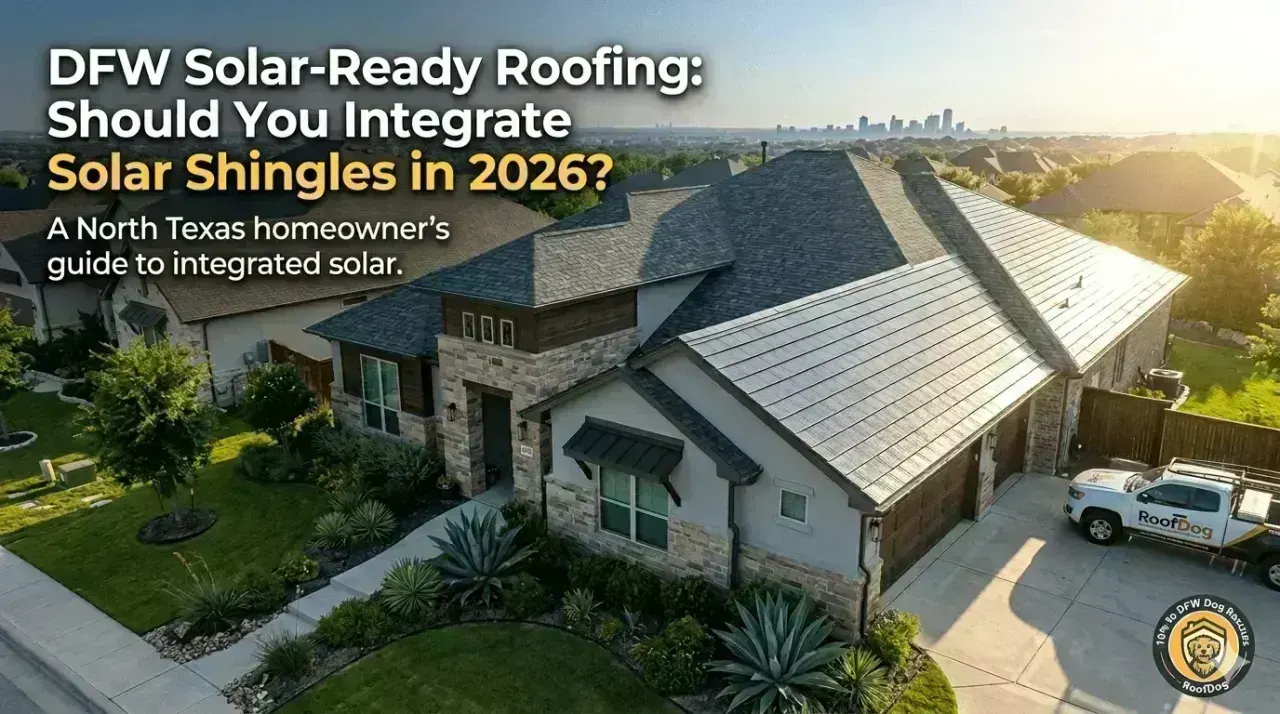
For years, North Texas homeowners faced a frustrating tradeoff: reduce a $400–$600 monthly electric bill with solar panels, or preserve the clean, architectural look of a high-end home.
In 2026, that tradeoff is effectively gone.
Between the maturation of integrated solar shingles, stronger incentives, and rising electricity costs across ERCOT, a new category has emerged: solar-ready roofing systems. These systems treat your roof not as a surface to mount equipment — but as an energy-producing asset from day one.
At RoofDog, we have seen a 300% increase in solar-related inquiries across Dallas–Fort Worth this year alone. The shift is real — but the decision still requires precision.
This guide breaks down:
- Solar shingles vs. panels (real-world performance)
- DFW-specific economics and incentives
- Whether your roof is actually "solar-ready"
- HOA realities in North Texas
- Battery backup strategy (critical in Texas)
- Permitting across Dallas, Fort Worth, and Plano
1. The 2026 Heavyweight Fight: Solar Shingles vs. Solar Panels
The market has finally reached a point where this is a legitimate decision — not a novelty vs. standard comparison.
Integrated Solar Shingles (The "Sleek" Choice)
Products like GAF Timberline Solar and Tesla's Solar Roof have transitioned from early adopters to viable mainstream options.
These systems function as:
- Your primary roofing material
- Your water barrier
- Your power generation system
Advantages:
- Clean, flush appearance (no racks, no gaps)
- Higher wind resistance (important for North Texas storms)
- No debris accumulation underneath
- HOA-friendly by design
- Eliminates need for a second install phase
Trade-offs:
- Slightly lower efficiency per square foot vs. premium panels
- Higher upfront cost if you were not replacing your roof anyway
- More specialized installation requirements (fewer qualified contractors)
Rack-Mounted Solar Panels (The "Efficiency" Choice)
Traditional panels still dominate in pure energy output.
Advantages:
- Maximum energy production per square foot
- Adjustable tilt for optimal solar angle
- Easier to upgrade or replace individual panels
Trade-offs:
- Adds weight to existing roof structure
- Creates maintenance zones (debris, pests)
- Visually intrusive on high-end homes
- HOA friction (still very real in DFW)
Bottom Line
- If your roof is less than 5 years old → panels often make sense
- If your roof is approaching replacement → solar shingles become significantly more attractive
This is where most homeowners miscalculate.
2. The Economics of Solar in DFW (2026 Reality)
Texas does not offer a statewide rebate — but the incentive stack remains strong enough to materially impact ROI.
Federal Clean Energy Credit
30% tax credit on:
- Solar equipment
- Installation labor
- Electrical components
- Battery storage
This is the single largest driver of adoption.
Texas Property Tax Exemption
Under Texas Tax Code §11.27, solar-related value is fully exempt.
Example:
- $40,000 system added to your home value
- $0 increase in property taxes
In a state with aggressive appraisal increases, this matters more than most homeowners realize.
Oncor Battery Incentives
For most DFW homeowners:
- Rebates available for battery integration
- Additional savings through time-of-use optimization
- Ability to store power during low-cost periods and deploy during peak (4–7 PM)
Real ROI Expectations
- Typical payback: 12–16 years
- Faster with battery optimization, high energy usage homes (common in $750K+ segment), and electric vehicles
Solar is not a short-term flip — it is a long-duration hedge against energy inflation.
3. Is Your Roof Actually "Solar-Ready"?
This is where poor decisions cost homeowners thousands.
The RoofDog Rule
If your roof has less than 10 years of life remaining, do not install solar panels.
Why:
- Detach + reset costs: $5,000–$8,000
- Risk of damaging panels during reinstallation
- Warranty complications
Solar-Ready Criteria
Before any system is installed, you need:
1. Structural Integrity
- Can your rafters handle added load?
- Particularly important for tile-to-shingle conversions
2. Decking Condition
- Solar shingles require perfectly flat, healthy decking
- No soft spots, warping, or moisture intrusion
3. Impact Resistance Strategy
North Texas hail is not theoretical.
You should be pairing solar with:
- Class 4 impact-resistant materials
- Upgraded underlayment system
Common Mistake
Homeowners install panels on aging roofs to "save money." In practice, they:
- Pay twice for labor
- Shorten system lifespan
- Complicate insurance claims
4. Dealing with the "Barking" HOA
Texas law (SB 1697) protects your right to solar — but does not eliminate friction.
HOAs in DFW can still:
- Require panels to be parallel to roofline
- Mandate black-on-black aesthetics
- Push installations to rear-facing slopes
Where Solar Shingles Win
Because they mimic architectural shingles:
- No visual disruption
- No rack systems
- No glare issues
In neighborhoods like Southlake, Frisco, and Castle Hills:
- Approval rates are significantly higher
- Approval timelines are faster
This alone is enough to justify the premium for certain homeowners.
5. 2026 Battery Backup: Powering Your Home Through the Next North Texas Ice Storm
If 2021 taught anything, it is this: energy independence in Texas is not optional — it is strategic.
Why Battery Storage Matters in DFW
- Grid instability during peak events
- Rolling blackouts still possible
- Increasing strain from population growth
What a Modern System Looks Like
A properly designed setup includes:
- Solar generation (roof or panels)
- Battery storage (e.g., Tesla Powerwall)
- Smart load management
What It Actually Powers
Depending on system size:
- HVAC (partial or full)
- Refrigeration
- Lighting
- Internet + workstations
- Garage systems
Financial Angle
Batteries are not just backup — they are optimization tools:
- Store energy during low rates
- Use during peak pricing windows
- Reduce grid dependency
Practical ROI Perspective
Battery ROI is not purely financial — it is:
- Risk mitigation
- Comfort continuity
- Property value enhancement
For high-end homes, this is increasingly becoming expected — not optional.
6. City-by-City Permit Guide (Dallas, Fort Worth, Plano)
Permitting is where projects get delayed — and where inexperienced contractors lose credibility.
Dallas
- Requires detailed electrical plans
- Utility interconnection approval needed (Oncor)
- Typical timeline: 2–4 weeks
Common friction points: incomplete load calculations, incorrect inverter specs.
Fort Worth
- Slightly more streamlined process
- Faster turnaround if documentation is correct
- Timeline: 1–3 weeks
Key note: strong emphasis on structural verification.
Plano
- Most detail-oriented of the three
- Requires HOA documentation (if applicable)
- Engineering review for larger systems
- Timeline: 3–5 weeks
Why This Matters
Permitting errors delay installs, increase labor costs, and frustrate homeowners.
A competent contractor should:
- Handle all permitting
- Coordinate utility approvals
- Manage inspections end-to-end
7. Why RoofDog is Positioned Differently
Solar roofing is not just electrical — it is water management + structural integrity + energy engineering.
Most companies only understand one of those.
RoofDog Approach
- Roofing-first mindset (no leaks, no shortcuts)
- Integrated solar expertise
- High-end home experience
The 10% Rescue Mission
This is not marketing — it is operational.
- 10% of profits go to no-kill shelters
- Funds support cooling systems, facility upgrades, and rescue capacity expansion
The "Sunny Dog" Initiative
Solar is not just powering homes — it is:
- Cooling kennels in 100°F+ summers
- Improving animal safety
- Expanding adoption capacity
Strategic Positioning
You are not just installing a roof or installing solar. You are:
- Increasing asset value
- Reducing long-term costs
- Supporting a mission with tangible outcomes
FAQ: Solar Roofing in North Texas
Will hail damage solar shingles?
Most 2026 systems carry a Class 4 impact rating, designed for 2-inch hail and high-wind events. They are engineered to match or exceed premium asphalt performance.
What is the ROI in Dallas?
- 12–16 year payback (typical)
- Faster with EV usage, battery optimization, and higher energy consumption homes
Do you handle permits and utility approvals?
Yes — end-to-end: city permitting, HOA documentation, and utility interconnection.
Final Take: Is Solar Roofing Worth It in 2026?
For DFW homeowners — especially in the $750K+ segment — the answer is increasingly yes, but only if executed correctly.
It makes sense when:
- You are already replacing your roof
- You want long-term cost control
- You value aesthetics and property value
It does not make sense when:
- Your roof is relatively new
- You are optimizing purely for short-term ROI
- You choose the wrong contractor
Next Step
If you are evaluating solar, do not start with panels. Start with your roof.
A Solar-Ready Assessment should answer:
- Structural viability
- Remaining roof life
- Optimal system type (shingles vs. panels)
- Real ROI projections
Ready to see if your roof can pay for itself?
Contact RoofDog for a Solar-Ready Assessment. We will run the numbers, inspect your structure, and show you how your home can generate power — while helping dogs find one.
RoofDog — High-tech roofs. Heart-led mission.
Need a Roof Inspection?
Get expert advice and a free estimate from North Texas's trusted roofing professionals.
Schedule Free Inspection