How Long Do Roofs Last in Lantana, TX?
Short answer: Most roofs in Lantana, TX last 15 to 20 years — but the open, windy terrain and DFW's brutal hail season push many builder-grade architectural shingle roofs toward the lower end of that range. Because Lantana is a master-planned community built largely from the early 2000s onward, a huge share of its homes are hitting that critical 15-20 year window right now. Upgrading to Class 4 impact-rated shingles at replacement can stretch a new roof toward 25-30 years while lowering your insurance premium.
🐾 RoofDog has completed several full roof replacements right here in Lantana. Free drone inspection, lifetime workmanship warranty, and 10% of our profits go to dog rescues. Call 940.828.ROOF — Protecting Homes. Saving Dogs.
Table of contents
- Roof lifespan in Lantana at a glance
- Why Lantana's housing stock matters
- Local climate and weather exposure
- DFW hail and your roof
- High wind on open Lantana lots
- Dominant roofing materials in Lantana
- Common roof problems we see locally
- When and how to inspect
- Frequently asked questions
- Summary
Roof lifespan in Lantana at a glance
Lantana sits in Denton County, just south of Argyle and next to Bartonville, in the northwest arc of the Dallas-Fort Worth metroplex. Roofs here face the same core challenges as the rest of North Texas — intense summer heat, sudden hailstorms, and gusty spring fronts — but a few things about Lantana's layout and age make the local answer distinct.
Here's how typical materials perform in Lantana conditions versus their marketing lifespan:
| Material | Marketed lifespan | Realistic Lantana lifespan |
|---|---|---|
| Builder-grade 3-tab (older sections) | 20-25 yrs | 12-16 yrs |
| Architectural (dimensional) asphalt | 30 yrs | 15-20 yrs |
| Class 4 impact-rated shingles | 30-50 yrs | 25-30 yrs |
| Standing seam metal | 40-70 yrs | 40-50 yrs |
For the wider regional picture, see our guide on how long roofs last in Texas. Lantana lands on the shorter side of the state average because of its exposure — more on that below.
Why Lantana's housing stock matters
Lantana is a master-planned community, and that single fact shapes almost everything about roofing here. Most of the neighborhood was built in a compressed window from the early 2000s through the 2010s, with builders working through phases of largely uniform housing stock. That means whole streets share the same age, the same builder-grade materials, and — critically — the same replacement clock.
The practical consequence: a large share of Lantana homes installed their original architectural asphalt roofs 15 to 22 years ago. Those roofs are now squarely inside the replacement window. When one home on a cul-de-sac needs a new roof, its neighbors usually aren't far behind, because they were shingled the same summer with the same product.
Uniformity also means predictability, which is good news for homeowners. Once RoofDog has worked several roofs on a given Lantana street, we know exactly what decking, ventilation, and flashing details to expect — and where the original builder cut corners.
Local tip: If your Lantana home was part of an early build phase (2003-2010) and still wears its original roof, you're overdue for a professional inspection. Even a roof that "looks fine" from the ground is often past its economic prime after 18 years of North Texas sun and hail.
Local climate and weather exposure
Lantana experiences the full North Texas weather spectrum: long, punishing summers with roof-surface temperatures well over 150°F, dry spells that bake shingle asphalt brittle, and violent spring and fall frontal systems that arrive with hail and straight-line wind. Thermal cycling — hot days followed by cool nights — expands and contracts shingles daily, slowly loosening the granules that protect the asphalt underneath.
One thing that sets Lantana apart from older DFW suburbs like Denton proper or parts of Fort Worth is its relative lack of mature tree canopy. As a newer community on formerly open ranch and prairie land, many Lantana lots have young, small trees. Less shade means more direct UV exposure on the roof deck — accelerating aging — but it also means fewer overhanging limbs dropping debris or scraping shingles. It's a trade-off, and it nudges expected lifespan slightly downward on sun-baked south and west slopes.
DFW hail and your roof
The Dallas-Fort Worth metroplex sits inside one of the most active hail corridors in the country, and Denton County catches its share nearly every storm season. Hail is the single biggest reason Lantana roofs get replaced before their theoretical lifespan. A single significant hailstorm can bruise an asphalt roof so severely that the shingle mat fractures — damage that may not leak for months but has already ended the roof's useful life.
This is exactly why so many Lantana homeowners are now upgrading to Class 4 impact-rated shingles at replacement. These shingles are tested to withstand a two-inch steel ball dropped from height without cracking, and most Texas insurers offer a premium discount for installing them. Learn more in our breakdown of how long Class 4 shingle roofs last in Texas. If your current roof is standard architectural asphalt, our guide to architectural shingle lifespan in Texas explains what to expect before that upgrade.
High wind on open Lantana lots
Because Lantana was developed on open prairie with wide streets and comparatively few windbreaks, wind exposure is higher than in tightly wooded older neighborhoods. Spring cold fronts and summer downbursts can hit exposed ridgelines and second-story gables with gusts strong enough to lift and peel shingle tabs — especially on aging roofs where the factory sealant strip has already dried out.
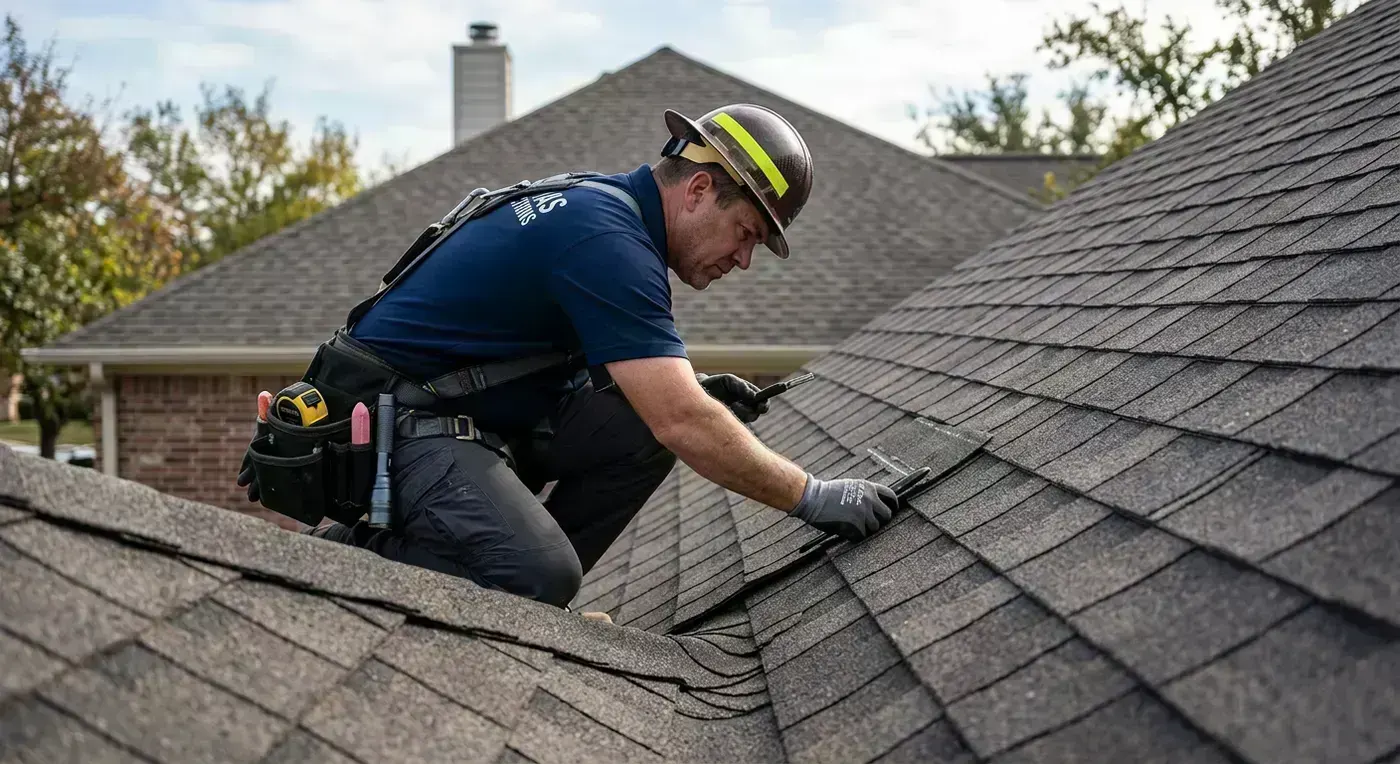
The most common wind damage we find in Lantana is creased or missing shingles along ridges, hips, and rake edges, plus lifted ridge caps. Once a tab lifts even slightly, wind-driven rain can work underneath and rot the decking. Homes on the community's outer edges and near open greenbelts tend to see this first. A properly nailed, high-wind-rated shingle installation makes an enormous difference here — many builder-grade roofs were installed with the minimum number of nails, which is why they fail early in the wind.
Dominant roofing materials in Lantana
Walk any Lantana street and you'll see a clear pattern: architectural (dimensional) asphalt shingles dominate, reflecting the community's 2000s-and-later construction era. These replaced the older 3-tab shingles that builders used in previous decades, and they're a meaningful upgrade in both appearance and wind resistance.
The current trend at replacement time is a shift toward Class 4 impact-rated architectural shingles. Homeowners here have learned — often the hard way, after a hail claim — that spending a little more on impact resistance pays off in both longevity and insurance savings. A smaller number of Lantana homes use concrete tile or standing-seam metal accents, but asphalt remains overwhelmingly the norm. When RoofDog replaces a roof in Lantana, the conversation almost always centers on which Class 4 product best matches the neighborhood's architectural style while maximizing storm resilience.
Common roof problems we see locally
Across the Lantana roofs RoofDog has inspected and replaced, a consistent set of issues shows up — many tied directly to the community's age and original builder-grade installation:
- Granule loss and shingle brittleness on roofs at the 15-plus year mark, worst on south- and west-facing slopes.
- Hail bruising that fails an insurance inspection even when no active leak is present.
- Wind-lifted and creased shingles along ridges and rake edges on exposed lots.
- Under-nailed original installations that shed shingles prematurely in high wind.
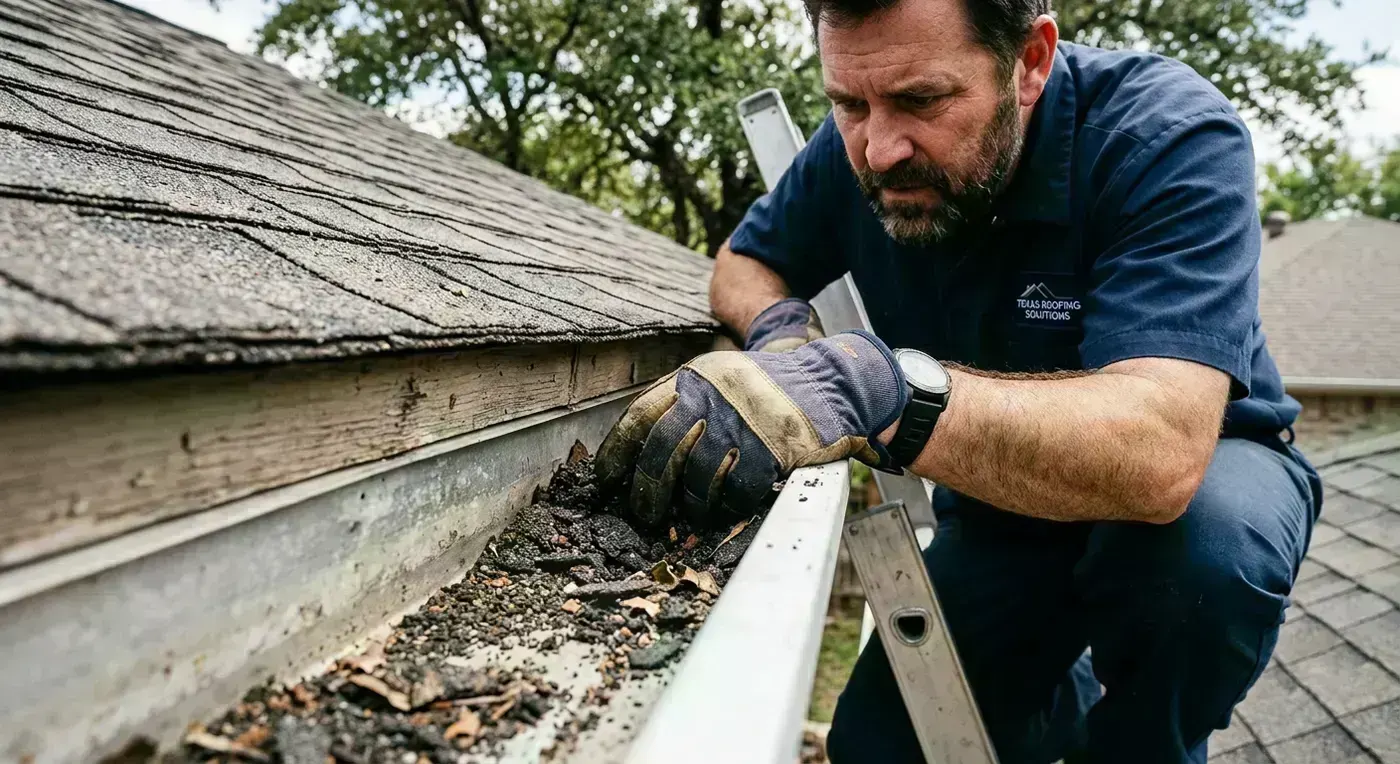
- Failing pipe-boot and flashing seals — a very common first leak point on 15-20 year old Lantana roofs.
- Inadequate attic ventilation that cooks shingles from below and shortens lifespan.
🐾 The single most common early failure we find on Lantana roofs isn't the shingles at all — it's the rubber pipe boots around plumbing vents. They dry-rot and crack around year 12-15, letting water in long before the field of the roof gives out. It's a cheap fix if caught early.
When and how to inspect
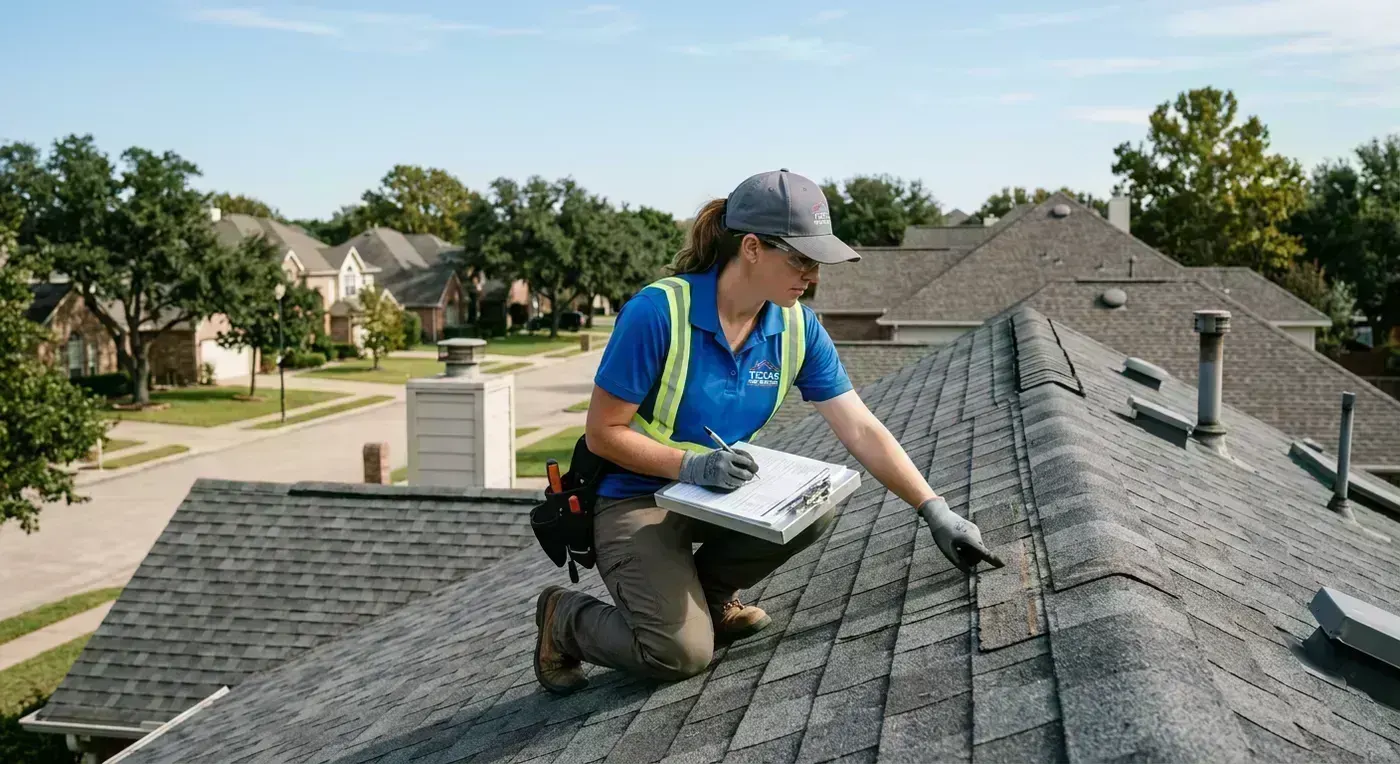
Given Lantana's uniform age and heavy hail exposure, we recommend a professional roof inspection once a year and again after any significant hail or wind event. If your roof is 15 years or older, this isn't optional — it's how you catch storm damage inside the insurance claim window and avoid paying out of pocket for a leak that started months earlier.
RoofDog uses drone inspections to document every slope in high resolution without walking (and potentially damaging) an aging roof. You get photo evidence of exactly what's happening up there — invaluable for insurance claims and for deciding between a targeted repair and a full replacement. Learn what's included on our roof inspection service page, and see everything we offer locally on our Lantana, TX roofing page.
Ready to know exactly how much life your roof has left? Schedule your free drone inspection or call RoofDog at 940.828.ROOF.
Frequently asked questions
How long should I expect my Lantana roof to last?
Most Lantana roofs — built with architectural asphalt shingles from the 2000s onward — realistically last 15 to 20 years given the local hail and wind exposure. Upgrading to Class 4 shingles at replacement can push that toward 25-30 years.
My whole street was built around the same time. Does that affect my roof?
Yes. Lantana's master-planned build phases mean neighboring homes often share the same roof age and materials. If a few homes on your street are getting replacements, yours is likely approaching the end of its life too.
Is hail really that big a deal in Lantana?
Absolutely. Denton County sits in the DFW hail corridor, and hail is the number-one reason Lantana roofs get replaced early. A single storm can end an asphalt roof's useful life even if it doesn't leak right away.
Why do Lantana roofs seem more exposed to wind?
Lantana was built on open prairie with wide streets and few mature windbreaks. That open terrain lets spring fronts and downbursts hit ridgelines and gables harder than in older, densely wooded suburbs.
Should I upgrade to Class 4 impact-rated shingles?
For most Lantana homeowners, yes. Class 4 shingles resist hail far better and typically earn an insurance premium discount in Texas, which helps offset the higher upfront cost over the life of the roof.
Do fewer trees in Lantana help or hurt my roof?
It's a trade-off. Fewer mature trees means less debris and no scraping limbs, but also more direct UV exposure, which ages shingles faster on sun-facing slopes. Net effect is a slightly shorter lifespan on south and west slopes.
How often should I have my roof inspected?
Once a year, plus after any major hail or wind event. Roofs 15 years or older should never skip an annual inspection — it's how you catch damage inside the insurance claim window.
What's the most common early problem you find on Lantana roofs?
Cracked rubber pipe boots around plumbing vents. They dry-rot around year 12-15 and leak long before the shingles themselves fail. It's an inexpensive fix if caught during a routine inspection.
Can I just repair my aging roof instead of replacing it?
Sometimes. If damage is isolated and the roof is under 15 years old, a repair may buy years. But once a roof is 18-plus years old with widespread granule loss, repairs become throwing good money after bad — a drone inspection helps you decide.
Does a drone inspection really matter?
Yes. Drones document every slope in high resolution without anyone walking on a brittle, aging roof. The photo evidence is invaluable for insurance claims and for choosing between a targeted repair and full replacement.
Will my insurance cover a hail-damaged Lantana roof?
Often, if the damage is documented within the claim window and your policy covers storm damage. This is why annual and post-storm inspections matter so much — undocumented damage discovered too late may be denied.
Does RoofDog actually work in Lantana?
Yes — RoofDog has completed several full roof replacements in Lantana and knows the local housing stock, builder details, and storm patterns well. Call 940.828.ROOF or schedule a free drone inspection online.
What makes RoofDog different?
Free drone inspections, a lifetime workmanship warranty, and a mission: 10% of our profits go to dog rescues. Protecting Homes. Saving Dogs.
🐾 Every RoofDog roof helps a dog. 10% of our profits go to dog rescues — so replacing your Lantana roof does more than protect your home. Protecting Homes. Saving Dogs. Call 940.828.ROOF.
Summary
Roofs in Lantana, TX typically last 15 to 20 years — often at the lower end because of the community's open, windy lots, heavy DFW hail exposure, and sun-baked slopes with little tree cover. Because Lantana is a master-planned community built largely from the 2000s onward, a huge portion of its uniform, architectural-asphalt housing stock is hitting the replacement window right now. Upgrading to Class 4 impact-rated shingles at replacement is the smart local move, extending roof life toward 25-30 years and earning insurance discounts. Annual and post-storm drone inspections are the key to catching damage in time. RoofDog has replaced several roofs in Lantana and offers free drone inspections and a lifetime workmanship warranty. Call 940.828.ROOF or schedule online. Protecting Homes. Saving Dogs.
You Might Also Need
Need a Roof Inspection?
Get expert advice and a free estimate from North Texas's trusted roofing professionals.
Schedule Free Inspection