How Long Do Roofs Last in Double Oak, TX?
Short answer: In Double Oak, TX, a quality architectural asphalt roof typically lasts 18 to 25 years, and a Class 4 impact-rated upgrade can push toward the upper end. But Double Oak is not an average North Texas town — its extraordinarily dense oak canopy means constant leaf and limb debris, abrasion from overhanging branches, and heavy north-slope shade that breeds algae and moss. Those tree factors, layered on top of DFW hail and wind, are usually what decides whether your roof reaches 25 years or gives out at 15.
If you own a home on one of Double Oak's wooded acre-plus lots, you already know the trade-off: the mature post oaks and blackjack oaks that make this town beautiful are also, quietly, the biggest threat your roof faces. Below we break down exactly how long roofs last here, why the local environment behaves differently than open subdivisions a few miles away, and how to get the full lifespan out of the roof you paid for.
RoofDog at a glance: Local drone roof inspections, a lifetime workmanship warranty, and a promise we live by — Protecting Homes. Saving Dogs. We donate 10% of our profits to dog rescues. Questions about your Double Oak roof? Call 940.828.ROOF.
Table of contents
- How long roofs actually last in Double Oak
- Double Oak's climate and DFW hail exposure
- The oak canopy problem — Double Oak's defining factor
- Housing stock and dominant roofing materials
- Common roof problems we see here
- Inspection advice for wooded lots
- Frequently asked questions
- Summary
How long roofs actually last in Double Oak
Statewide, roof lifespan follows fairly predictable ranges by material. If you want the full breakdown, our guide on how long roofs last in Texas covers every common system. But Double Oak sits at the intersection of two forces that pull in opposite directions: upscale homeowners tend to install better-than-average materials (which extends life), while the tree canopy accelerates wear (which shortens it). Here's the realistic picture for this town:
| Roofing material | Typical DFW lifespan | Realistic Double Oak lifespan |
|---|---|---|
| 3-tab asphalt (rare here) | 12-18 years | 10-15 years |
| Architectural asphalt | 20-30 years | 18-25 years |
| Class 4 impact-rated asphalt | 25-30 years | 22-28 years |
| Standing-seam metal | 40-70 years | 35-60 years |
| Concrete/clay tile | 40-75 years | 40-70 years |
Notice the pattern: the more a material relies on a granule surface (asphalt), the more Double Oak's trees and shade drag the number down. Metal and tile — which don't shed granules and resist abrasion — lose the least to the canopy. Since architectural asphalt dominates the town, most Double Oak homeowners should plan around that 18-to-25-year window and treat the top of that range as something you earn through maintenance, not something you're handed.
Double Oak's climate and DFW hail exposure
Double Oak shares the North Texas climate: hot, UV-heavy summers with roof-deck temperatures that can top 150°F, followed by sharp swings in spring and fall storm season. That thermal cycling is hard on asphalt — shingles expand and contract daily, slowly loosening sealant strips and cracking aging mats.
Then there's hail. The Denton County corridor sits squarely in the DFW hail belt, and it's not unusual for the area to see a damaging hail event every few years. Spring supercells rolling in from the west routinely drop quarter-to-golf-ball-sized stones, and a single severe storm can end an otherwise healthy roof's life overnight. This is exactly why so many Double Oak homes carry Class 4 impact-rated shingles — the upgrade often pays for itself in reduced storm damage and, frequently, an insurance premium discount. Straight-line winds from those same storms, gusting past 60 mph, are the other half of the equation, lifting tabs and peeling ridge caps on exposed sections.
Local tip: After any storm that drops hail or throws limbs, book an inspection even if the roof looks fine from the driveway. Under Double Oak's canopy, storm damage is easy to miss from the ground. RoofDog's drone inspections let us photograph every slope up close — including the shaded, tree-covered north faces you can't see — without anyone tramping across your shingles.
The oak canopy problem — Double Oak's defining factor
This is the section that matters most, because it's where Double Oak diverges from every open subdivision in the Metroplex. The town was carved out of native oak forest, and homeowners here deliberately preserved the big post oaks, blackjack oaks, and cedar elms. Beautiful — and brutal on roofing. Here's how the canopy attacks a roof, mechanism by mechanism:
1. Constant organic debris
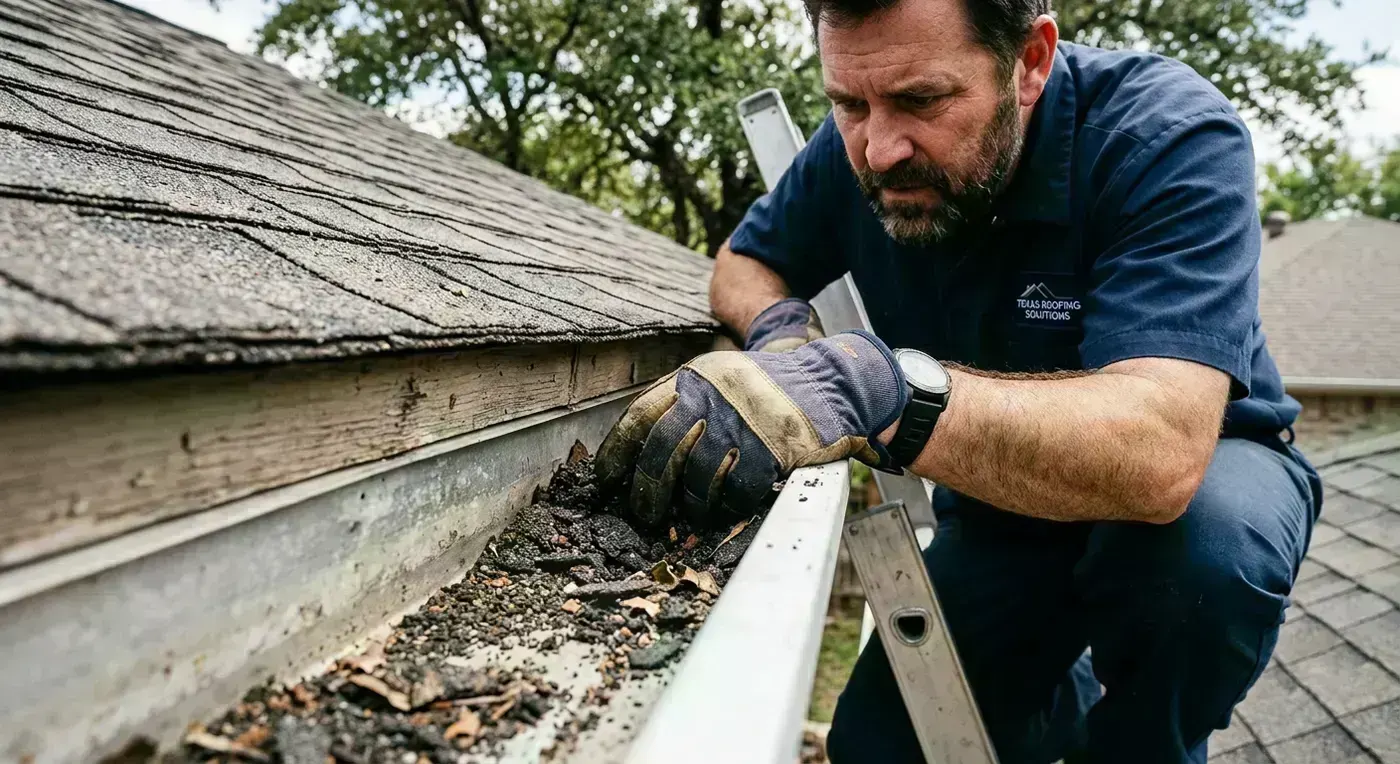
Oaks are messy. They drop leaves, catkins, acorns, and small twigs nearly year-round, and that debris collects in valleys, behind chimneys, and in gutters. Wet leaf litter sitting on shingles holds moisture against the surface, accelerating granule loss and rotting the organic mat underneath. Clogged valleys and gutters back water up under shingles — a leading cause of premature deck rot on wooded Double Oak lots.
2. Overhanging branches abrading shingles
Every time the wind blows, limbs that overhang the roof scrape back and forth across the shingle surface like sandpaper. Over years this rubs away the protective granule layer along the branch's arc, exposing the asphalt to UV and moisture. We regularly find bald, worn stripes on Double Oak roofs that map exactly to an overhanging limb — damage that has nothing to do with age and everything to do with proximity to a tree.
3. Heavy shade, algae, and moss on north slopes
The dense canopy keeps north- and east-facing slopes damp and shaded for most of the day. That's the perfect environment for Gloeocapsa magma (the black-streak algae) and, in the most heavily shaded spots, actual moss. Both trap moisture, lift shingle edges, and feed the decay cycle. If you've noticed dark streaks or green fuzz on the shaded side of your roof, read our deep dive on whether moss or algae can reduce roof lifespan — the short version is yes, meaningfully, and Double Oak's shade makes it one of the most common issues we treat here.
4. Falling limbs during storms
When straight-line winds hit, mature oaks shed limbs — and a heavy branch dropping from 40 feet can puncture decking or shatter shingles in one strike. The upscale two-story custom homes common in Double Oak, with steep and complex rooflines, give limbs plenty of surface to hit.
The single highest-return maintenance step in Double Oak: trim back every branch overhanging the roof to at least 6-10 feet of clearance, and keep valleys and gutters clear of leaf litter. Homeowners who do this routinely reach the top of the lifespan range; those who don't often lose 3-7 years.
Housing stock and dominant roofing materials
Double Oak is overwhelmingly a town of custom and semi-custom single-family homes on large, wooded lots — many an acre or more. The housing stock skews upscale, with a lot of two-story brick-and-stone homes built from the 1990s onward, plus a steady stream of newer custom builds. Rooflines here tend to be complex: multiple gables, steep pitches, dormers, and long valleys — all of which create more spots for debris to collect and more transitions where flashing can fail.
The dominant material is, by a wide margin, architectural (dimensional) asphalt shingle, very often in a Class 4 impact-rated line given the hail exposure. You'll also find scattered metal accents and the occasional full standing-seam or tile roof on higher-end custom homes. Because architectural asphalt is what most of the town is working with, our guide to how long architectural shingle roofs last in Texas is the most relevant material reference for Double Oak owners.
Common roof problems we see here
- Abrasion stripes from overhanging limbs, especially on the sides of the house nearest the biggest trees.
- Algae streaking and moss on shaded north and east slopes — cosmetic at first, structural if ignored.
- Clogged valleys and gutters from oak debris, leading to water backup and deck rot.
- Impact bruising from hail, which crushes granules and shortens life even when it doesn't leak immediately.
- Wind-lifted ridge caps and tabs on exposed sections above the canopy line.
- Flashing failures at the many valleys, chimneys, and wall transitions on complex custom rooflines.
- Puncture damage from fallen limbs after storms.
Inspection advice for wooded lots
Because so much of a Double Oak roof is hidden under trees, a ground-level look is nearly useless. Here's what we recommend:
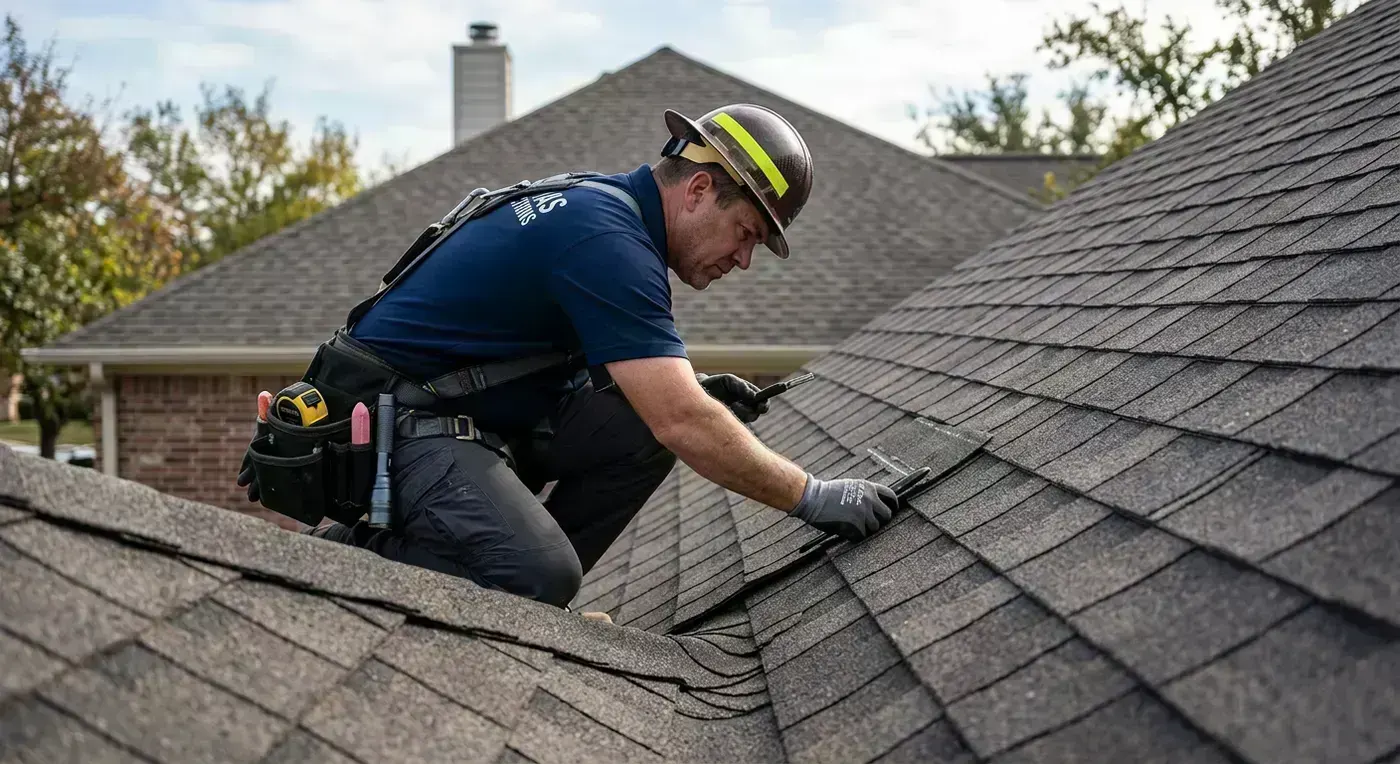
- Inspect twice a year — after spring hail season and after fall leaf drop — plus once after any severe storm.
- Prioritize the shaded slopes. The north and east faces under the canopy age fastest and hide the most damage.
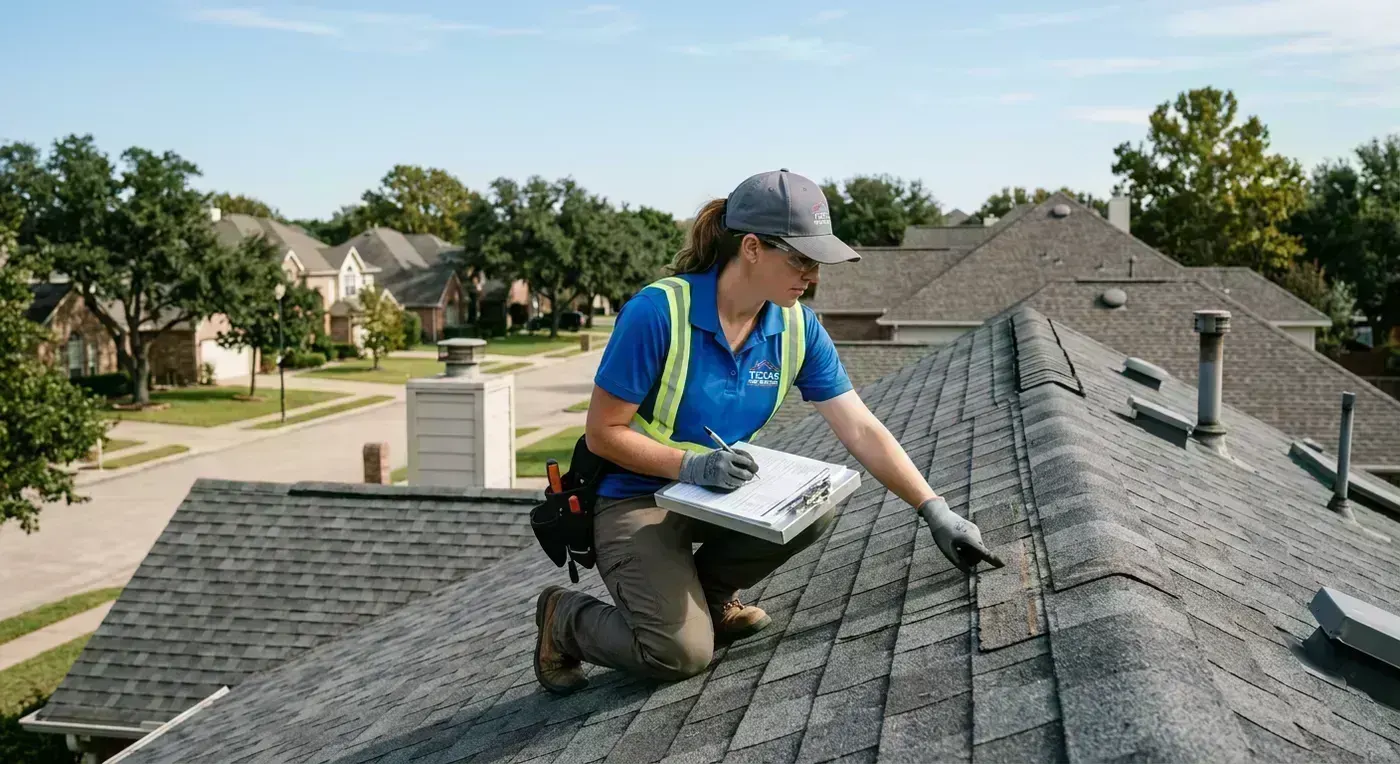
- Use aerial imaging. A drone inspection gets a close-up on every slope and valley without foot traffic, and it documents debris load and abrasion you'd never spot from below.
- Check the gutters and valleys for standing organic material — a fast proxy for whether water is draining or pooling.
- Keep records. Dated photos matter for insurance claims after hail, which are common in this corridor.
Want a local team that knows exactly what the canopy does to roofs in this town? See our Double Oak roofing service area page, or go straight to schedule an inspection. Every RoofDog roof is backed by our lifetime workmanship warranty, and every job helps fund dog rescues — Protecting Homes. Saving Dogs.
Frequently asked questions
How long should I expect my architectural shingle roof to last in Double Oak?
Plan on 18 to 25 years. A Class 4 impact-rated shingle with the trees kept trimmed can reach the upper end; a heavily shaded, debris-covered roof may fall to the lower end.
Do the oak trees really shorten my roof's life that much?
Yes. Between abrasion from overhanging limbs, constant organic debris holding moisture, and heavy shade breeding algae and moss, the canopy is the number-one lifespan factor in Double Oak — often costing 3 to 7 years on an asphalt roof.
Why does my north-facing slope look so much worse than the south side?
The canopy keeps north and east slopes shaded and damp most of the day, which promotes algae and moss growth. Those organisms trap moisture and lift shingle edges, aging the shaded slopes noticeably faster.
Is a Class 4 impact-rated roof worth it here?
For most Double Oak homes, yes. The DFW hail belt runs right through Denton County, and Class 4 shingles resist hail bruising far better. Many insurers also offer a premium discount for the upgrade.
How often should I have my roof inspected?
Twice a year — after spring storm season and after fall leaf drop — and again after any severe hail or wind event. Wooded lots hide damage, so regular checks matter more here than in open subdivisions.
Can I just clean the algae and moss off myself?
Light cleaning is possible, but pressure washing destroys granules and voids many warranties. A gentle, roof-safe treatment plus trimming the trees to let in light is the durable fix. Have a pro assess how deep the growth has gotten first.
How far back should I trim branches over my roof?
Aim for at least 6 to 10 feet of clearance. That stops limb abrasion, reduces debris load, and lets more light and air onto the roof to suppress algae and moss.
A limb fell on my roof during a storm — what now?
Get it inspected right away, even if you don't see an obvious hole. Falling limbs can crack decking or fracture shingles in ways that leak later. A drone inspection documents the damage for your insurance claim. Call RoofDog at 940.828.ROOF.
Does all that shade at least keep my roof cooler and help it last longer?
Shade does reduce UV and heat on covered slopes, which helps a little — but in Double Oak that benefit is outweighed by the trapped moisture, debris, and moss the same shade creates. Net effect on asphalt is negative.
My roof is 15 years old and under heavy trees — should I replace or wait?
It depends on condition, not just age. A drone inspection will show granule loss, abrasion stripes, and moss penetration. Many wooded-lot roofs need attention around 15-18 years, but a well-maintained one can keep going. Get real data before deciding.
Will a drone inspection reach the slopes hidden under my trees?
In most cases, yes — the drone flies under and around the canopy to photograph slopes and valleys up close, capturing detail you can't see from the ground. Where the canopy is too dense, we supplement with a hands-on look.
Do you serve all of Double Oak?
Yes. RoofDog covers Double Oak and the surrounding Denton County communities. Visit our Double Oak roofing page or call 940.828.ROOF to get on the schedule.
What warranty comes with a RoofDog roof?
Every installation is backed by our lifetime workmanship warranty, in addition to the manufacturer's material warranty. And 10% of our profits go to dog rescues — because we're about Protecting Homes and Saving Dogs.
Summary
In Double Oak, TX, expect a quality architectural asphalt roof to last 18 to 25 years, with Class 4 upgrades and diligent tree maintenance pushing toward the top of that range. The town's defining challenge isn't hail or heat alone — it's the magnificent oak canopy, which showers roofs with debris, abrades shingles with overhanging limbs, and keeps shaded slopes damp enough for algae and moss to take hold. Trim your trees, keep valleys and gutters clear, and inspect twice a year plus after every storm. When you want a close, honest look at what's happening up there, RoofDog's drone inspections and lifetime workmanship warranty have you covered. Call 940.828.ROOF or schedule online.
You Might Also Need
Need a Roof Inspection?
Get expert advice and a free estimate from North Texas's trusted roofing professionals.
Schedule Free Inspection