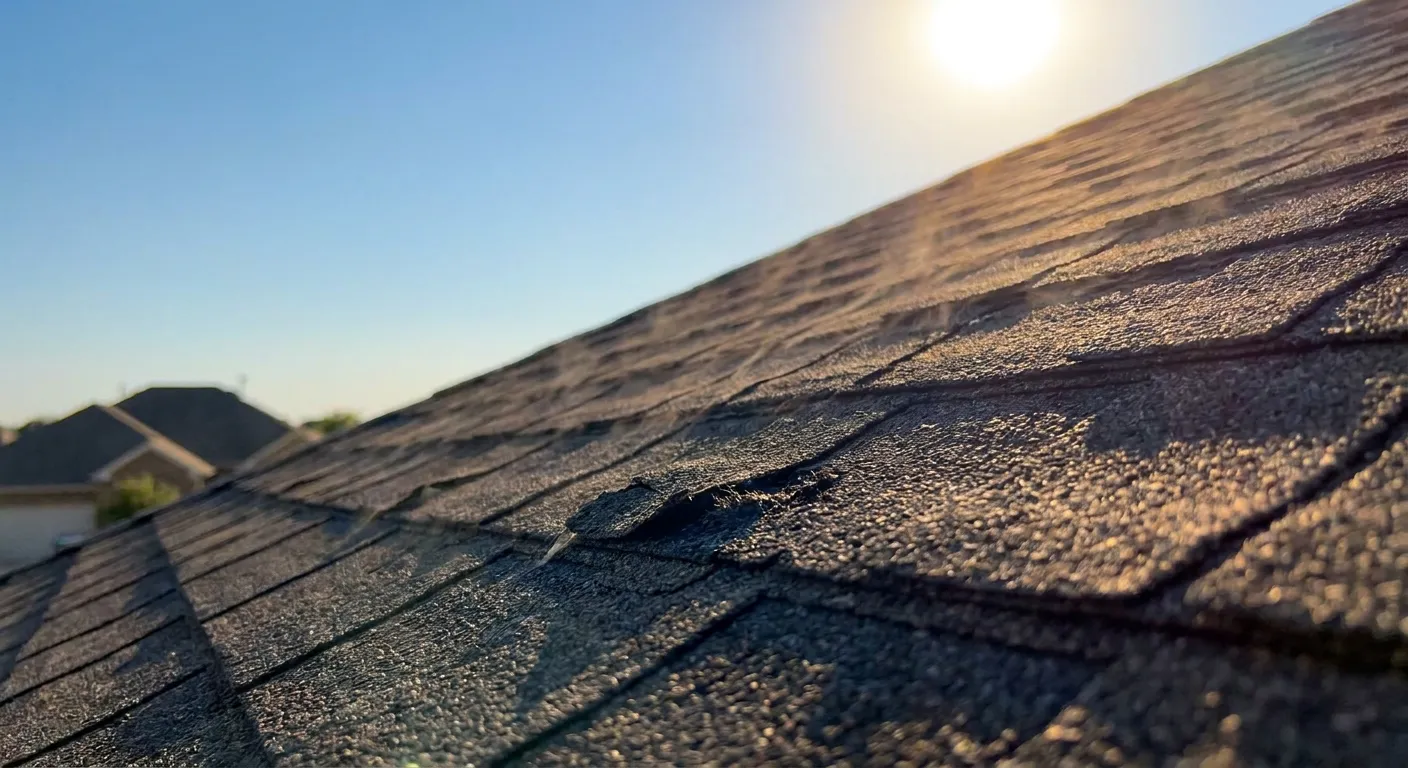
Can Moss or Algae Reduce Roof Lifespan?
Short answer: yes — but the degree depends on which organism you have. The dark streaks most North Texas homeowners see are algae (Gloeocapsa magma), which is mostly cosmetic in its early stages but slowly degrades the reflective granules that protect asphalt shingles. Moss and lichen are the real structural troublemakers: they hold water against the roof surface, pry granules loose, and can lift shingle edges. In the DFW climate, algae streaks are far more common than thick moss carpets — but ignoring either shaves years off a roof that should last decades.
If you've noticed dark vertical stains running down the north side of your home, or a spongy green patch where two slopes meet, you're not imagining a problem. Roof biology is one of the most misunderstood causes of premature aging in Texas, partly because so much of the damage happens slowly and out of sight. Let's break down exactly what's growing up there, whether it's a cosmetic annoyance or a countdown clock on your shingles, and what you can safely do about it.
Table of contents
- Meet the three organisms: algae, moss, and lichen
- Why DFW's climate favors algae over heavy moss
- How growth actually degrades a roof
- Cosmetic vs. structural: telling them apart
- How many years does it really cost you?
- North-facing and shaded slopes: ground zero
- Safe cleaning — and why never to pressure wash
- Prevention: zinc strips, trees, and algae-resistant shingles
- When to call a professional
- Frequently asked questions
Meet the three organisms: algae, moss, and lichen
People lump every roof stain into one bucket, but algae, moss, and lichen are biologically different, behave differently, and demand different responses. Getting the diagnosis right is the whole game.
Algae (Gloeocapsa magma)
The infamous black streaks are a blue-green cyanobacterium called Gloeocapsa magma. It feeds partly on the limestone filler baked into asphalt shingles, and it produces a dark, UV-protective sheath that gives the stains their coffee-brown-to-black color. Algae spreads by airborne spores, which is why you often see the same streaks jump from house to house down a street. It lies flat against the roof and, on its own, does not physically pry the roof apart — but it does undermine the shingle's ability to reflect heat.
Moss
Moss is a true plant with tiny root-like structures called rhizoids. It forms raised, spongy green mounds, usually along the upper edges of shingles where debris collects. Because it's a plant, it holds water like a sponge — and that retained moisture is what makes moss genuinely dangerous to shingles and the wood decking beneath them.
Lichen
Lichen is a symbiotic organism — a fungus living with algae. It appears as crusty, flat, gray-green or orange patches that bond tenaciously to the shingle surface. Lichen is the hardest of the three to remove because its filaments grow down into the granular surface, and pulling it off often takes granules with it.
Quick field ID: Flat black streaks running downward = algae. Raised, fuzzy green clumps = moss. Crusty, tightly-bonded gray-green or orange spots = lichen. If you see raised or crusty growth, the roof needs hands-on attention sooner rather than later.
Why DFW's climate favors algae over heavy moss
In the Pacific Northwest, roofs disappear under thick moss carpets. In North Texas, that's rare — and the reason is our climate. Moss needs sustained moisture and cool shade to thrive. Dallas–Fort Worth summers deliver brutal, prolonged heat and long dry stretches that scorch and desiccate moss before it can establish deep mats. What we do get, in abundance, is humidity in the warm months, morning dew, and enough airborne spores to keep algae happy.
Algae is heat-tolerant and thrives on the exact combination DFW serves up: humid mornings, hot afternoons, and shingles that stay warm. That's why the signature roof-biology problem across Plano, Frisco, Arlington, McKinney, and greater Dallas is the black streak — not the green mound. Moss and lichen still show up here, but they're concentrated in specific microclimates: deeply shaded north slopes, roofs under heavy tree canopy, and areas that stay damp because gutters overflow or debris never dries out.
Understanding this matters because it shapes your priorities. For most North Texas homes, the battle is against algae streaking and the slow granule loss it accelerates — a problem that overlaps heavily with how heat damages roofs in Texas. Where shade and moisture combine, moss and lichen jump to the top of the list.
How growth actually degrades a roof
To understand the harm, you have to understand what a shingle is. An asphalt shingle is a fiberglass mat saturated with asphalt and coated on top with ceramic-coated mineral granules. Those granules do two jobs: they shield the asphalt from UV rays, and they reflect a portion of solar heat. When granules go, the asphalt below is exposed, dries out, cracks, and the shingle's life collapses. Here's how each organism attacks that system.
| Organism | Primary damage mechanism | Severity in DFW |
|---|---|---|
| Algae | Darkens surface, raises heat absorption, feeds on granule filler over years | Very common; mostly cosmetic early, accelerates aging long-term |
| Moss | Retains water against surface, lifts shingle edges, rhizoids pry granules loose | Localized to shaded/damp areas; genuinely structural |
| Lichen | Filaments bond into granule layer; removal strips granules; holds moisture | Uncommon but stubborn; damaging to remove and to leave |
The moisture problem
Moss and lichen keep the shingle surface wet long after rain or dew should have dried. Persistent moisture is corrosive to a roof: it accelerates asphalt breakdown, encourages the metal components (nails, flashing) to corrode, and in freeze events — which North Texas does get — trapped water expands and contracts, prying granules and shingle layers apart. A shingle that stays damp simply ages faster than one that dries quickly after every rain.
The granule and mat problem
Moss rhizoids and lichen filaments physically grip the granular layer. As the organism grows and as you (or a careless cleaner) try to remove it, granules come off with it. Every bare patch is a hotspot where UV can now cook the asphalt directly, and where the fiberglass mat is one step closer to exposure. This is the pathway from "green patch" to "leak."
The heat problem
Algae's dark sheath turns a heat-reflecting roof into a heat-absorbing one. A streaked roof runs hotter, which stresses the asphalt binder and can nudge attic temperatures up. It's a subtler effect than a moss-lifted shingle, but across the long, punishing DFW summer, extra heat is never your roof's friend.
Cosmetic vs. structural: telling them apart
This is the question homeowners really want answered: do I have an eyesore or an emergency? The honest answer is that it's a spectrum, and it changes over time.
Mostly cosmetic (for now): Faint-to-moderate algae streaking on a shingle roof under 10 years old, with granules still firmly in place. It hurts curb value and appraisal impressions, and it's aging the roof faster than it should — but it isn't causing leaks today.
Trending structural: Any raised moss, any crusty lichen, algae combined with visible granule loss, or growth concentrated where water pools. These retain moisture and mechanically damage the roof, and they should be addressed before the next wet season.
The trap is treating everything as "just cosmetic" and waiting. Algae that looks harmless is quietly eating granule filler and darkening a surface built to reflect heat. Left for years, cosmetic becomes structural. That's why organism growth belongs on your radar as part of how roof maintenance extends roof life — catching it early keeps it in the cheap, cosmetic zone.
How many years does it really cost you?
There's no single number, because it depends on organism, coverage, roof age, and how long it's neglected. But we can talk in realistic ranges. A quality architectural shingle in North Texas might be engineered for 25–30 years and, with good ventilation and maintenance, get close to that. Untreated moss or lichen concentrated on a shaded slope can locally shorten that slope's life by several years — sometimes forcing partial replacement long before the rest of the roof is due. Heavy algae won't typically cause outright failure by itself, but by accelerating granule and heat aging, it can quietly trim a handful of years off the whole roof.
Put differently: the growth rarely causes a dramatic overnight failure. It steals years quietly. For a fuller picture of what governs total roof longevity here, see our pillar guide on how long roofs last in Texas. Biology is one lever among several — but it's one of the few you can control cheaply and early.
| Scenario | Typical lifespan effect |
|---|---|
| Light algae, promptly treated | Negligible — cosmetic only |
| Heavy algae left for years | A few years lost to granule/heat aging |
| Moss on a shaded slope, untreated | Several years lost on that slope; possible early partial replacement |
| Established lichen, aggressively scraped | Immediate granule loss; localized shingle failure risk |
North-facing and shaded slopes: ground zero
If you only inspect one part of your roof, make it the north-facing and tree-shaded slopes. Here's why: sunlight is the roof's natural sterilizer. South and west slopes bake dry within hours of rain, killing off would-be growth. North slopes and anything under a canopy stay cooler and damper for far longer — and that lingering moisture is exactly what algae, moss, and lichen need.
This is why you'll so often see a roof that's pristine on one side and streaked or mossy on the other. It's not a defect in the shingles; it's the microclimate. Overhanging branches make it worse in two ways: they cast shade, and they drop leaf litter and organic debris that feeds growth and holds water in the shingle courses. Trimming branches back to let sun and air reach the roof is one of the most effective, least glamorous things you can do for a North Texas roof.
RoofDog tip: Shaded slopes are also the hardest to see from the ground, so they hide problems the longest. Our drone roof inspections put a camera directly over every slope — including the north side you can't spot from the driveway — so early moss and lichen get caught while they're still cheap to handle.
Safe cleaning — and why never to pressure wash
Here is the single most important rule in this entire article: never pressure wash an asphalt shingle roof. A pressure washer will blast the protective granules straight off your shingles, doing more damage in ten minutes than the algae would have done in ten years. It can also drive water up under shingles and into the decking. Countless roofs in North Texas have been prematurely ruined by well-meaning homeowners and unqualified "cleaners" with a power washer. Don't be one of them.
The correct method: soft washing
The industry-standard, manufacturer-approved approach is soft washing: applying a specialized cleaning solution (typically a sodium hypochlorite or manufacturer-recommended blend) at low pressure, letting it dwell to kill the organism, then rinsing gently. Done correctly, soft washing kills algae at the root, lifts stains, and — crucially — leaves the granules intact. Moss and lichen usually need the solution to kill the growth first, then a gentle brushing or a rain or two to release it. You do not scrape living moss off dry; scraping tears granules away with it.
Cautions
- Protect landscaping and pets from runoff; cleaning solutions can harm plants if not diluted and rinsed properly.
- Walking a roof is dangerous and can itself damage shingles — especially in Texas heat, when hot shingles scuff easily underfoot.
- DIY roof cleaning voids some manufacturer warranties if done improperly. Confirm before you start.
- Lichen often survives a single cleaning and needs a repeat treatment; resist the urge to scrub it off aggressively.
For most homeowners, the safest path is to let a professional handle it as part of routine roof maintenance. It keeps you off a hot, slick roof and keeps your warranty intact.
Prevention: zinc strips, trees, and algae-resistant shingles
Cleaning treats the symptom. Prevention keeps it from coming back. Three strategies do the heavy lifting.
Zinc and copper strips
This is the classic, elegant fix. A strip of zinc or copper installed just below the ridge releases trace metal ions every time it rains. As that runoff washes down the slope, it creates an environment algae and moss can't tolerate — you'll often see a clean band beneath any existing metal on a roof, like the streak-free stripe below a copper chimney flashing. Strips are inexpensive, retrofit easily, and quietly suppress growth for years. They're most effective installed before growth takes hold, but they help slow re-colonization after a cleaning too.
Managing shade and debris
As covered above, trimming overhanging branches restores sunlight and airflow, and keeping gutters and valleys clear stops the standing water and debris that growth feeds on. Free maintenance, big payoff.
Algae-resistant shingles
If you're already facing a roof replacement, this is your chance to solve the problem permanently at the source. Most major manufacturers now offer algae-resistant (AR) shingles that embed copper-infused granules across the shingle surface. These release the same growth-suppressing ions as a zinc strip, but everywhere, and typically carry a dedicated algae-resistance warranty (often 10–25 years of streak-free coverage). In a climate like DFW's, where algae is the dominant roof organism, specifying AR shingles is one of the smartest replacement decisions you can make.
Planning a replacement? Ask RoofDog about algae-resistant shingle options and integrated zinc detailing. Every RoofDog install is backed by our lifetime workmanship warranty — and 10% of our profits go to dog rescues, so a streak-free roof helps a shelter pup too. Call 940.828.ROOF or schedule a consultation.
When to call a professional
Call for a professional assessment when you see any raised moss or crusty lichen, when algae covers large sections or reappears quickly after cleaning, when you notice granules collecting in gutters, or when growth is on a slope you can't safely see. A professional inspection also answers the bigger question: is this growth still cosmetic, or has it already caused granule loss and moisture intrusion that need repair?
RoofDog's drone roof inspections map every slope without anyone walking your roof, so we can pinpoint growth, granule loss, and shaded problem areas precisely. From there we recommend the right response — soft washing, zinc strips, targeted repair, or full replacement with AR shingles — and back the work with our lifetime workmanship warranty. It's all part of how we live up to "Protecting Homes. Saving Dogs."
Frequently asked questions
Are the black streaks on my roof mold or dirt?
Neither — they're almost always algae, specifically Gloeocapsa magma, a cyanobacterium. It's often mistaken for mold or general grime, but it won't rinse off like dirt and it needs a proper soft-wash treatment to kill and remove.
Will roof algae cause leaks?
Algae alone rarely causes leaks in the short term. Its harm is slow: darkening the roof, raising heat absorption, and gradually degrading granule filler. Moss and lichen are the ones that trap moisture and lift shingles in ways that lead to leaks.
Can I just pressure wash it off myself?
No. Pressure washing strips the protective granules off asphalt shingles and can force water under them, doing far more damage than the growth itself. Only low-pressure soft washing is safe on shingles.
Why does only one side of my roof have growth?
Almost certainly the shaded, north-facing, or tree-canopied side. It stays cooler and damper longer after rain, giving algae, moss, and lichen the moisture they need. Sun-baked slopes dry too fast for growth to establish.
Is moss worse than algae?
Structurally, yes. Moss is a water-retaining plant whose rhizoids pry into the granule layer and can lift shingle edges. Algae is mostly cosmetic early on. In DFW, though, algae is far more common because our climate discourages heavy moss.
Why isn't moss a big problem in North Texas?
Our hot, dry summers desiccate moss before it can form thick mats. Moss thrives in cool, consistently damp climates. In DFW it's confined to specific shaded, moisture-holding pockets rather than blanketing whole roofs.
Do zinc strips really work?
Yes. Zinc or copper strips near the ridge release trace metal ions in rain runoff that suppress algae and moss down the slope. You can see the effect naturally in the clean band beneath any existing copper flashing on older roofs.
What are algae-resistant shingles?
They're shingles with copper-infused granules baked into the surface, releasing growth-suppressing ions everywhere. Most carry a dedicated algae-resistance warranty. In an algae-dominated climate like DFW's, they're an excellent choice at replacement time.
How often should a Texas roof be cleaned of algae?
There's no fixed schedule — it depends on shade, tree cover, and shingle type. Many North Texas homeowners find a professional soft wash every few years, combined with zinc strips, keeps streaking under control. An annual inspection tells you when it's time.
Does roof growth affect my home's value or appraisal?
It can. Heavy algae streaking hurts curb appeal and can make a roof look older and more neglected than it is, which influences buyer perception and appraisal impressions. Cleaning is a low-cost way to restore appearance before selling.
Is it safe to remove lichen myself?
It's risky. Lichen bonds into the granule layer, so scraping it off dry tears granules away and creates bare spots. It also usually needs more than one treatment. This is a job best left to a professional using the right dwell-and-rinse method.
Will cleaning my roof void the warranty?
Improper cleaning — especially pressure washing — can void a manufacturer warranty. Manufacturer-approved soft washing generally does not. When in doubt, have it done professionally so the method and products are documented and compliant.
Can growth come back after cleaning?
Yes, because the spores are airborne and constant in North Texas. Cleaning removes what's there; preventing return means adding zinc strips, trimming shade, keeping the roof debris-free, or choosing algae-resistant shingles at replacement.
Does RoofDog handle roof cleaning and prevention?
We assess growth during drone inspections and address it through safe maintenance, zinc-strip installation, and AR-shingle recommendations at replacement. Call 940.828.ROOF or schedule online to get a north-slope-to-ridge evaluation.
Summary
Moss, algae, and lichen can absolutely shorten a North Texas roof's life — but not equally. Algae (the black streaks) dominates in DFW's hot, humid-then-dry climate and is largely cosmetic early, while slowly degrading heat-reflecting granules. Moss and lichen are rarer here, concentrated on shaded north slopes, and genuinely structural because they trap moisture and pry granules loose. The worst thing you can do is pressure wash; the right response is soft washing, zinc or copper strips, shade and debris management, and algae-resistant shingles at replacement. Catch it early, keep it cosmetic, and you protect the years your roof was built to give. When you want a precise read on what's growing and how much it's cost you, RoofDog's drone inspections and lifetime-workmanship-backed maintenance have you covered — 940.828.ROOF. Protecting Homes. Saving Dogs.
You Might Also Need
Need a Roof Inspection?
Get expert advice and a free estimate from North Texas's trusted roofing professionals.
Schedule Free Inspection