Signs Your Roof Is Nearing the End of Its Life
Short answer: A roof is nearing the end of its life when several signs cluster together at once — heavy granule loss, curling or clawing shingles, bald spots, brittle cracking, sagging, daylight in the attic, and leaks that return no matter how many times they are patched. One symptom on its own may just need a repair. Three or four appearing together, especially past the 15–20 year mark, usually mean replacement is the smarter money.
Roofs do not fail on a schedule. They fail on a slope — a slow decline where the material gives up its protective qualities year by year until one storm finally exposes what the sun and heat already did. In North Texas the decline runs faster than the national average. Our combination of triple-digit summers, sudden hailstorms, wild temperature swings between February mornings and July afternoons, and UV exposure that never really lets up all age a roof harder than a mild climate ever would. That is why a roof rated for 30 years on the wrapper often shows serious wear by year 18 in Denton, Collin, or Dallas County.
The good news is that a dying roof announces itself long before it caves. If you know what to look for, you can read the signs from your driveway, your gutters, and your attic — and make a calm decision instead of an emergency one. This guide walks through every major warning sign, gives you a self-assessment checklist you can run this weekend, and tells you exactly when it is time to bring in a professional.
Table of contents
- 1. Granule loss — grit in your gutters
- 2. Curling, cupping, and clawing shingles
- 3. Bald spots and exposed mat
- 4. Cracked and brittle shingles
- 5. A sagging deck or roofline
- 6. Daylight in the attic
- 7. Recurring leaks and water stains
- 8. Rising energy bills
- 9. Moss, algae streaking, and trapped moisture
- 10. Exposed nails and failed flashing
- 11. Age — the 15-to-20-year line
- Your DIY self-assessment checklist
- When to call a professional
- Frequently asked questions
- Summary
1. Granule loss — grit in your gutters
The mineral granules coating an asphalt shingle are not decoration. They are the shingle's sunscreen — a hard ceramic layer that absorbs UV punishment and shields the asphalt underneath. When those granules wash away, the asphalt bakes, dries, and cracks. Losing granules is the single most reliable sign that a shingle roof is heading toward the finish line.
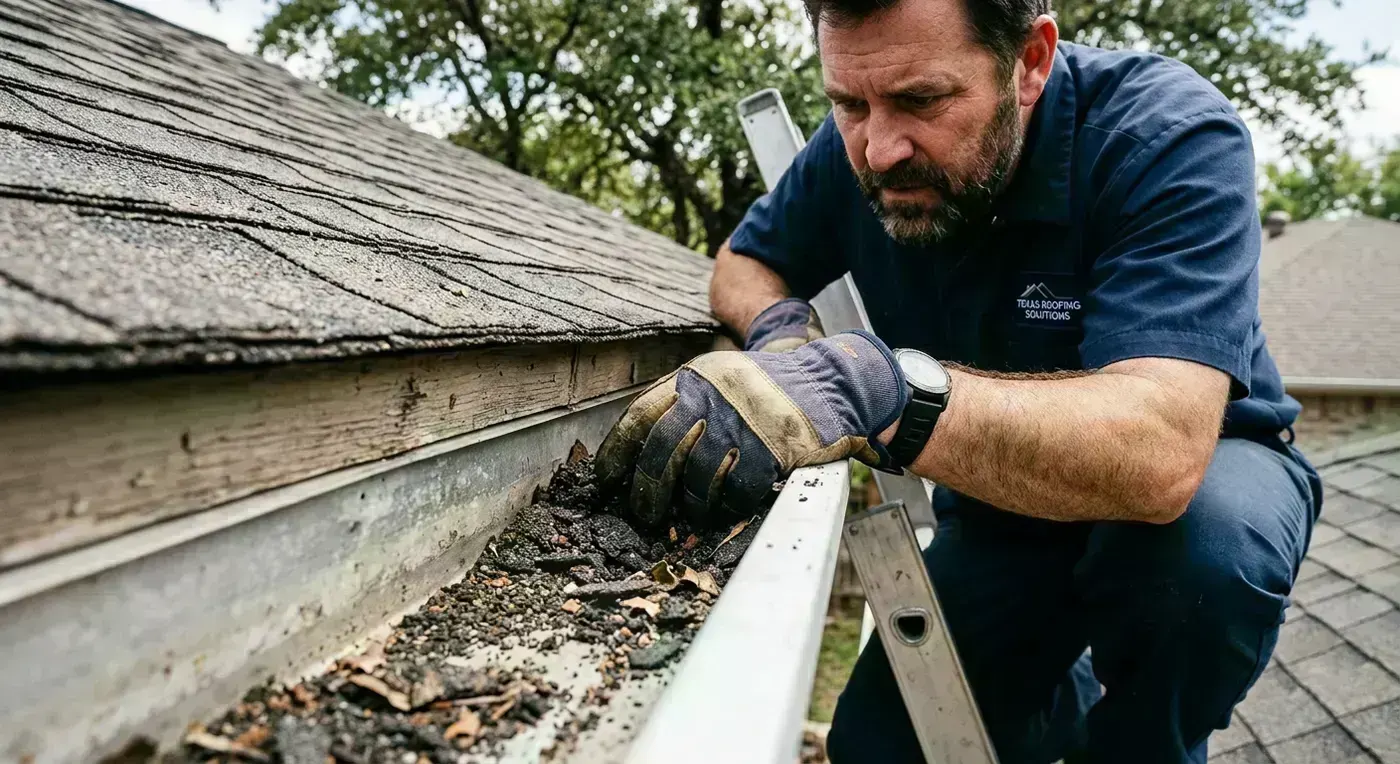
You rarely see granule loss on the roof first; you see it at the bottom. Check your gutters and downspout splash blocks after a hard rain. A light sprinkle of grit is normal on a young roof settling in. But if you are scooping out cupfuls of what looks like coarse black sand, or your downspouts leave dark gritty piles on the driveway, the shingles above are shedding their armor faster than they should. Look up at the roof itself and you may spot patches that have gone a shade darker or shinier than the rest — that sheen is exposed asphalt.
2. Curling, cupping, and clawing shingles
Healthy shingles lie flat and tight, overlapping like fish scales. When they age, they lose the oils that keep them flexible and start to deform. Roofers describe three related shapes, and each tells you something slightly different:
- Curling — the edges lift up and away from the roof, often because the shingle has dried out or the attic below runs too hot.
- Cupping — the center of the shingle rises while the edges stay down, forming a shallow bowl, usually a sign of heat and moisture cycling.
- Clawing — the middle bulges up while the edges press flat, a classic marker of an old shingle nearing the end.
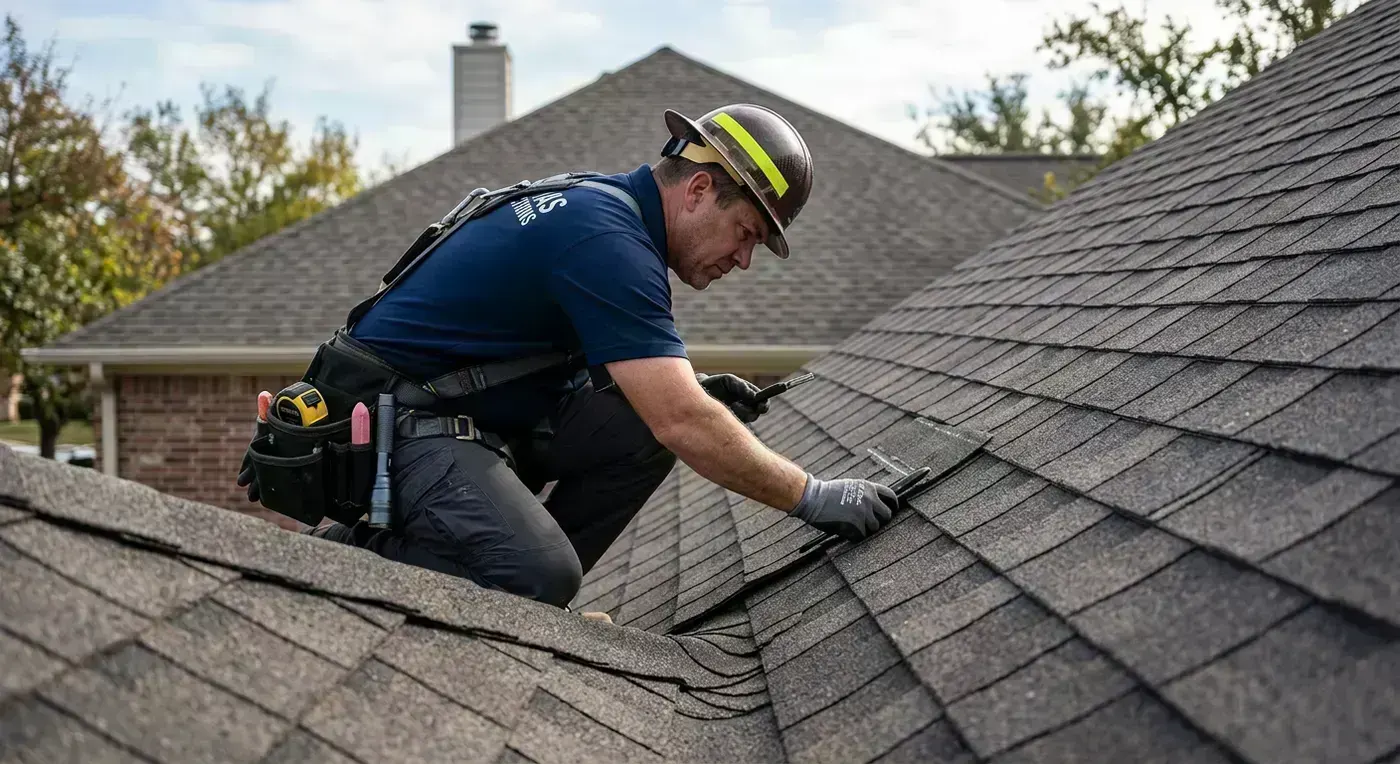
Any of these three lets wind get underneath the shingle and rain get behind it. In North Texas, where a 60-mph gust can arrive with almost no warning, a field of curled or clawing shingles is an open invitation for a blow-off event that turns a slow problem into a sudden one. You can usually see curling from the ground with binoculars, especially on the south- and west-facing slopes that take the most sun.
3. Bald spots and exposed mat
Bald spots are granule loss taken to its conclusion. Where enough granules have worn away, you are left looking at the raw fiberglass mat and asphalt beneath — smooth, dark, and sometimes slightly shiny. These spots have zero UV protection left, so they degrade far faster than the shingle around them. Once you see distinct bald patches scattered across multiple slopes, the roof is no longer weathering evenly; it is breaking down in earnest.
Bald spots concentrated near the ridge, valleys, or the sunniest exposures are especially telling because those are the areas that take the most abuse. A handful of small spots might be spot-repairable. Widespread balding across the whole roof is a replacement conversation.
4. Cracked and brittle shingles
Grab a shingle edge — carefully, and only on a cool day — and a healthy one flexes a little. An end-of-life shingle snaps. As asphalt loses its volatile oils to years of heat, it turns from pliable to brittle, and hairline cracks spread across the surface like a dry riverbed. You will often see cracking run in the direction of the roof's thermal expansion, and it tends to show up first on the hottest slopes.
Cracks are entry points. Every fissure is a channel for water to reach the mat and eventually the decking. Brittle shingles also shatter under hail instead of absorbing the impact, which is why an old roof and a Texas hailstorm are such a bad combination. If your shingles crack when you barely touch them, they have no life left to give.
5. A sagging deck or roofline
Step back to the curb and look at your ridgeline and the planes of the roof. They should be straight and true. A ridge that dips in the middle, or a slope that ripples or bows, points to something structural — and structural is serious. Sagging usually means the wooden decking underneath has absorbed moisture over time and is rotting or delaminating, or that the framing is fatigued.
A sag is not a surface problem you can shingle over. It signals damage to the layers that hold everything up, and it almost always requires tearing off to the deck, replacing the compromised sheathing, and rebuilding. If you see a visible dip or feel a soft, spongy spot when someone walks the roof, treat it as urgent — a sagging roof is one that has already been leaking silently for a while.
6. Daylight in the attic
One of the most convincing signs lives inside your house, not on top of it. On a bright day, go into the attic and turn off the lights. If you can see pinpoints or thin lines of daylight coming through the roof deck, you have gaps — and where light gets through, water and air do too. Small holes around old nail penetrations or seams that have opened up are common in aging roofs.
While you are up there, look at the underside of the decking. Dark staining, water tracks, damp insulation, or a musty smell all indicate the roof has been leaking, sometimes for years before it ever showed on a ceiling below. Soft or crumbling wood confirms rot. An attic that shows daylight and moisture damage is telling you the roof system has failed at the deck level, not just the surface.
7. Recurring leaks and water stains
Every homeowner gets the occasional leak. The difference between a repair and a replacement is repetition. A roof that leaks in one spot, gets patched, and then leaks in a new spot a few months later is a roof that is failing everywhere at once — you are just seeing it one hole at a time. Chasing leaks across an old roof is like bailing a boat that keeps springing new holes; at some point you need a new boat.
Watch for brown or yellowish rings on ceilings and upper walls, bubbling or peeling paint, and stains that reappear after you thought they were fixed. Interior water damage means the failure has already worked its way through every protective layer. If you are dealing with your third leak in two years, it is worth reading our honest breakdown of whether to repair or replace an aging roof before you spend on another patch.
8. Rising energy bills
Your utility statement can be an early warning system. As a roof deteriorates, its ability to keep conditioned air inside and radiant heat outside drops. Curled shingles, gaps at the deck, and failing attic ventilation let your July air conditioning bleed away and let attic temperatures climb past 130°F, which then radiates down into your living space. Your HVAC runs longer to compensate, and the bill creeps up.
If your energy costs have climbed noticeably without a change in rates or habits, and your roof is showing other signs on this list, the two are almost certainly connected. A tired roof is quietly expensive long before it ever leaks.
9. Moss, algae streaking, and trapped moisture
Those dark vertical streaks on a roof are usually algae, and while they are partly cosmetic, they signal that the surface is holding moisture longer than it should. On the shaded north side, you may see actual moss or lichen taking hold. Moss is more than ugly — it acts like a sponge, holding water against the shingles and working its roots between them, which accelerates deterioration and can lift shingle edges.
On an otherwise young roof, streaking is a cleaning issue. On an aging roof, persistent moss and moisture retention are one more sign the surface has lost its ability to shed water quickly, which is the whole point of a roof in the first place.
10. Exposed nails and failed flashing
Flashing is the metal that seals the vulnerable joints — around chimneys, in valleys, at wall intersections, and around vents and skylights. It is where most leaks actually start. Over the years, flashing corrodes, the sealant beneath it dries and cracks, and fasteners back out. When you see nail heads sitting proud of the shingles, rusted metal at the chimney, or cracked caulk lines around penetrations, the roof's weakest points are opening up.
Exposed or backed-out nails are a double problem: they leave a hole where they used to sit tight, and the raised head can puncture the shingle above it as the roof expands and contracts. Failed flashing plus everything else on this list means the whole system — not just the shingles — has reached the end of its service life.
11. Age — the 15-to-20-year line
Sometimes the biggest clue is simply the calendar. Most three-tab asphalt roofs in North Texas realistically last 15 to 20 years, and architectural shingles a bit longer, though our climate tends to pull those numbers toward the low end. Once a roof passes 15 years, the signs above start appearing faster and clustering together. If you do not know how old your roof is, that uncertainty is itself a reason to get it looked at.
Age alone does not condemn a roof — a well-ventilated, quality install can outrun the averages. But age combined with any two or three of the signs above shifts the odds hard toward replacement. For a full breakdown of realistic lifespans by material and how our climate shortens them, see our guide on how long roofs last in Texas.
How the signs stack up: repair vs. replace
| Warning sign | Isolated → likely repair | Widespread → likely replace |
|---|---|---|
| Granule loss | A little grit after storms | Cupfuls in gutters, shiny bald patches |
| Curling / clawing | A few lifted shingles on one slope | Deformed shingles across multiple slopes |
| Leaks | One leak, one cause, one fix | New leaks in new spots repeatedly |
| Sagging | Rarely a simple repair | Deck/framing failure — full tear-off |
| Age | Under 15 years, minor issues | Past 15–20 years with clustered signs |
Your DIY self-assessment checklist
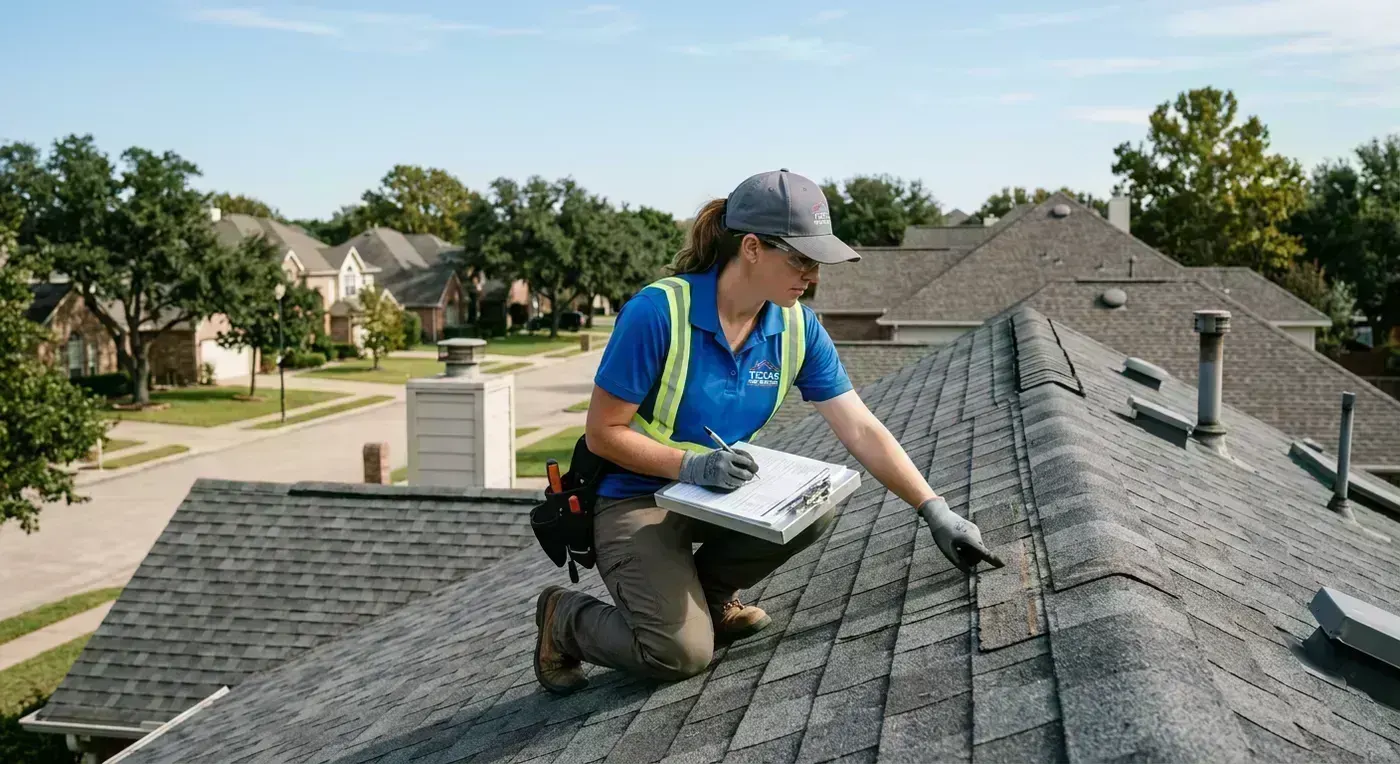
You can run most of this yourself in about 20 minutes without ever leaving the ground or setting foot on a ladder’s top rungs. Grab a pair of binoculars, a flashlight, and pick a dry, sunny day. Tally your yes answers as you go.
- Is the ridgeline straight, or does it dip or wave?
- Do you see curled, cupped, or clawing shingles through binoculars?
- Any obvious bald spots, dark patches, or missing shingles?
- Dark algae streaks or green moss, especially on shaded slopes?
- Rusted or lifted flashing around the chimney and vents?
- Heavy granule sediment or gritty piles below downspouts?
- Any shingle pieces or exposed nail heads visible along the eaves?
- Can you see daylight through the deck?
- Water stains, tracks, or damp insulation on the underside?
- Musty smell or soft, discolored wood?
- Ceiling or upper-wall stains that keep coming back?
- Energy bills climbing without a rate change?
- Is the roof past 15 years old — or do you not even know its age?
Scoring it: Zero to one yes — your roof is probably fine; keep an eye on it. Two to three — schedule a professional inspection to catch problems while they are still repairs. Four or more, or any single “yes” on sagging or attic daylight — your roof is likely at or near end-of-life, and you should get a professional assessment before the next big storm makes the decision for you.
When to call a professional
A self-assessment tells you whether to worry. A professional inspection tells you what to do. Call a roofer when you check two or more boxes above, when you spot any sign of sagging or attic moisture, after any significant hail or wind event, or simply when your roof crosses the 15-year mark and you have never had it evaluated. Regular checkups are cheap insurance — our guide on how often a roof should be inspected in Texas lays out a sensible schedule.
At RoofDog, we inspect the way that keeps everyone safe and finds what the ground misses. Our drone inspections capture high-resolution imagery of every slope, valley, and penetration — including the sagging and deck problems you should never climb up to check yourself — and we walk you through exactly what we find with no pressure. If the honest answer is a repair, we will tell you. If it is time for a full roof replacement, every job is backed by our lifetime workmanship warranty so you are never guessing about the quality of the install.
Frequently asked questions
How do I know if my roof needs replacing or just a repair?
Count your warning signs. A single, isolated problem — one leak with one clear cause, a few lifted shingles on one slope — is usually a repair. When three or four signs cluster together, or the roof is past 15–20 years, replacement is typically the more economical long-term choice because you stop paying for repeat patches.
How much granule loss is normal?
A light dusting of granules in the first year or two after installation is normal as the roof settles. Ongoing, heavy shedding — cupfuls in the gutters, gritty piles under downspouts, and shiny bald patches on the shingles — is not normal and signals the shingles are losing their UV protection.
Is a curling shingle always a sign of end-of-life?
Not always. A few curled shingles can result from a poor install, an isolated ventilation issue, or a defective batch. But widespread curling, cupping, or clawing across multiple slopes, combined with the roof's age, is a strong end-of-life indicator.
Can I check my own roof safely?
You can safely check most signs from the ground with binoculars, from your gutters, and from inside the attic with a flashlight. What you should never do is climb onto a roof you suspect is sagging or has soft decking — it may not hold your weight. Leave the on-roof inspection to a pro or a drone.
How long do roofs last in North Texas?
Most three-tab asphalt roofs last 15–20 years here, and architectural shingles somewhat longer, though our heat, hail, and UV exposure tend to pull those numbers toward the low end. See our full guide on how long roofs last in Texas for lifespans by material.
What does daylight in the attic mean?
It means there are gaps in your roof deck — open nail holes or separated seams — where light, and therefore water and air, can pass through. Combined with any staining or damp wood in the attic, it indicates the roof has failed at the deck level and needs professional attention quickly.
Why are my energy bills going up because of my roof?
A deteriorating roof and its failing ventilation let attic temperatures spike and let conditioned air escape. Your HVAC runs longer to keep up, which raises your bill. If costs climbed without a rate change and your roof shows other signs of aging, they are usually connected.
Is roof sagging an emergency?
Treat it as urgent. Sagging points to rotted decking or fatigued framing, meaning water has likely been getting in for a while. It cannot be fixed by shingling over it — it requires opening the roof to replace the compromised structure. Have it inspected right away and stay off the roof.
Do algae streaks mean my roof is dying?
Not by themselves. On a young roof, dark streaks are largely cosmetic algae that can be cleaned. On an older roof, persistent streaking, moss, and moisture retention are a sign the surface no longer sheds water efficiently — one more data point in the end-of-life picture.
How often should I inspect my roof?
In North Texas, a professional inspection once a year and after any major hail or wind event is a sensible baseline, with more frequent checks once the roof passes 15 years. Regular inspections catch small problems while they are still cheap repairs.
Will insurance help pay for a worn-out roof?
Homeowners insurance generally covers sudden storm damage, such as hail or wind, not gradual wear and age-related deterioration. If a storm accelerated an already-aging roof toward failure, an inspection documents the damage. RoofDog can help you understand what you are looking at before you file.
What happens during a drone roof inspection?
We fly a high-resolution drone over every slope, valley, ridge, and penetration to capture detailed imagery — including areas that are unsafe to walk, like a suspected sagging deck. Then we review the findings with you and give an honest recommendation, whether that is a repair, continued monitoring, or replacement.
How much does a roof replacement cost in North Texas?
Cost depends on size, pitch, material, and how much decking needs replacing, so a real number requires an inspection. What matters most is the value: a properly installed replacement backed by a lifetime workmanship warranty ends the cycle of repeat repairs and protects the home for decades.
My roof is under 15 years old but showing signs — what now?
Premature aging often points to an installation defect, poor attic ventilation, or storm damage rather than normal wear. A professional inspection can pinpoint the cause — and if it is a workmanship or material issue, you may have warranty coverage worth pursuing.
What is the fastest way to get a professional opinion?
Call RoofDog at 940.828.ROOF or schedule online. We serve homeowners across North Texas with drone inspections and honest recommendations, and every replacement is backed by our lifetime workmanship warranty.
Summary
A roof rarely fails overnight — it declines, and it leaves clues. The signs to watch are heavy granule loss showing up as grit in your gutters, curling and clawing shingles, bald spots and exposed mat, cracked and brittle shingles, a sagging deck, daylight in the attic, leaks that keep returning, rising energy bills, moss and algae streaking, exposed nails and failed flashing, and an age past 15 to 20 years. Any one of these might be a repair. Several appearing together, especially on an older roof, mean it is time to plan a replacement rather than chase problems one patch at a time.
Run the self-assessment checklist this weekend, and if you tally two or more warning signs — or spot any sagging or attic moisture — get a professional set of eyes on it before the next storm forces the issue. RoofDog is here for North Texas homeowners with safe drone inspections, honest recommendations, and a lifetime workmanship warranty on every replacement. Call 940.828.ROOF or schedule your inspection today. Protecting Homes. Saving Dogs.
You Might Also Need
Need a Roof Inspection?
Get expert advice and a free estimate from North Texas's trusted roofing professionals.
Schedule Free Inspection