
How Extreme Texas Heat Quietly Destroys Asphalt Shingle Roofs
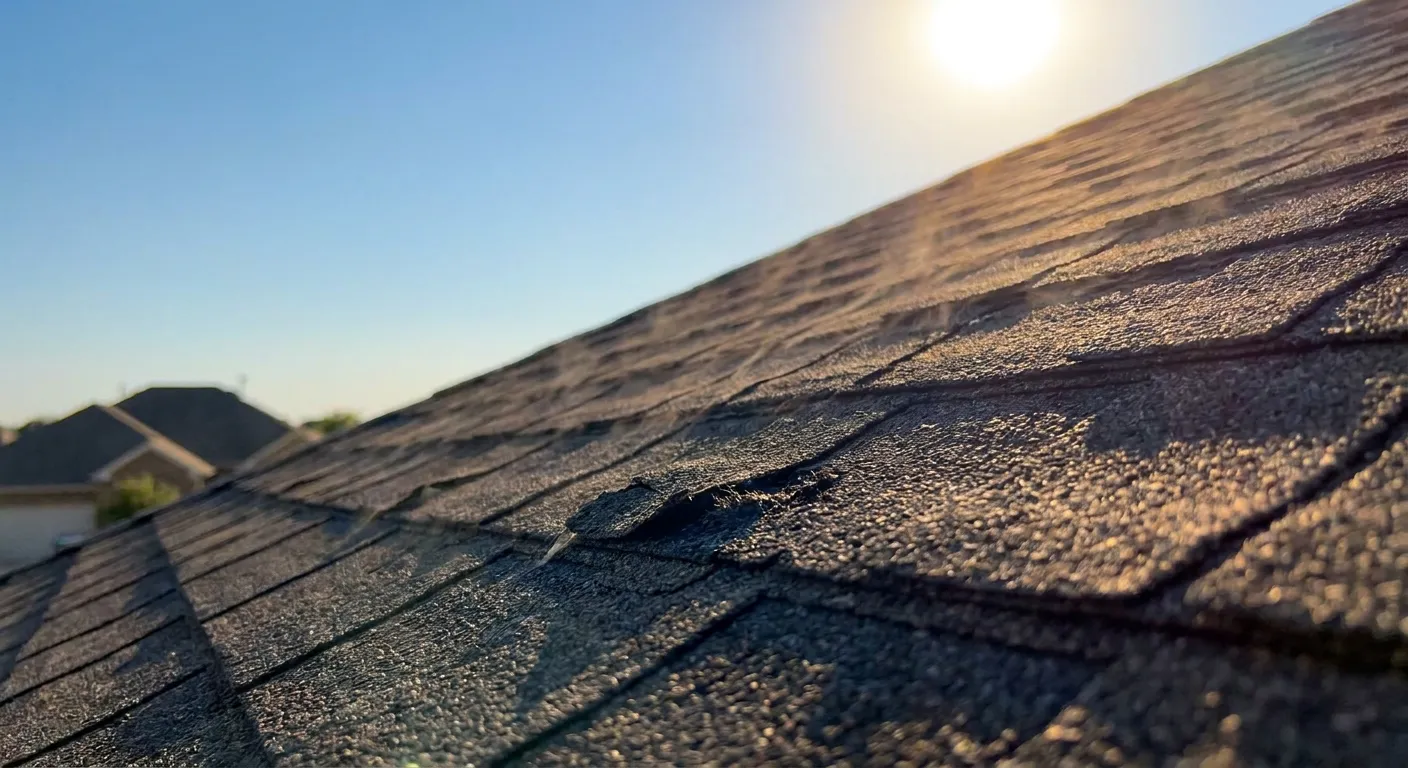
In North Texas, we are conditioned to fear the big one—that massive, green-tinted supercell that drops baseball-sized hail and sends everyone scrambling for their garage. We obsess over insurance claims and storm chasers. But while hail is the violent, sudden enemy of your home, there is a much more patient and pervasive threat that works 365 days a year: the Texas roof heat damage caused by our relentless summer sun. While hail might break a roof in ten minutes, the Texas heat spends a decade slowly baking your investment into a brittle, failed state.
Understanding the asphalt roof lifespan in Texas requires a shift in perspective. Our environment is one of the most hostile in North America for traditional roofing materials. Between the 105-degree August days and the thermal shock of a sudden thunderstorm hitting a sun-baked roof, your shingles are in a constant state of expansion and contraction. In this guide, we will explore how extreme heat causes shingles curling in Texas, how attic heat roof damage accelerates failure, and why roof ventilation in Texas is the single most important factor in extending your roof''s life. For a foundational overview, our what causes roofs to fail in North Texas guide is a perfect companion read.
1. The Chemistry of the "Baking" Process
Asphalt shingles are not a solid material; they are a complex composite. They consist of a fiberglass mat saturated with petroleum-based asphalt and topped with ceramic-coated granules. The asphalt provides the waterproofing, while the granules provide UV protection. However, asphalt is a volatile organic compound. Under the intense UV radiation of the North Texas sun, the oils that keep the asphalt flexible begin to evaporate. This process is known as off-gassing.
As these oils disappear, the shingle becomes increasingly brittle. In a cooler climate, an asphalt shingle might retain its flexibility for 25 years. In the DFW metroplex, that same shingle might become brittle in as little as 12 to 15 years. This is why the asphalt roof lifespan in Texas is significantly shorter than national averages. When a shingle loses its oils, it loses its ability to expand and contract. This leads to thermal cracking—small fissures that appear on the surface of the shingle, allowing water to reach the underlayment. This is the quiet destruction that hail adjusters often miss, but which eventually leads to catastrophic leaks. Over the course of a 100-degree summer, the loss of these essential oils is permanent and cumulative. Our DFW roof lifespan and insurance age trap post explains why insurers now actuarially assume this accelerated wear.
2. Shingles Curling in Texas: The Warning Signs
One of the most visible hail-free signs of heat damage is shingles curling in Texas. You may notice the edges or corners of your shingles turning upward (cupping) or the middle of the shingle bowing (clawing). This isn''t just an aesthetic issue; it''s a structural failure caused by differential drying and high-temperature stress.
The underside of the shingle is often cooler than the top side, which is absorbing direct solar radiation. As the top layer shrinks due to oil loss and extreme heat faster than the bottom layer, the shingle begins to pull itself into a curled shape. Once a shingle curls, it becomes a sail for the wind. The Texas roof heat damage has now compromised the roof''s wind rating. A curled shingle is also prone to snapping during a light hail event that a healthy, flexible shingle would have easily survived. If you see curling from the ground, your roof has reached the end of its functional life, regardless of how many storms it has weathered. The mechanical bond between the layers has been broken by heat. Cross-reference what you see with our warning signs your roof needs replacement.
3. The "Hidden Killer": Attic Heat Roof Damage
Many homeowners believe the heat damage only happens on the outside. In reality, the most significant damage often happens from the inside out. Attic heat roof damage is a result of poor airflow. In a typical July afternoon in Dallas, the surface temperature of your roof can reach 160 degrees. If your attic isn''t properly ventilated, that heat becomes trapped. We have measured attic temperatures in North Texas as high as 150 degrees, which is hot enough to cook more than just shingles. Our roof ventilation explained guide walks through the airflow math.
This trapped heat essentially double-bakes the shingles. The heat from the sun hits the top, and the heat from the attic hits the bottom. This accelerates the degradation of the petroleum matting from both sides. Furthermore, extreme attic heat can damage the seal strip—the adhesive line that bonds shingles together. When the seal strip is overheated for years, it can become gooey and then dry out completely, losing its adhesive properties. This makes the roof incredibly vulnerable to wind during our spring storm seasons. Without a functional seal strip, your shingles are just sitting there, waiting to be blown away by a 40-mph gust. This is the definition of a roof failure that happens on a clear, sunny day. Catch these issues early with a regular roof maintenance program.
Expert Insight: Proper roof ventilation in Texas isn''t just about comfort; it''s about physics. A well-ventilated attic should stay within 10-15 degrees of the outside temperature. If your attic is 140 degrees when it''s 100 degrees outside, you are effectively cutting your roof''s lifespan in half. This heat also puts a massive strain on your HVAC system, leading to higher bills and premature AC failure.
4. Granule Loss and UV Exposure
The granules on your shingles are like sunscreen for your house. Their primary job is to reflect UV rays and protect the underlying asphalt. However, the extreme heat cycles in North Texas cause the asphalt to expand and contract so violently that the grip on the granules is lost. You may see a large amount of sand-like material in your gutters after a rain—this is accelerated granule loss caused by thermal cycling.
Once the granules are gone, the sun has a direct path to the asphalt. This creates a bald spot. Within just a few months of UV exposure, an unprotected asphalt patch will crack and disintegrate. This is why a roof that looks okay one year can suddenly fail the next. The heat has stripped the protection away, and the UV rays have finished the job. To combat this, North Texas homeowners should consider cool roof systems or Class 4 shingles, which are designed with better granule retention and reflective properties specifically for southern climates.
5. Thermal Shock: The Summer Storm Paradox
We''ve all seen it: a 105-degree day in August followed by a sudden, cooling thunderstorm. While this feels great to us, it is brutal for your roof. This is known as thermal shock. The roof surface temperature drops from 160 degrees to 80 degrees in a matter of seconds. This rapid contraction puts immense stress on the shingles, the flashing, and the sealants around your vents.
Over time, thermal shock causes the sealant around your chimney and pipe jacks to pull away, creating small gaps. This is why many mysterious leaks occur during a normal rainstorm with no wind or hail. The heat has quietly prepared the way for water to enter your home by destroying the flexibility of the materials meant to keep it out. A scheduled professional roof inspection can catch these subtle failures before they become interior leaks—our guide on what an inspection should include shows exactly what to ask for.
6. The Solution: Modern Ventilation and Reflective Materials
So, how do we fight an enemy as consistent as the sun? It starts with roof ventilation in Texas. You need a balanced system of intake (soffit vents) and exhaust (ridge vents or solar fans). This creates a passive cooling effect that pulls fresh air through the attic, flushing out the super-heated air before it can damage the shingles. This airflow is the breathing mechanism that keeps your roof alive.
Secondly, the choice of material matters. Standard 3-tab shingles are virtually obsolete in North Texas because they cannot handle the thermal stress. Heavy-duty architectural shingles are better, but Class 4 shingles with SBS (Styrene-Butadiene-Styrene) polymer-modified asphalt are the gold standard. These rubberized shingles are designed to handle the extreme expansion and contraction of our climate without cracking or losing their seal. While the replacement cost might be slightly higher, the return on investment through a longer lifespan and better protection is undeniable for any DFW property owner. If budget is the bottleneck, our flexible roof financing options make Class 4 systems accessible.
7. The Long-Term Impact of Heat on Decking
The Texas roof heat damage doesn''t stop at the shingles. It impacts the plywood decking underneath. Under sustained 150-degree heat in an unventilated attic, the glues in the plywood can delaminate. This leads to soft spots in your roof. When a roofer eventually walks on your roof to inspect for hail, they may feel the deck giving under their feet. This isn''t always wood rot from a leak; often, it is heat rot where the structural integrity of the wood has been compromised by decades of being cooked. This is why we insist on a full deck inspection with every heat damage assessment.
Conclusion: Don''t Wait for the Hail to Check Your Roof
In North Texas, a roof doesn''t need a storm to die; it just needs a few summers. The Texas roof heat damage is happening right now, quietly and invisibly. By the time you see shingles curling in Texas or find granules in your downspouts, the damage is already done. Understanding the asphalt roof lifespan in Texas is about being proactive and acknowledging that the sun is a more consistent threat than the hail.
Don''t let the quiet killer of your roof go unchecked. Ensure your roof ventilation in Texas is up to par, and consider upgrading to heat-resistant materials when it''s time for a replacement. Your roof is your home''s first line of defense against the sun, the wind, and the rain. Give it the tools it needs to survive the Texas heat. Regular maintenance and a proper ventilation system can add 5 to 7 years to your roof''s life, saving you thousands in premature replacement costs.
Extended Technical Analysis: The Science of Thermal Cycles
To truly reach total topical authority, we must examine the specific behavior of the polymers within the shingles. In the 2020s, North Texas has seen an increase in the frequency of heat dome events. During these periods, the ambient air temperature remains high even at night, preventing the roof from resetting its thermal load. This 24/7 heat saturation means the shingles never leave their expanded state, which prevents the petroleum-based oils from settling back into the fiberglass matting. This constant tension is what leads to the premature brittle state we see across DFW.
Furthermore, we must address the Heat Island effect in dense suburban areas like Plano, Frisco, and Arlington. The density of dark-colored roofs and concrete in these areas creates a localized micro-climate that is 5-7 degrees hotter than the surrounding rural areas. This means a roof in a dense North Texas suburb is under significantly more stress than a roof on a farmhouse in Celina. This is why we recommend Cool Roof technology—shingles with higher solar reflectance index (SRI) values—specifically for our suburban clients. These shingles can reflect up to 25% of solar radiation, reducing the surface temperature by 15-20 degrees. This reduction in temperature is the difference between a roof that lasts 12 years and one that lasts 20.
Lastly, consider the role of the drip edge and the perimeter of the roof. The heat is most intense at the eaves and rakes, where the shingles meet the metal drip edge. The metal absorbs heat even faster than the asphalt, causing the shingles at the edge to char and become brittle first. This is where most wind failures begin. By understanding these subtle heat-driven failures, DFW homeowners can better appreciate why a free hail roof is a myth—the heat usually gets there first. Protect your investment by prioritizing ventilation and reflective materials today. Ready to find out what shape your roof is really in? Schedule a free inspection or contact RoofDog.
You Might Also Need
- Roof ventilation in Texas →
- What causes roofs to fail in North Texas →
- DFW roof lifespan and insurance age trap →
- Warning signs your roof needs replacement →
- Roof ventilation explained →
- Roof maintenance program →
- Gutter repair and cleaning →
- Cool roof systems →
- Class 4 impact-resistant shingles →
- Professional roof inspection →
- What a roof inspection should include →
- Roof replacement →
- Roof financing options →
- DFW service areas →
- Schedule a free inspection →
- Contact RoofDog →
Need a Roof Inspection?
Get expert advice and a free estimate from North Texas's trusted roofing professionals.
Schedule Free Inspection