Does Attic Ventilation Affect Roof Lifespan?
Short answer: absolutely, yes. Attic ventilation quietly decides whether a Texas roof reaches the end of its rated life or fails years early. A poorly vented attic in Dallas or Fort Worth can climb past 150°F in July, and that trapped heat bakes your shingles from underneath while cooking the asphalt binders that hold everything together. Add trapped moisture in the mix and you get rotting decking, rusting fasteners, and a warranty that may not even apply. Good ventilation is cheap insurance; bad ventilation is a slow, invisible tax on your roof.
Table of contents
- How attic ventilation actually works
- Why Texas heat, not ice, is the enemy here
- Superheated attics cooking shingles from below
- Trapped moisture and rotting decking
- Balanced intake and exhaust: the whole game
- Ridge, turbine, and powered exhaust compared
- Code and the 1:150 / 1:300 ratios
- Warning signs of poor ventilation
- How many years ventilation adds or subtracts
- What to do about it
- Frequently asked questions
How attic ventilation actually works
Think of your attic as a chimney that never quite empties. Warm air rises and wants to escape at the top of the roof. If you give it a clean path — cool air drawn in low, hot air pushed out high — the attic breathes on its own, driven by nothing more than physics. This is called the stack effect, and it runs day and night without a motor or an electric bill.
The catch is that air cannot leave unless an equal amount can enter. That is the single idea most homeowners miss. A ridge full of exhaust vents with no intake at the eaves is like trying to sip through a straw with your finger over the other end. Nothing moves. A working attic needs two openings that work as a pair: low intake at the soffits and high exhaust near the ridge. When those two are balanced, the entire attic volume flushes itself several times an hour, carrying heat and humidity out before they can do damage.
Roof lifespan is tied to this because shingles are not just weathering from the top down. They are also being attacked from the underside by whatever your attic is holding. A cool, dry attic is a neutral neighbor to your roof deck. A hot, damp one is a slow-acting solvent. If you want the full picture of what determines longevity, our guide to how long roofs last in Texas puts ventilation alongside the other lifespan factors.
Why Texas heat, not ice, is the enemy here
In northern states, the ventilation conversation revolves around ice dams — snow melting over a warm attic, refreezing at the cold eaves, and backing water up under the shingles. It is a real and expensive problem, but it is almost a non-issue across most of North Texas. We simply do not get the sustained snow load and deep freezes that build ice dams year after year. When we do get a hard freeze, it is a headline event, not a seasonal certainty.
Our ventilation problem is the opposite one. For roughly five months a year, our attics are the hottest place on the property. Where a Minnesota homeowner ventilates to keep the attic cold and prevent melt cycles, a Dallas homeowner ventilates to keep the attic from turning into a kiln. Same components, completely different job. That distinction matters because a lot of generic roofing advice online is written for cold climates and quietly assumes ice is your main threat. Here, it is heat — and the reason is worth understanding in detail, which is why we wrote a companion piece on exactly how heat damages roofs in Texas.
The North Texas reality: On a 100°F afternoon, a poorly vented attic can reach 150–160°F. That heat radiates down into living space (raising your cooling bill) and up into your roof deck (shortening your shingle life). A well-vented attic on the same day may run only 15–25°F above the outdoor temperature. That gap is the difference between a roof that ages gracefully and one that ages fast.
Superheated attics cooking shingles from below
Asphalt shingles are a sandwich of a fiberglass mat, asphalt, and a surface of ceramic-coated granules. The asphalt is what makes them waterproof and flexible, and asphalt is temperature-sensitive by nature. When shingles get hot, the volatile compounds in the asphalt slowly cook off. Over years, the shingle dries out, gets brittle, curls at the edges, and starts shedding granules. Once the granules go, the asphalt is exposed to UV and the decline accelerates.
Here is the part homeowners underestimate: shingles do not only heat up from the sun above. They also heat from the attic below. A shingle exposed to direct summer sun might be pushing 160–180°F on its top surface. If the attic underneath is also sitting at 150°F, that shingle is being heated from both sides at once and has no chance to shed the load. With good ventilation flushing the attic, the underside stays cooler, the shingle can dump heat downward at night, and the daily thermal swing is far less punishing.
That daily expand-contract cycle is the quiet killer. Every day the roof heats up and swells slightly, every night it cools and shrinks. Do that a few thousand times with an overheated attic amplifying the range, and the asphalt fatigues, the sealant strips let go, and the mat starts to crack. Ventilation does not stop the cycle — nothing does — but it dramatically narrows the temperature range, which is exactly what reduces the fatigue.
Trapped moisture and rotting decking
Heat gets the headlines, but moisture does the structural damage. Everyday life pumps water vapor into your home — showers, cooking, laundry, even breathing. That vapor drifts upward and, if the attic cannot exhale it, condenses on the cool underside of the roof deck, on nails, and on framing. In Texas, the classic trigger is a summer morning: the attic is humid, the air conditioning has cooled the ceiling below, and dew forms on the plywood.
Persistent attic moisture does several bad things at once. It rots the wood decking that your shingles are nailed to, so the roof loses its structural backbone. It rusts nails and fasteners, weakening the grip that holds shingles down in a wind event. It soaks and flattens insulation, so your energy bills climb. And it feeds mold, which becomes an indoor air-quality and health issue long before anyone spots a leak. A roof can look perfectly fine from the street while the deck underneath is going soft.
The insidious thing is that moisture damage is invisible from the ground and often from inside the house until it is advanced. This is one of the strongest arguments for periodic professional roof inspection — a trained eye in the attic can catch staining, delamination, and rust years before it becomes a five-figure repair.
Balanced intake and exhaust: the whole game
If you take one thing from this article, make it this: ventilation only works when intake and exhaust are balanced. Roofers talk about net free area — the actual open area of a vent after you subtract the screen and louvers. The goal is roughly equal net free area at the intake (low, at the soffits or eaves) and at the exhaust (high, near the ridge). Slight favor toward intake is fine and even preferred.
Why does balance matter so much? Because an unbalanced system does not just underperform — it can actively cause problems. Too much exhaust with too little intake forces the roof to pull replacement air from wherever it can, and often that means sucking conditioned air up out of the house through ceiling gaps, or worse, pulling air backward down through another exhaust vent, short-circuiting the whole loop. The attic barely flushes and you have paid for vents that do nothing.
The most common mistake we find: plenty of exhaust up top and blocked or missing soffit intake down below. Insulation shoved into the eaves, painted-over soffit vents, or a home that never had adequate intake to begin with. The fix is often inexpensive relative to a premature reroof — which is why we treat intake as seriously as exhaust in our attic ventilation and insulation service.
Ridge, turbine, and powered exhaust compared
There is no single "best" exhaust vent — the right choice depends on the roof shape, the length of the ridge, and how much intake you can provide. Here is how the common options stack up for North Texas homes.
| Exhaust type | How it works | Strengths | Watch-outs |
|---|---|---|---|
| Ridge vent | Continuous vent along the peak; hot air escapes across the whole ridge. | Even airflow, low profile, no moving parts, pairs perfectly with soffit intake. | Needs a long enough ridge and matching soffit intake to perform. |
| Turbine (whirlybird) | Wind-spun rotor that draws attic air out as it turns. | Inexpensive, works well on breezy days, no electricity. | Stalls on still days; bearings can wear and squeak over time. |
| Powered attic fan | Electric or solar fan that forces air out on a thermostat. | Strong airflow on demand; solar versions run free. | Can depressurize the attic and pull conditioned air if intake is undersized. |
| Box / static vents | Fixed low-profile vents placed near the ridge. | Simple, cheap, good for roofs without a long usable ridge. | Less airflow per vent; needs several placed correctly. |
One firm rule: never mix exhaust types on the same attic zone. A ridge vent combined with a powered fan or box vents nearby will short-circuit — the fan pulls its replacement air from the nearest ridge vent instead of from the soffits, and the far end of the attic never flushes. Pick one exhaust strategy per attic space and pair it with adequate intake.
Code and the 1:150 / 1:300 ratios
Building codes set a minimum amount of ventilation based on the size of your attic floor. The baseline rule is the 1:150 ratio: you need one square foot of net free vent area for every 150 square feet of attic floor. So a 1,500-square-foot attic footprint needs about 10 square feet of net free vent area total.
The code allows a relaxed 1:300 ratio — half as much venting — but only if you satisfy two conditions: a proper vapor barrier on the warm side of the ceiling, and a balanced split with 40–50% of the venting in the upper third of the roof (exhaust) and the rest low (intake). That balance requirement is the code quietly enforcing the same principle we keep returning to.
| Attic floor area | 1:150 (min net free area) | 1:300 (with balance + vapor barrier) |
|---|---|---|
| 1,200 sq ft | 8.0 sq ft | 4.0 sq ft |
| 1,500 sq ft | 10.0 sq ft | 5.0 sq ft |
| 2,000 sq ft | 13.3 sq ft | 6.7 sq ft |
Remember that the numbers refer to net free area, not the physical size of the vent. A vent with a screen and louvers might only deliver half its face area as usable opening, so the printed rating on the product matters. Meeting code is the floor, not the goal — in a Texas summer, erring toward more ventilation almost always pays off.
Warning signs of poor ventilation
You do not need instruments to suspect a ventilation problem. Watch for these signals, several of which show up inside the house rather than on the roof:
- An attic that feels like an oven in summer, even in the evening after the sun is down.
- Upstairs rooms that never cool off and an air conditioner that runs constantly.
- Curling, cupping, or blistering shingles, especially on the sunniest slopes.
- Rust on nail heads or metal connectors in the attic — a fingerprint of condensation.
- Dark staining or streaking on the underside of the roof deck, or a musty smell.
- Damp, matted, or discolored insulation.
- Frost on the deck in winter on the rare cold mornings — vapor that should have escaped.
- Peeling paint or wallpaper on top-floor ceilings, driven by trapped humidity.
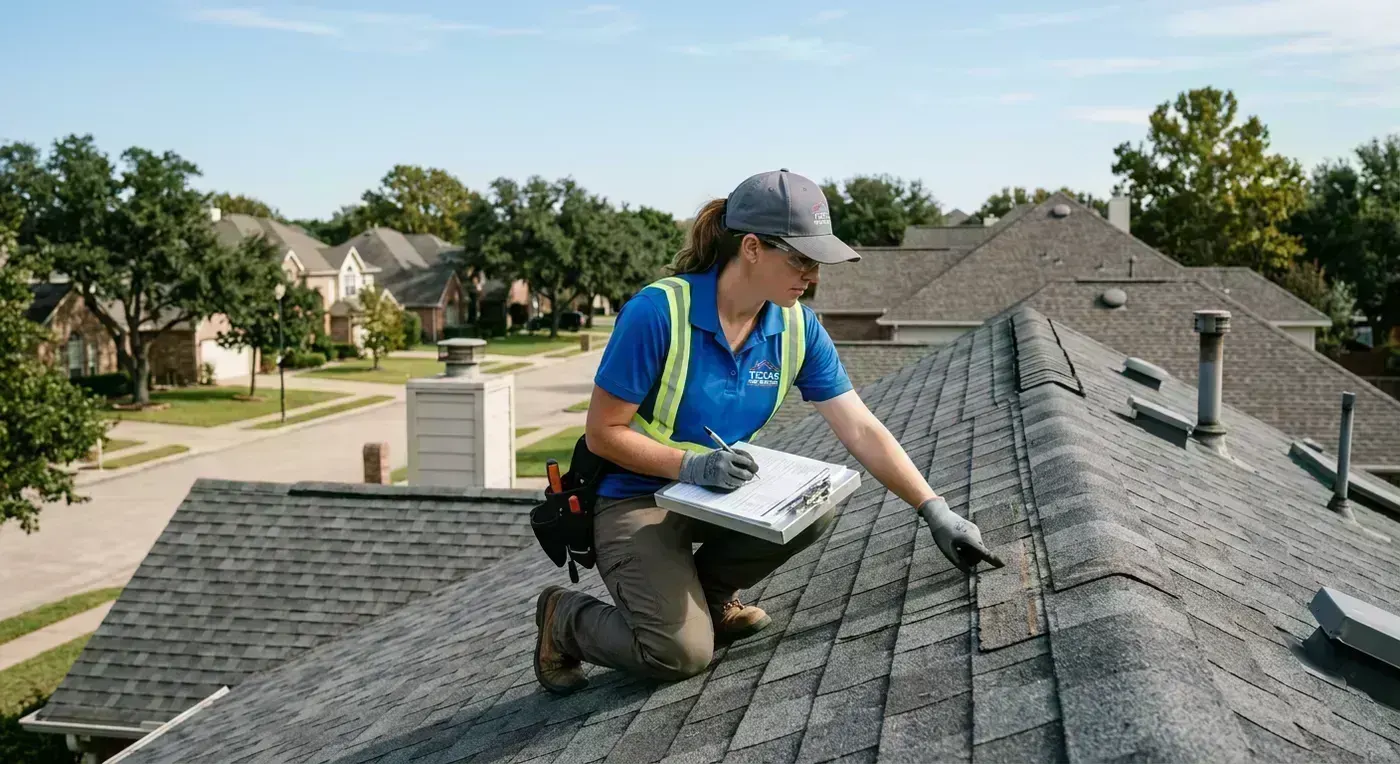
Any two of these together are worth a look in the attic. Because so many of the signs are hidden overhead, we use drone inspections to survey the exterior and pair that with an interior attic check — the combination catches problems that neither view reveals alone.
How many years ventilation adds or subtracts
Homeowners always want a number, so here is an honest one. A quality architectural shingle in North Texas is often rated for 25–30 years, but the field reality in our climate is that many roofs are replaced closer to the 15–20 year mark. Ventilation is one of the biggest swing factors in where a given roof lands in that range.
A roof with genuinely balanced ventilation, adequate intake, and a cool, dry attic tends to reach or approach its rated life. A roof over a superheated, moisture-laden attic can lose meaningful years — we regularly see roofs that were failing well before they should have, with the attic as the obvious culprit once you climb up and feel the heat. It is rarely the only factor, but it is often the difference between "you have several years left" and "you needed this replaced last summer."
Ventilation also protects the rest of your maintenance investment. All the sealing, flashing repair, and debris clearing in the world cannot offset an attic that is roasting your deck from below. Ventilation and upkeep work together — we cover the maintenance side in detail in our guide to whether roof maintenance can extend roof life.
What to do about it
The good news is that ventilation is one of the more affordable roof improvements, and it frequently pays for itself in lower cooling bills before you even count the added roof life. The right first step is an honest assessment: how much intake do you actually have, how much exhaust, and are they balanced? That question is best answered by someone in your attic with a temperature reading, not by a guess from the driveway.
If you are in North Texas and want a straight answer, RoofDog will inspect your attic and roof, measure the ventilation you have against what your attic size needs, and tell you plainly whether it is helping or hurting your roof. Every replacement we do is backed by a lifetime workmanship warranty, and we use drone inspections to document the roof surface so nothing gets missed. Call us at 940.828.ROOF or schedule an inspection online.
Protecting Homes. Saving Dogs. RoofDog gives 10% of our profits to dog rescues across North Texas. When you protect your roof with us, you are also helping shelter animals find their forever homes — a roof over their heads and yours.
Frequently asked questions
Does attic ventilation really affect how long my roof lasts?
Yes, significantly. A superheated attic cooks shingles from below and accelerates the loss of the asphalt binders that keep them waterproof and flexible. Trapped moisture rots the decking underneath. Balanced ventilation keeps the attic cooler and drier, which reduces the daily thermal stress on shingles and protects the wood beneath them — often the difference between a roof reaching its rated life and one failing years early.
How hot does a poorly ventilated attic get in Texas?
On a 100°F afternoon, a poorly vented North Texas attic can reach 150–160°F. A well-ventilated attic on the same day typically runs only 15–25°F above the outdoor air. That gap is exactly what ages your roof deck and drives up your cooling bill.
What is the difference between intake and exhaust vents?
Intake vents sit low, usually at the soffits or eaves, and let cool air enter. Exhaust vents sit high, near the ridge, and let hot air escape. Both are required and they must be roughly balanced. Exhaust without matching intake barely moves any air, no matter how many vents you install.
Do I need to worry about ice dams in North Texas?
Rarely. Ice dams need sustained snow and freezing temperatures that we almost never get here. Our ventilation challenge is the opposite — controlling extreme summer attic heat and humidity. Advice written for cold climates often overweights ice dams and underweights heat, which is backwards for Texas.
Can too much ventilation be a problem?
It is less about "too much" and more about imbalance. Too much exhaust relative to intake forces the roof to pull replacement air from inside the house or from other vents, short-circuiting airflow. The fix is matching intake to exhaust, not simply adding more vents up top.
Which is better: ridge vents, turbines, or powered fans?
It depends on the roof. Ridge vents give even, motor-free airflow and pair beautifully with soffit intake when the ridge is long enough. Turbines are cheap and effective on breezy days. Powered and solar fans move a lot of air but can depressurize the attic if intake is undersized. What matters most is adequate intake and never mixing exhaust types on one attic zone.
Why should you never mix exhaust vent types?
Because they short-circuit each other. A powered fan or box vent placed near a ridge vent will pull its replacement air from that nearby vent instead of from the soffits below. The result is that part of the attic never flushes. Pick one exhaust strategy per attic space and pair it with proper intake.
What does the 1:150 ratio mean?
It is the code baseline: one square foot of net free vent area for every 150 square feet of attic floor. A relaxed 1:300 ratio is allowed if you have a vapor barrier and a balanced 40–50% split of venting in the upper third. Net free area is the actual open area after subtracting screens and louvers, not the physical vent size.
How can I tell if my attic ventilation is bad?
Look for an attic that stays oven-hot into the evening, upstairs rooms that never cool, curling or blistering shingles, rust on attic nails, dark staining on the deck underside, damp insulation, or peeling paint on top-floor ceilings. Two or more of these together warrant a professional attic check.
Does poor ventilation void my shingle warranty?
It can. Most shingle manufacturers require ventilation that meets code as a condition of their warranty. If an inspection reveals the attic was inadequately ventilated, a manufacturer may deny a heat-related claim. Proper ventilation protects both your roof and your warranty coverage.
Will better ventilation lower my energy bills?
Usually yes. A cooler attic radiates less heat into your living space, so your air conditioner runs less during the long Texas summer. Many homeowners notice more comfortable upstairs rooms and lower cooling costs, which is why ventilation upgrades often pay for themselves before you even count the added roof life.
Can insulation block my ventilation?
Very often, yes. Loose or batt insulation pushed into the eaves can smother the soffit intake vents, choking off airflow at the source. Baffles (also called insulation stops) keep a clear air channel from the soffit up into the attic. This is one of the most common and most fixable ventilation problems we find.
How much does it cost to fix attic ventilation?
It varies with roof size and what the attic needs, but ventilation is one of the more affordable roof improvements — typically far less than a premature reroof, and it frequently pays for itself in cooling savings. The right first step is an inspection so you are not paying for vents you do not need or leaving intake blocked.
Should I check ventilation before or after a new roof?
Before, and ideally as part of the same project. A reroof is the ideal moment to correct intake and exhaust, add ridge venting, or install baffles, because the roof is already open. Installing a fresh roof over a badly ventilated attic just starts the clock on the same premature aging all over again.
Does RoofDog inspect attic ventilation?
Yes. We assess intake and exhaust, measure attic temperature, compare your venting to what your attic size requires, and pair a drone survey of the roof surface with an interior attic check. Call 940.828.ROOF or schedule online, and every replacement we do carries a lifetime workmanship warranty.
Summary
Attic ventilation is a genuine, measurable factor in North Texas roof lifespan. In our climate the enemy is summer heat, not ice: a superheated attic bakes shingles from below and speeds their aging, while trapped moisture quietly rots the decking beneath them. The fix is balanced airflow — cool intake low at the soffits and hot exhaust high near the ridge, sized to your attic and never mixed across exhaust types. Meeting the 1:150 or 1:300 code ratio is the floor, not the goal. Watch for oven-hot attics, curling shingles, rusted nails, and damp insulation, and get an attic that is both cool and dry. RoofDog can measure your ventilation against what your attic needs, back the work with a lifetime workmanship warranty, and — because we are Protecting Homes. Saving Dogs. — give 10% of profits to dog rescues. Call 940.828.ROOF or schedule an inspection.
You Might Also Need
Need a Roof Inspection?
Get expert advice and a free estimate from North Texas's trusted roofing professionals.
Schedule Free Inspection