Does Wind Damage Shorten Roof Life?
Short answer: yes — wind damage shortens roof life, often invisibly. A single storm rarely ends a roof, but repeated wind events break seal strips, crease shingles, back out nails, and chip away at the ridge and edges. That cumulative aging can strip years off a roof rated to last decades, especially in DFW's spring storm belt.
Most homeowners think of wind damage as the dramatic stuff — shingles scattered across the lawn, a tarp flapping over a bare deck. But the wind that ages a North Texas roof fastest is the wind you never think twice about: the 45 mph gust front ahead of an April thunderstorm, the downburst that flattens a section of fence, the steady spring blow that worries a shingle tab back and forth for an hour. This article walks through exactly how wind works on a roof, why North Texas gets hit so hard, and how the way your roof was installed decides whether it shrugs off a storm or quietly loses a decade of service life.
Table of Contents
- How wind actually damages a roof
- Why North Texas wind is so hard on roofs
- The seal strip: your roof's weakest link
- Shingle lifting, creasing, and blow-offs
- Exposed nails and back-out
- Why the ridge and edges fail first
- Wind ratings explained (110–130+ mph)
- Cumulative aging: the slow kill
- How proper installation changes everything
- What to do after a wind event
- Frequently asked questions
How wind actually damages a roof
Wind doesn't push a roof so much as it pulls it. As air moves across a sloped surface, it accelerates over the ridge and along the eaves, and fast-moving air creates a zone of low pressure — the same lift that gets an airplane off the ground. That suction grabs the leading edge of every shingle tab and tries to peel it upward. If the shingle's adhesive seal holds, the tab stays put. If the seal has weakened, the tab flexes up, snaps back down, and the cycle repeats with every gust.
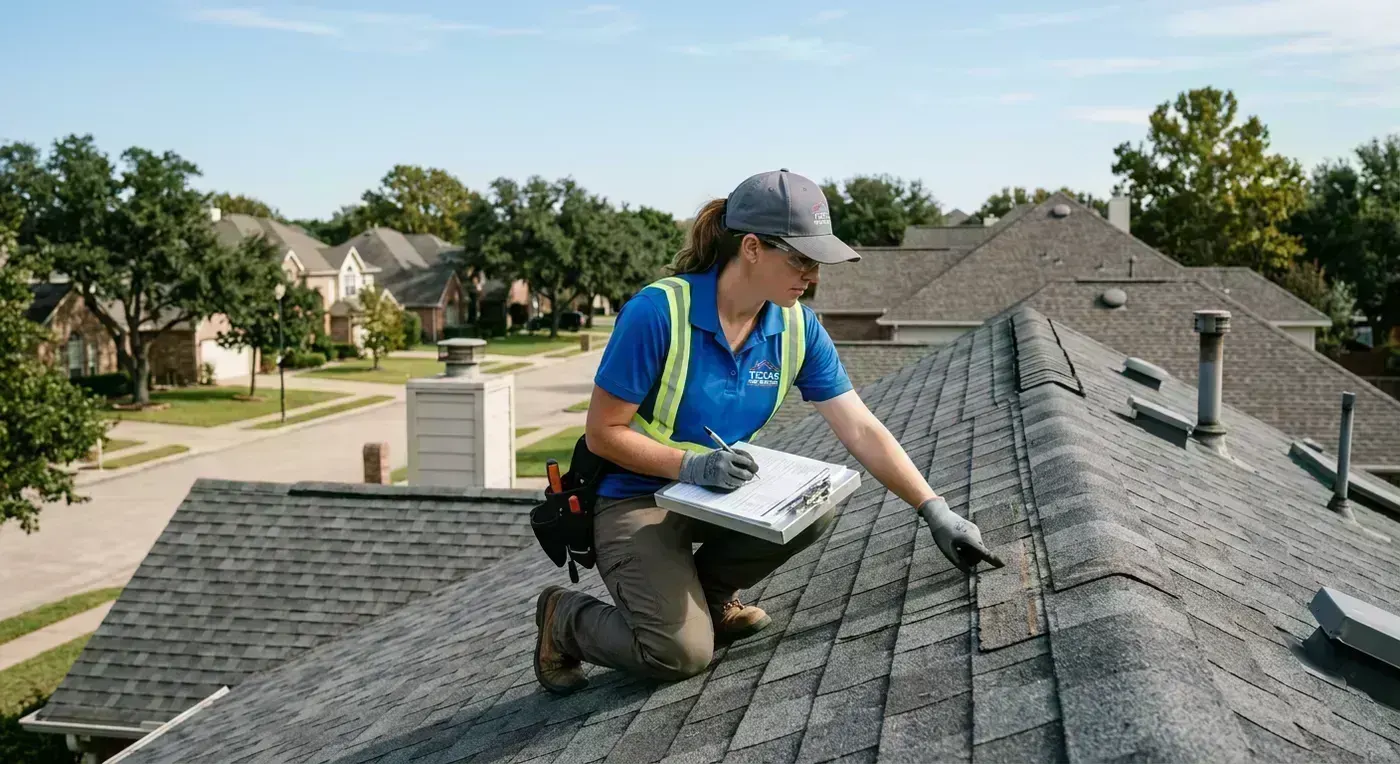
This is why wind damage is deceptive. The forces at work are strongest at exactly the spots you can't see from the ground — ridges, rakes, eaves, and the transitions around valleys and penetrations. A roof can look flawless from the driveway while its seal strips have been quietly fatigued along the top course. Understanding how long a roof is supposed to last starts with understanding these forces, which is why we cover the full picture in our guide on how long roofs last in Texas.
Why North Texas wind is so hard on roofs
DFW sits in a corridor where dry air off the Caballo and Chihuahuan deserts collides with warm Gulf moisture. That collision fuels the spring storm season — roughly March through June — that defines roofing here. The wind that comes with these storms falls into a few distinct categories, and each ages a roof differently.
| Wind type | Typical speed | Effect on roof |
|---|---|---|
| Straight-line winds | 40–70 mph | Sustained lift on tabs; seal fatigue over time |
| Gust fronts | 50–80 mph | Sudden peel force; creasing at ridge and rakes |
| Downbursts / microbursts | 70–100+ mph | Localized blow-offs; edge-metal and starter failure |
| Tornadic winds | 100–200+ mph | Catastrophic loss of field shingles and decking |
The tornadic events grab headlines, but they're rare for any single house. The real lifespan thief is the routine stuff — the gust fronts and straight-line winds that roll through a dozen or more times a season. Each one adds a little fatigue, and North Texas delivers them year after year.
Local context: A typical DFW roof faces 15–25 thunderstorm days per year, with the bulk clustered in spring. Even if none of those storms is a "damage event" by insurance standards, the accumulated wind loading is real — and it's why two identical roofs in Frisco and Fort Worth can age very differently based on exposure and how well they were installed.
The seal strip: your roof's weakest link
Every asphalt shingle has a strip of factory-applied adhesive on its underside. When a roof is new and the sun warms it, that strip melts slightly and bonds each shingle to the one below, turning thousands of individual pieces into one continuous, wind-resistant surface. This seal — not the nails — is what gives a shingle roof most of its wind resistance in the field.
Wind attacks the seal in two ways. First, direct lift can break a partially cured seal on a young roof, especially if the shingles were installed in cool weather and never got a chance to bond properly. Second, and more insidiously, repeated flexing fatigues an aged seal. Asphalt gets brittle as its volatile oils evaporate over the years, so an older seal strip cracks and releases far more easily than a fresh one. Once a tab is unsealed, it flaps freely, and each subsequent gust drives the damage further down the shingle.
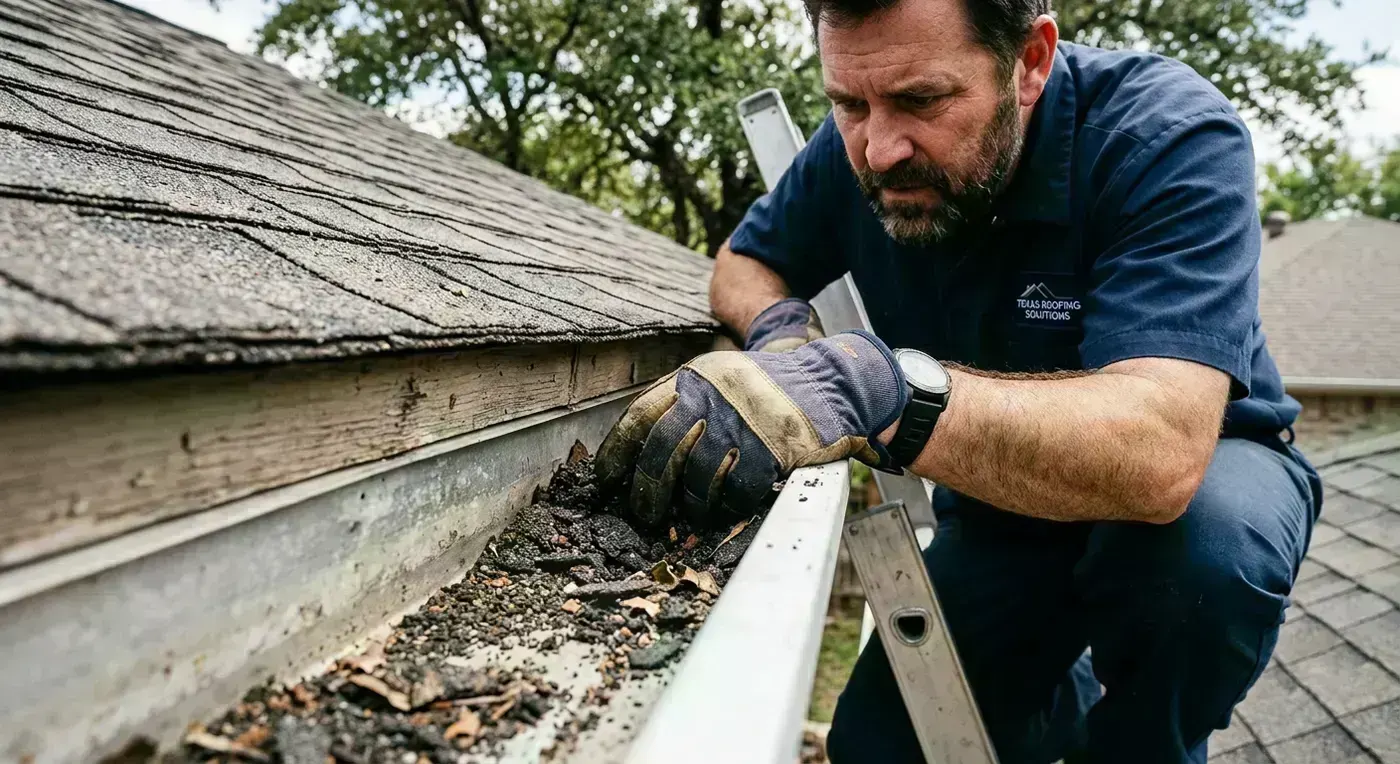
An unsealed but still-nailed shingle is a subtle failure. It won't blow off immediately, it won't leak right away, and it's nearly impossible to see from the ground — which is exactly why a close-up roof inspection matters after a storm. This is one place where our drone inspections earn their keep: we can photograph the top of every course and spot lifted tabs and broken seals without a crew tramping across your roof.
Shingle lifting, creasing, and blow-offs
Wind damage to shingles progresses through recognizable stages, and knowing them helps you understand what an inspector is actually looking for.
Lifting
The earliest and mildest stage. The seal has released and the tab lifts under wind but settles back down afterward. The shingle looks normal at rest but is no longer weatherproof. Left alone, lifted shingles allow wind-driven rain underneath and set up the next stage.
Creasing
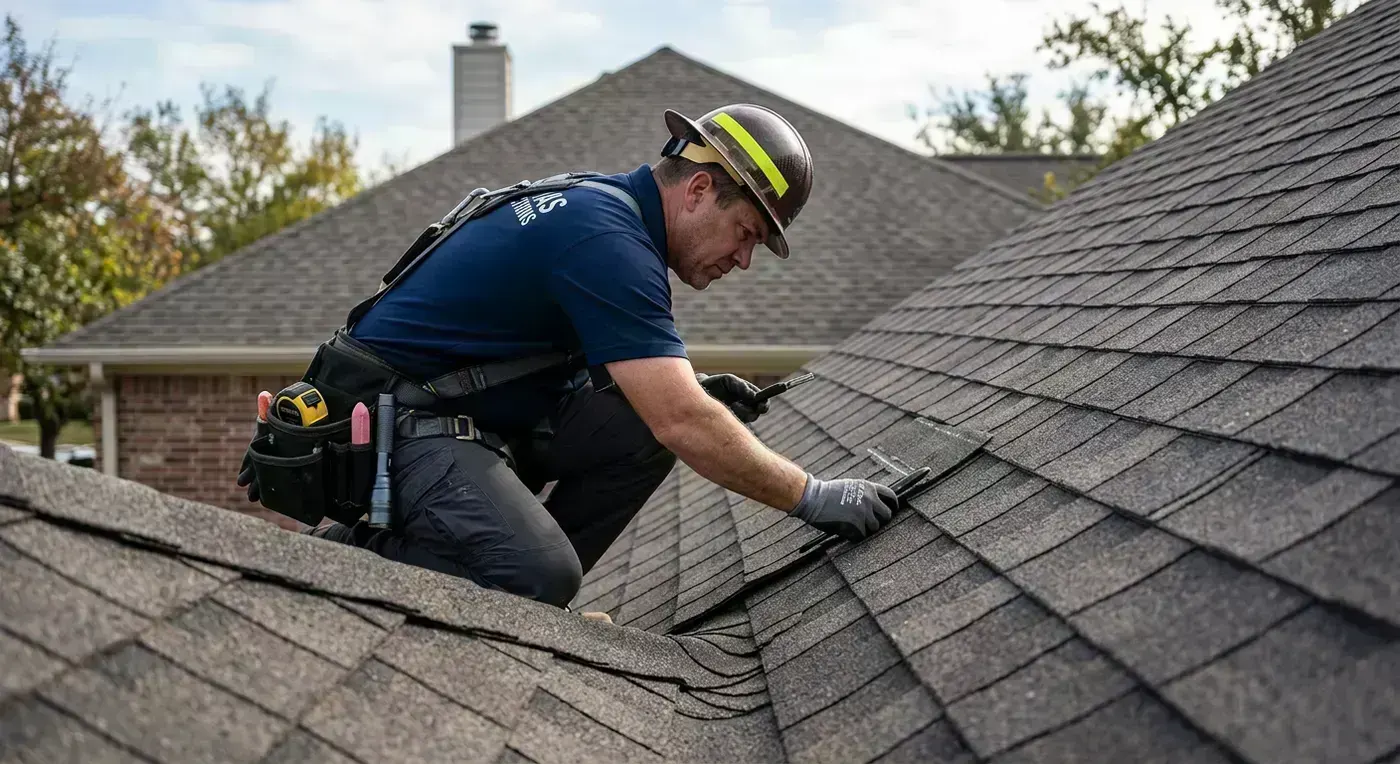
When a lifted tab folds back far enough, the asphalt mat cracks across the fold — a crease. This is permanent. A creased shingle is structurally compromised even after it lays back down, and the crack line is a future leak and a future breakaway point. Creasing is the single most common wind-damage finding on North Texas roofs, and it's frequently missed by ground-level "inspections."
Blow-off
The dramatic end state: the tab, or the whole shingle, tears free and leaves the roof. Blow-offs expose the underlayment and decking directly to the elements. Even a single missing shingle can cascade, because the exposed edge of the neighboring shingle now catches the wind head-on.
Exposed nails and nail back-out
Wind doesn't only work on shingles — it works on the fasteners holding them. As shingles flex repeatedly in the wind, the movement can slowly walk a nail upward out of the decking, a phenomenon called nail back-out or nail pop. A backed-out nail tents the shingle above it, creating a raised bump that both catches more wind and, eventually, punctures through the shingle surface.
The result is an exposed nail head sitting proud of the roof surface — a tiny but reliable leak path. Rain runs down the shank, and the hole in the shingle mat widens with each freeze-thaw and thermal cycle. Exposed nails are also a common consequence of poor original nailing: overdriven nails that cut the mat, underdriven nails that never seated, or nails placed too high above the sealant line where they don't get the shingle's overlap protection. All of these leave the roof more vulnerable to wind from day one.
Rule of thumb: If you can see a nail head from the roof surface, it's a problem. Every exposed fastener should be sealed or the shingle replaced. On a repair, we don't just dab caulk and move on — we look at why the nail backed out, because a pattern of pops usually points to a nailing or ventilation issue worth addressing before it spreads.
Why the ridge and edges fail first
If you map out where wind damage shows up, it clusters at the perimeter and the peak. That's not coincidence — it's aerodynamics. The corners, eaves, rakes, and ridge are the high-pressure and high-suction zones on any roof, sometimes experiencing two to three times the uplift force of the broad field in the middle. Wind engineers literally design for higher fastening rates in these zones for exactly this reason.
The ridge
Ridge caps sit at the highest, most exposed line on the roof and take wind from both sides. Cheap or poorly fastened caps are among the first things to lift and blow off. On a well-built roof, ridge caps are purpose-made, properly nailed, and often paired with a sealed ridge vent that's rated for wind.
The rakes and eaves
The edges are where wind first gets under the roof system. This is the job of edge metal (drip edge) and starter strip — and it's where corner-cutting installs fail. Without a proper starter course sealed at the eave, the first row of shingles has nothing anchoring its leading edge, and the whole field can unzip from the bottom up.
Wind ratings explained (110–130+ mph)
Shingles carry a wind rating from lab testing — commonly ASTM D3161 and the tougher ASTM D7158. You'll see these translated into marketing classes:
| Class | Rated wind speed | Notes |
|---|---|---|
| Class D | 90 mph | Baseline; light for North Texas exposure |
| Class G | 120 mph | Common architectural-shingle rating |
| Class H | 150 mph | Premium; requires enhanced nailing pattern |
Here's the catch every homeowner should understand: the rating is a laboratory maximum for a shingle installed exactly to spec — and it only holds while the seal is intact. A 130 mph shingle that was nailed too high, installed cold, or has a broken seal strip is nowhere near 130 mph in the real world. Wind ratings describe the product's potential, not the roof's actual performance. That gap between rated and real is where installation quality lives, and it's the difference between a roof that hits its full life and one that ages out early.
Cumulative aging: the slow kill
This is the heart of the question. A roof rarely dies from one storm. It dies from the accumulation of many storms, each of which does a little damage that never fully heals. Think of it the way a paperclip breaks: not from one bend, but from bending it back and forth until the metal fatigues and snaps.
Each wind event that lifts a tab, even briefly, can crack a brittle seal. Each cracked seal means that tab flaps a little more freely next time, which makes the next crack easier, which exposes a nail, which tents a shingle, which catches more wind. The process compounds. A roof that might have delivered 25 years in a calm climate can lose a third of that lifespan to a decade of aggressive North Texas springs — not because any single storm was catastrophic, but because the wear never stopped.
This compounding is exactly why other weather works the same way. Hail, for instance, bruises the mat and knocks off protective granules in a similar cumulative pattern — we break that down in our companion piece on whether hail reduces roof lifespan. And when wind and hail damage stack on the same roof over several seasons, the aging accelerates fastest of all. Knowing the signs your roof is nearing the end of its life helps you catch that acceleration before it turns into an interior leak.
Why timely repair pays off: A single creased shingle or lifted tab caught early is a $200 fix. Left for two more storm seasons, it becomes a soft deck, a stained ceiling, and often a conversation about early replacement. The cheapest roof you'll ever own is the one you maintain a little every year — which is the whole point of a post-storm roof repair check.
How proper installation changes everything
If wind ratings describe potential and cumulative damage describes the threat, installation quality is the variable you can actually control. Four details decide how a roof holds up to years of North Texas wind.
1. Nailing pattern and placement
Nails must land in the manufacturer's nail zone — not too high (where they miss the double-layer overlap) and not too low. They must be flush, never overdriven or underdriven. High-wind installs call for six nails per shingle instead of four, and skipping that upgrade in a wind-prone region is a false economy. Bad nailing is the most common reason a "good" shingle underperforms its rating.
2. Starter strip
A proper starter course — factory starter, not upside-down field shingles — puts a continuous bead of adhesive right at the eave and rake to lock down the leading edge of the first row. This is the single most important defense against edge blow-offs, and it's routinely skipped on cut-rate jobs.
3. Edge metal (drip edge)
Drip edge stiffens the perimeter, directs water off the fascia, and gives the starter something solid to bond to. Properly overlapped and fastened edge metal keeps wind from getting a fingerhold under the roof's most vulnerable line.
4. Ridge and hip caps
Purpose-made cap shingles, correctly fastened with longer nails that reach through the extra layers, keep the peak intact when the wind hits from every direction. Cutting field shingles into makeshift caps is a shortcut that shows up as blow-offs within a few seasons.
Get these four right and a roof performs at or near its rating for its full expected life. Get them wrong and even premium shingles age like budget ones. This is why RoofDog backs every installation with a lifetime workmanship warranty — we stand behind the details that actually determine how your roof survives North Texas wind.
What to do after a wind event
You don't need to climb up after every gusty afternoon, but a few habits protect your roof's lifespan:
- Do a ground scan after any storm with strong gusts. Walk the perimeter looking for shingle pieces, granule piles at downspouts, and displaced ridge caps.
- Check the attic. Daylight through the deck or fresh water stains after a storm are urgent signs.
- Get a professional look after a major event. Creasing and broken seals are invisible from the ground — this is what a drone inspection catches.
- Don't wait for a leak. By the time water shows inside, the wind damage has usually been working for a while.
- Document dates. Noting storm dates helps with both maintenance planning and any future insurance claim.
If you've been through a rough spring and want certainty rather than guesswork, the fastest path is to schedule a free RoofDog inspection. We'll fly the drone, photograph every course and edge, and give you a straight answer on whether the wind cost you any roof life — no scare tactics, no upsell.
Protecting Homes. Saving Dogs.
RoofDog serves homeowners across North Texas with drone-based inspections, honest wind and storm repairs, and a lifetime workmanship warranty. We donate 10% of our profits to local dog rescues. Call 940.828.ROOF or book online.
Frequently asked questions
Can wind damage a roof without any shingles blowing off?
Absolutely — this is the most common case. Wind frequently breaks the adhesive seal and creases shingles without removing them, leaving the roof looking intact from the ground while it's no longer weatherproof.
How much wind does it take to damage shingles?
Damage can begin around 45–50 mph on an aged or poorly installed roof, well below the shingle's lab rating. Ratings assume perfect installation and an intact seal, which real roofs rarely maintain forever.
Does a higher wind rating mean my roof will last longer?
It helps, but only if the shingles are installed to spec. A 130 mph shingle nailed incorrectly performs far below its rating. Installation quality matters more than the number on the box.
What is a downburst and why is it worse than regular wind?
A downburst is a column of air that slams straight down out of a storm and spreads outward at ground level, often exceeding 70–100 mph. Because it's sudden and localized, it can peel off a whole roof section while leaving neighbors untouched.
Is wind damage covered by homeowners insurance in Texas?
Most Texas policies cover sudden wind damage, though some carry separate wind/hail deductibles. Documentation and prompt inspection matter, since insurers distinguish storm damage from long-term wear.
Why does wind damage always seem to start at the edges of my roof?
Aerodynamics. Corners, eaves, rakes, and ridges experience the highest uplift — often two to three times the force on the middle of the roof — so those zones fail first.
Can a creased shingle be repaired, or does it need replacing?
A crease is permanent damage to the shingle mat, so the shingle should be replaced rather than resealed. A resealed crease will still crack and leak along the fold line.
What are exposed nails and are they serious?
Exposed nails are fasteners that have backed out or were placed above the shingle overlap, leaving the head exposed to rain. Each one is a direct leak path and should be sealed or the shingle replaced.
How often should I have my roof inspected in North Texas?
Once a year is a good baseline, plus after any significant wind or hail event. Given DFW's active spring storm season, a post-storm check each summer is smart insurance.
Does repeated minor wind really shorten my roof's life?
Yes. Cumulative fatigue is the main way wind ages roofs. Each event cracks seals and loosens fasteners a little more, compounding over years until the roof wears out well before its rated lifespan.
Why do you use drones for wind inspections?
Wind damage lives at the ridge, edges, and tops of courses — places that are hard to see and risky to walk. Drones let us photograph every square foot up close without adding foot traffic that could damage aging shingles.
My neighbor's roof lost shingles and mine didn't. Am I fine?
Not necessarily. Downbursts are localized, and your roof may have broken seals or creased shingles that simply didn't detach. The only way to know is a close-up inspection.
Can better installation actually make a normal shingle last longer?
Yes — correct nailing, a real starter strip, proper edge metal, and purpose-made ridge caps let a shingle reach its rated wind performance and its full lifespan. Poor installation strips years off even premium products.
Does RoofDog charge for a wind-damage inspection?
No. Our inspections are free. Call 940.828.ROOF or book online, and we'll give you an honest assessment with photos — plus, 10% of our profits go to local dog rescues.
Summary
Wind does shorten roof life — mostly through slow, cumulative aging rather than a single dramatic storm. North Texas straight-line winds, gust fronts, and downbursts repeatedly break seal strips, crease shingles, back out nails, and attack the vulnerable ridge and edges. Lab wind ratings of 110–130+ mph only hold up when the roof is installed correctly: proper nailing, a real starter strip, solid edge metal, and purpose-made ridge caps. Catch broken seals and creasing early and your roof reaches its full lifespan; ignore them through a few DFW springs and you can lose years. If you're unsure where your roof stands after a stormy season, RoofDog offers free drone inspections and honest repairs backed by a lifetime workmanship warranty. Call 940.828.ROOF or schedule online — Protecting Homes. Saving Dogs.
You Might Also Need
Need a Roof Inspection?
Get expert advice and a free estimate from North Texas's trusted roofing professionals.
Schedule Free Inspection