Does Wind Damage Warrant a Full Roof Replacement in Texas?
Understanding Wind Damage: Repairs vs. Full Replacement
Texas weather is notoriously relentless. Between early spring supercells rolling across North Texas, sudden summer microbursts, and coastal tropical systems, high winds are an unavoidable reality of Texas homeownership. After a severe wind event, walking out into your yard to find lifted shingles, creased tabs, or roofing debris scattered across your lawn immediately raises a stressful question: Does wind damage warrant a full roof replacement in Texas, or will a localized patch repair suffice?
The short answer is: It depends on the scope of structural compromise, the age of your roofing system, and specific Texas insurance coverage guidelines. While isolated missing shingles can often be repaired, straight-line winds and tornadoes routinely inflict widespread, invisible structural damage that necessitates a complete roof replacement.
In this comprehensive guide, we unpack everything you need to know about wind damage in Texas—from identifying subtle shingle failure to navigating complex insurance claims, local building codes, and protecting your property investment.
Wind doesn't affect a roof the same way hail does. Hail inflicts impact damage, bruising the mat and knocking off protective granules. Wind, on the other hand, exerts intense uplift pressure and dynamic shear force.
As severe winds flow over your home, aerodynamic forces create negative pressure (suction) along the edges, eaves, and ridges. This uplift breaks the adhesive seal binding your shingles together, tearing fasteners through the material or peeling sections off entirely.
Wind Damage Decision Matrix
| Criteria | Repair Sufficient | Replacement Needed |
|---|---|---|
| Affected Roof Area | Less than 25% | Greater than 25–30% |
| Shingle Seal Integrity | Intact across roof | Widespread breach |
| Shingle Creasing/Tearing | Isolated shingles | Widespread across slopes |
| Roof Age | Under 10–12 years | Over 15+ years |
| Mat Brittle Test | Passes (Pliable) | Fails (Cracks) |
| Decking / Structural Integrity | Uncompromised | Sagging / Wet |
| Shingle Availability | Exact match exists | Discontinued |
When a Spot Repair Is Sufficient
A spot repair is typically adequate when:
- The damage is isolated: Less than 5–10% of a single roof slope is affected.
- The roof is relatively young: The surrounding shingles are under 10 years old, remaining pliable enough to lift and re-fasten without tearing.
- The thermal seal is intact elsewhere: Unaffected slopes maintain a strong, unbroken factory seal strip.
- Exact matching materials exist: The existing shingle manufacturer, line, and color batch are still actively produced and accessible.
When a Full Roof Replacement Is Warranted
A full roof replacement becomes necessary—and is often mandated by Texas insurance guidelines—when:
- Damage exceeds 25–30% of the total roof surface: When wind affects multiple slopes, spot repairs become structurally unviable and cost-ineffective.
- Widespread seal failure occurs: Wind can lift shingles, break their thermal seal strip, drop them back down, and leave them looking “normal” from the ground while completely destroying their wind resistance.
- Shingles show horizontal creasing: When wind bends a shingle back, it fractures the internal fiberglass matting along the nail line. Even if the shingle isn't missing, its structural integrity is permanently destroyed.
- The material fails brittle testing: Aging shingles lose volatile oils over time. If surrounding shingles crack when lifted to install replacement units, a spot repair is impossible.
- Decking or framing is compromised: Wind-driven rain entering through lifted shingles can rot internal OSB/plywood decking, fascia, and structural rafters.
- Materials are discontinued: If matching shingles are no longer manufactured, repairing a visible slope can violate municipal building codes or insurance “like-kind and quality” requirements.
Not sure which category your roof falls into? A free professional roof inspection is the fastest way to get a definitive answer.
The Hidden Mechanics of Wind Damage on Texas Roofs
To understand why wind damage often warrants a full replacement, you must understand how a modern roofing system operates. A shingle is not merely laid on top of a house; it is part of an engineered water-shedding system held together by mechanical fasteners (nails) and a heat-activated sealant strip.
1. Seal Strip Rupture and Loss of Adhesion
Every asphalt shingle features a strip of factory-applied asphaltic adhesive. Once installed, ambient heat from the Texas sun seals overlapping shingles together into a monolithic barrier. High winds break this bond.
Once torn apart, dirt, dust, and atmospheric debris coat the adhesive line. A broken seal strip will almost never re-seal on its own. Subsequent minor wind events will continually lift these unsealed shingles, allowing wind-driven rain to scour underneath.
2. Fiberglass Mat Creasing and Fracturing
When high-velocity wind catches an unsealed shingle, it hinges the material back toward the ridge. This creates a distinct horizontal crease line across the top of the shingle tab.
Even if the shingle lays back flat after the storm, the internal fiberglass reinforcement mat is broken. The protective granules along that crease strip away, exposing the raw asphalt to accelerated UV degradation. During the next thunderstorm, wind will snap the weakened shingle tab off completely.
3. Fastener Pull-Through
Severe uplift forces pull the shingle upward against the heads of the roofing nails. If the original installation suffered from improper nailing depth (over-driven nails) or incorrect placement, high wind will pull the shingle clean over the nail heads. The shingle may remain on the roof, but it is no longer attached to the deck structure.
4. Wind-Driven Rain Intrusion
Texas storms rarely bring wind without rain. When wind lifts shingles, rain is driven sideways beneath the overlapping courses, saturating the underlayment. If underlayment seams are compromised or deteriorated, water penetrates directly to the wooden roof deck, leading to hidden rot, ceiling leaks, and toxic mold growth inside the attic.
If you suspect wind-driven rain has entered your home, emergency roof repair and tarping can prevent further damage while you schedule a full evaluation.
Texas Weather Patterns & Wind Speeds: What Causes Severe Damage?
Texas experiences some of the most dynamic meteorological conditions in North America. Understanding the type of wind event that impacted your home helps determine the likely severity of your roof's hidden damage.
Texas Wind Event Classification
| Event Type | Typical Wind Speeds | Primary Roof Damage |
|---|---|---|
| Straight-Line Winds | 50 – 80+ mph | Uplift at eaves/gable; widespread seal failure |
| Microbursts / Downbursts | 60 – 100+ mph | Severe localized impact; widespread shearing |
| Tornadoes (EF0 – EF1) | 65 – 110 mph | Extreme uplift; complete slope section removal |
| Tropical Systems (Sustained) | 45 – 90+ mph | Prolonged fatigue; mass water infiltration |
Straight-Line Winds vs. Microbursts
Straight-line winds associated with Texas gust fronts often exceed 60 to 70 mph. They push uniformly across large surface areas, concentrating uplift on roof perimeters, ridge caps, and rake edges.
Microbursts, conversely, deliver sudden downward columns of air that slam into the roof deck and radiate outward in all directions at speeds exceeding 100 mph. Microbursts can shear off large patches of architectural shingles instantaneously.
The Role of Texas Heat and UV Exposure
Texas roofs endure extreme heat stress. Summer roof surface temperatures in North Texas frequently exceed 150°F to 160°F. This prolonged heat bakes the essential volatile oils out of asphalt shingles, making them brittle over time.
When a high-wind event hits an aged, thermal-baked roof, the shingles cannot flex under wind shear; they snap, crease, or tear away. This synergy between UV degradation and wind uplift is the primary reason older Texas roofs frequently require total replacement rather than spot repairs after a storm. Understanding what causes roofs to fail can help you anticipate when your roof is most vulnerable.
Identifying Wind Damage: Ground-Level vs. Professional Inspection
Detecting wind damage requires a trained eye. While missing shingles are obvious, subtle wind damage requires climbing onto the roof structure or relying on specialized diagnostic tools.
Safety Warning: Never walk on a roof that has sustained recent storm damage. Lifted or unsealed shingles can slide unexpectedly beneath your feet, and structural decking may be compromised. Always conduct initial observations from ground level and hire a licensed, insured roofing contractor for an on-roof evaluation.
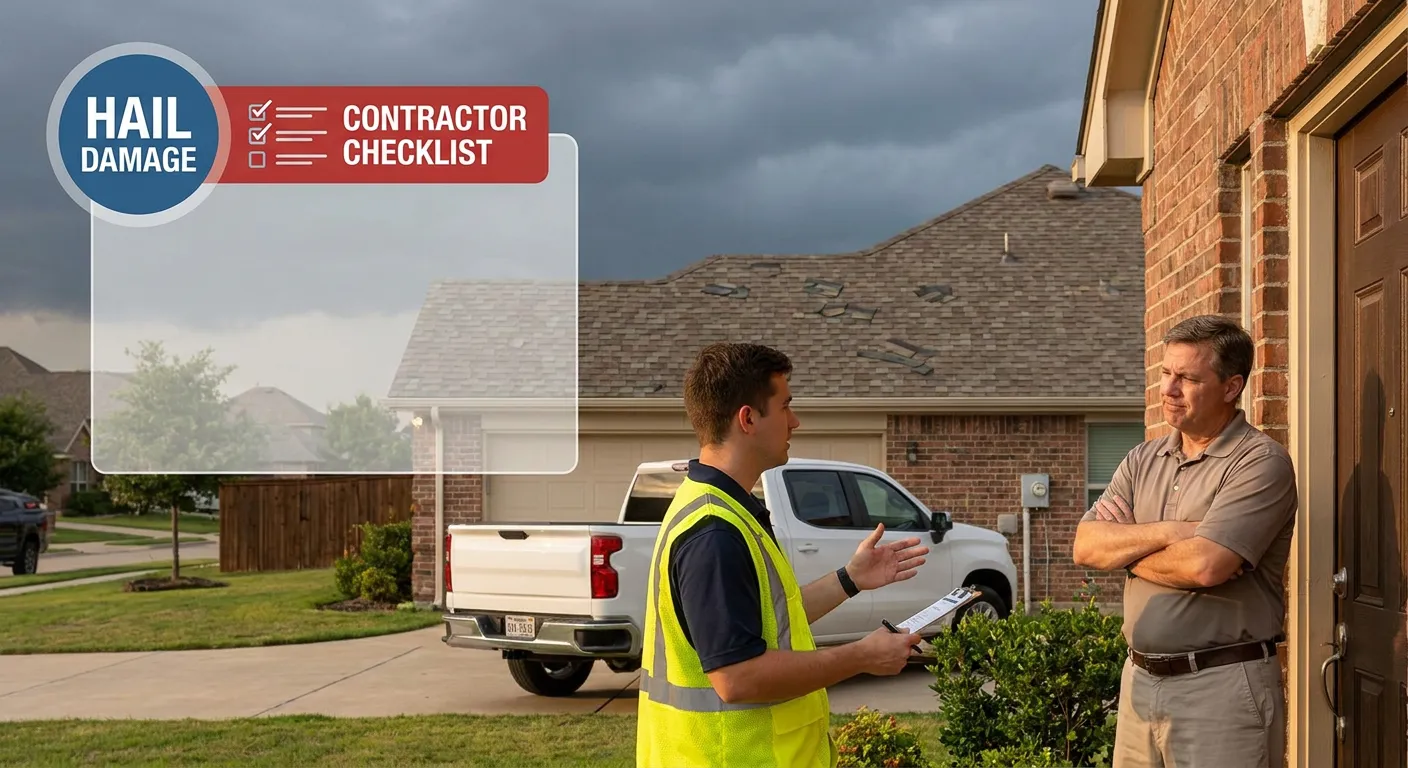
Wind Damage Inspection Checklist
Ground Inspection
- Look for missing shingle tabs in lawn, driveway, or gutters.
- Inspect ridge caps and hips for missing or crooked sections.
- Check fascia, soffits, and rake boards for loose metal trims.
- Check downspouts for excessive asphalt granule accumulation.
Interior / Attic Inspection
- Inspect attic insulation for wet spots or displacement.
- Check wood decking (plywood/OSB) for water staining or drips.
- Look for light filtering through the roof deck near ridge lines.
Professional On-Roof Diagnostics
- Perform physical seal check along suspect shingle courses.
- Identify subtle horizontal creasing across shingle faces.
- Conduct brittle tests on unaffected slopes for repairability.
- Check pipe boots, flashing, and turtle vents for lift.
A thorough professional roof inspection covers all of these items and more. RoofDog inspections include drone imagery and a photo-documented report — always at no cost to you.
Ground-Level Indicators
- Shingle Debris: Finding shingle fragments or entire tabs in your yard, flower beds, or swimming pool.
- Exposed Underlayment: Dark, felt-like paper or woven synthetic material visible on the roof line.
- Misaligned Ridge Caps: Ridge cap shingles that look crooked, lifted, or displaced against the skyline.
- Distorted Flashing or Fascia: Chimney flashing, step flashing, or metal rake edges that have been bent or peeled back by wind forces.
Roof-Level Professional Diagnostics
When a qualified roofing inspector evaluates your home, they look for less obvious indicators:
- Thermal Seal Breach: Testing whether shingle tabs lift effortlessly without resistance.
- Crease Line Mapping: Documenting faint, dark horizontal lines caused by wind flex and granule sloughing.
- Granule Stripping: Identifying lines where high-velocity wind literally blew protective granules off the matting.
- Deck Flexing & Nail Pull-Through: Identifying areas where shingles remain intact but have pulled completely free from the underlying wooden deck fasteners.
The Insurance Claim Process for Wind Damage in Texas
Filing a wind damage insurance claim in Texas requires a clear understanding of your policy terms, state laws, and proper documentation procedures.
Texas Wind Claim Process
- Post-Storm Emergency Mitigation & Inspection: Document visible damage; install emergency tarps if leaking.
- File Formal Claim with Carrier: Provide date of loss, photos, and preliminary contractor assessment.
- Field Adjuster On-Site Inspection: Adjuster evaluates scope of loss (RCV vs. ACV calculation). A reputable contractor should attend this meeting with you.
- Estimate Review & Scope Reconciliation: Ensure estimate includes all IRC/local Texas building codes.
- Roof Replacement Execution: Contractor completes full tear-off and system installation. See exactly what happens on Build Day.
- Depreciation Recovery & Claim Closure: Submit final invoice to carrier to release withheld depreciation.
RCV vs. ACV: How Your Policy Structure Affects Replacement
Understanding how your insurer calculates payout determines your out-of-pocket exposure:
- Replacement Cost Value (RCV): The total cost to replace your damaged roof with new materials of like kind and quality at current market prices, without deducting for age or wear. The insurer pays the initial Actual Cash Value (ACV), and releases the remaining depreciation money once the work is completed.
- Actual Cash Value (ACV): The current value of your roof, factoring in physical depreciation based on age and condition. If you have an ACV-only policy on an older roof, the insurance payout may only cover a fraction of a full replacement, leaving you responsible for the remaining balance.
Crucial Policy Note: Many insurance carriers operating in Texas have systematically transitioned homeowners to Roof Damage Schedules or ACV Endorsements for roofs older than 10 or 15 years. Review your policy declaration page annually to verify whether you have RCV or ACV coverage for wind and hail events.
The Texas Insurance Code & Matching Guidelines
One of the most contentious issues in wind damage claims is material matching. If wind blows off 20 shingles on a prominent front slope, can the insurance company simply pay to replace those 20 shingles?
In Texas, while there is no explicit statutory “matching law” mandating that insurers replace an entire roof purely for cosmetic uniformity, standard policy language requires the carrier to restore the property to a “like kind and quality.”
If your existing shingle is discontinued, or if age and weathering have caused color shifting so severe that a replacement patch creates a glaring mismatch, a spot repair fails to restore the pre-loss value of your home. Professional contractors use physical shingle samples and specialized industry matching services (like ITEL testing) to prove to adjusters that a spot repair is impossible, triggering coverage for a full slope or full roof replacement.
Understanding the 25% Rule and Local Texas Building Codes
Many Texas municipalities enforce the International Residential Code (IRC). Under IRC Section R908.3.1.1:
“Not more than 25 percent of the roof covering of any building or structure shall be repaired, replaced or recovered within any 12-month period unless the entire roof covering is made to conform to the requirements for new structures.”
If wind damage compromises more than 25% of your total roof surface, municipal building codes often mandate a 100% full roof replacement. Insurance policies typically include Ordinance or Law coverage, which funds code-mandated upgrades during a covered loss claim.
Texas House Bill 2102: The Strict Legal Prohibition on Deductible Wiping
In Texas, paying your insurance deductible is required by law. Enacted in 2019, Texas Insurance Code Chapter 707 (HB 2102) strictly prohibits roofing contractors from absorbing, waiving, rebating, or “working around” a homeowner's insurance deductible.
| Statute Requirement | Legal Mandate |
|---|---|
| Deductible Payment | Mandatory out-of-pocket homeowner expense |
| Contractor Rebates | Strictly Illegal (Class A Misdemeanor) |
| Proof of Payment | Insurers can demand bank records/canceled checks before releasing final depreciation |
Under HB 2102:
- Contractors who offer to “cover,” “absorb,” or “credit back” your deductible commit a Class A misdemeanor.
- Insurance companies have the legal right to request proof of payment before releasing the final recoverable depreciation check.
- Homeowners who knowingly participate in a deductible-waiving scheme can face criminal fraud charges.
This is one of the key reasons choosing a reputable roofing contractor matters so much in Texas.
Technical Evaluation: When Repairs Fail & Replacement Is Mandatory
When an adjuster or homeowner pushes for a partial repair after a wind event, a qualified professional evaluates the repairability matrix of the existing system.
The “Brittle Test” (Pliability Assessment)
To execute a spot repair, a roofing installer must lift the overlapping undamaged shingles above the broken section to strip out old nails and drive new ones.
On a Texas roof that has endured years of thermal exposure, bending an old shingle up to a 45-degree angle to insert a nail gun will break the internal fiberglass matrix of the undamaged shingle. This creates a secondary fracture line, causing adjacent shingles to fail during the next gust of wind. If a roof fails a standardized brittle test, a spot repair is structurally impossible; attempting it creates more damage than it fixes.
Decking Saturation and Structural Delamination
Wind damage frequently exposes the roof decking to direct rain. Standard Texas home construction utilizes 7/16-inch Oriented Strand Board (OSB) or exterior-grade plywood for roof sheathing.
When water sits on unsealed OSB decking, the wood swelling causes edge delamination. Plywood layers separate, losing structural screw- and nail-holding capacity. If the wooden deck becomes spongy or saturated, installing new shingles over top is a code violation. The damaged wood must be torn out and replaced—an operation that typically requires stripping large contiguous sections or the entire roof deck. Our Build Day process includes a thorough deck inspection after every tear-off, with all compromised decking replaced before a single new shingle is installed.
Financial Considerations: Cost of Repair vs. Total Replacement
Evaluating wind damage requires looking at both short-term repair estimates and long-term asset protection.
Cost Comparison: Repair vs. Replacement
| Metric | Spot Repair | Full Replacement |
|---|---|---|
| Average Out-of-Pocket Cost | $400 – $1,800 (if not claimed) | Deductible Only (on RCV claim) |
| Workmanship Warranty | None or 30–90 Days | 5 – 25+ Years |
| System Wind Rating Restored | Compromised | Up to 110–130 mph |
| Expected Remaining Lifespan | Unpredictable | 25 – 30+ Years |
| Impact on Home Resale Value | Negative (Patched) | Positive (New) |
For a deeper breakdown of repair vs. replacement costs and considerations, see our Roof Repair vs. Replacement guide.
The Hidden Risk of Repeated Spot Repairs
Homeowners sometimes opt to pay out-of-pocket for minor spot repairs to avoid filing an insurance claim. However, patching an aging, wind-damaged roof often leads to a cycle of escalating expenses:
- Compromised System Integrity: A patched roof remains vulnerable. The remaining, unsealed shingles will continue to peel away in subsequent storms.
- Cumulative Water Damage: Unnoticed leaks beneath patched areas rot internal decking, ceiling drywall, and insulation over time.
- Loss of Transferable Warranties: Spot repairs using non-matching products void original manufacturer warranties on the surrounding material. Learn how roofing warranties protect your investment.
Choosing Wind-Resistant Materials for Your Texas Roof Replacement
If your wind damage claim warrants a total replacement, selecting the right materials ensures your home survives the next severe storm cycle without issue.
Texas Roofing Material Selection
| Material Type | Wind Rating | Impact Rating | Relative Cost |
|---|---|---|---|
| Standard 3-Tab | Up to 60 mph | Class 1 or 2 | $ (Baseline) |
| Architectural (Laminated) | Up to 110 mph | Class 3 or 4 | $ |
| High-Wind / Class 4 Impact Architectural | Up to 130 mph | Class 4 (UL 2218) | $$ |
| Standing Seam Metal | Up to 140+ mph | Class 4 | $$ |
RoofDog installs exclusively Owens Corning roofing systems, including Duration and Duration Storm Class 4 impact-resistant shingles. Explore our full shingle color library to see what's available for your home.
1. Class 4 Impact-Resistant Architectural Shingles
Upgrading to a Class 4 Impact-Resistant shingle (tested under UL 2218 standards) is one of the smartest investments a Texas homeowner can make:
- Superior Wind Resistance: Enhanced polymer-modified asphalt formulations provide tear strength resisting wind uplift up to 130 mph.
- Hail Protection: Class 4 shingles endure impact from 2-inch steel balls dropped from 20 feet without fracturing the internal mat.
- Insurance Premium Discounts: Most Texas home insurance carriers offer annual premium discounts ranging from 10% to 35% for homes with certified Class 4 roofing systems.
2. High-Wind Installation Protocols: Hand-Nailing and 6-Nail Patterns
A shingle's wind rating depends heavily on how it is installed. Standard residential installations use 4 nails per shingle. In high-wind areas across Texas, professional contractors follow enhanced high-wind installation standards:
- 6-Nail Pattern: Adding two additional nails per shingle increases wind uplift resistance by up to 20 mph.
- Precision Nailing: Ensuring nails are driven straight and directly through the double-laminated nail zone—never over-driven or under-driven.
- Enhanced Starter Strips: Installing dedicated, factory-made starter shingles along all rake and eave edges. Starter strips feature heavy-duty adhesive lines that lock down vulnerable roof perimeters where wind damage typically starts.
These are exactly the standards our crews follow on every RoofDog Build Day. You can see the full process — from material delivery through same-day warranty registration — on our dedicated Build Day page.
3. Synthetic Underlayment vs. Traditional Felt
Traditional 15 lb or 30 lb organic felt paper easily tears away when shingles lift during a storm. Modern full replacements should utilize woven synthetic underlayment:
- Tear Resistance: Synthetic underlayments are up to 20 times stronger than asphalt felt paper.
- Secondary Water Barrier: Even if high winds tear shingles away, a properly installed, cap-nailed synthetic underlayment remains intact, preventing severe water intrusion while repairs are scheduled.
Proper ventilation is just as critical as the shingles themselves. Learn why in our Roof Ventilation Explained guide.
The RoofDog Mission: Protecting Texas Homes & Supporting Local Rescue Dogs
At RoofDog, we approach roofing with a clear purpose: protecting Texas families with top-tier craftsmanship while giving back to our community. We donate a portion of the proceeds from every single commercial and residential roof replacement directly to local, no-kill dog rescues across Texas.
When storm season strikes, our team delivers complete end-to-end support:
- Comprehensive Storm Assessments: Advanced drone imaging and physical brittle-testing evaluations during every free roof inspection.
- Insurance Claim Guidance: Line-by-line Xactimate scope reviews, code compliance documentation, and joint adjuster inspections.
- High-Wind Installation: 6-nail high-wind patterns, premium starter strips, and Class 4 impact options on every Build Day.
- Purpose-Driven Impact: Restoring your home while saving the lives of vulnerable shelter dogs across our state.
Post-Storm Checklist for Texas Homeowners
If a severe windstorm recently passed through your area, follow this step-by-step action plan:
- Conduct a Ground-Level Safety Inspection: Walk your property perimeter and take high-resolution photos of any fallen shingles, damaged gutters, or displaced trim.
- Check for Interior Leaks: Inspect ceilings, top-floor drywall, and your attic space for damp insulation, water stains, or dripping water.
- Prevent Secondary Damage: If you spot active leaks or severe roof exposures, call a professional contractor to install emergency tarps. Keep all receipts, as temporary mitigation costs are reimbursable under standard insurance policies.
- Schedule an Inspection: Have a licensed Texas contractor perform a full, on-roof structural and brittle-test evaluation before calling in an insurance claim. Schedule your free RoofDog inspection here.
- Verify Insurance Policy Terms: Review your declarations page to confirm whether your wind coverage operates on an RCV or ACV basis, and verify your current storm deductible.
- File the Claim with Documented Proof: Provide your insurance company with your contractor's comprehensive inspection report, photo evidence, and date of loss.
The Bottom Line
Whether wind damage warrants a simple spot repair or a complete roof replacement comes down to structural integrity, safety, and long-term protection. By taking action quickly, relying on objective data, and working with a trusted contractor, you can navigate Texas storm season with total confidence.
Need help deciding between repair and replacement? Our Roof Repair vs. Replacement guide breaks down every factor. And if you're ready to explore financing options, we offer flexible monthly payments through our partnership with Lyon Financial.
Facing recent wind damage on your Texas home? Contact RoofDog today to schedule an expert storm damage inspection—and help us support local dog rescues with every roof we build.
You Might Also Need
Need a Roof Inspection?
Get expert advice and a free estimate from North Texas's trusted roofing professionals.
Schedule Free Inspection