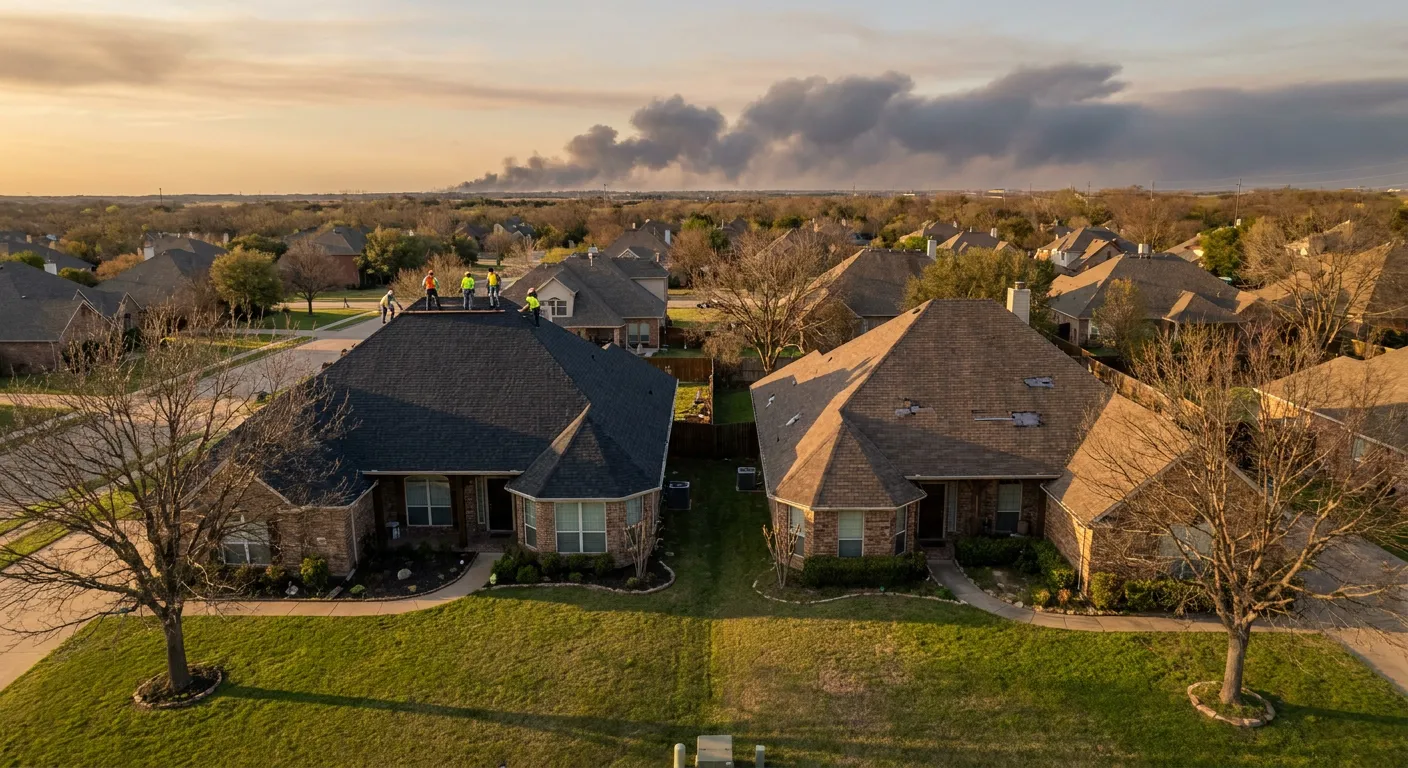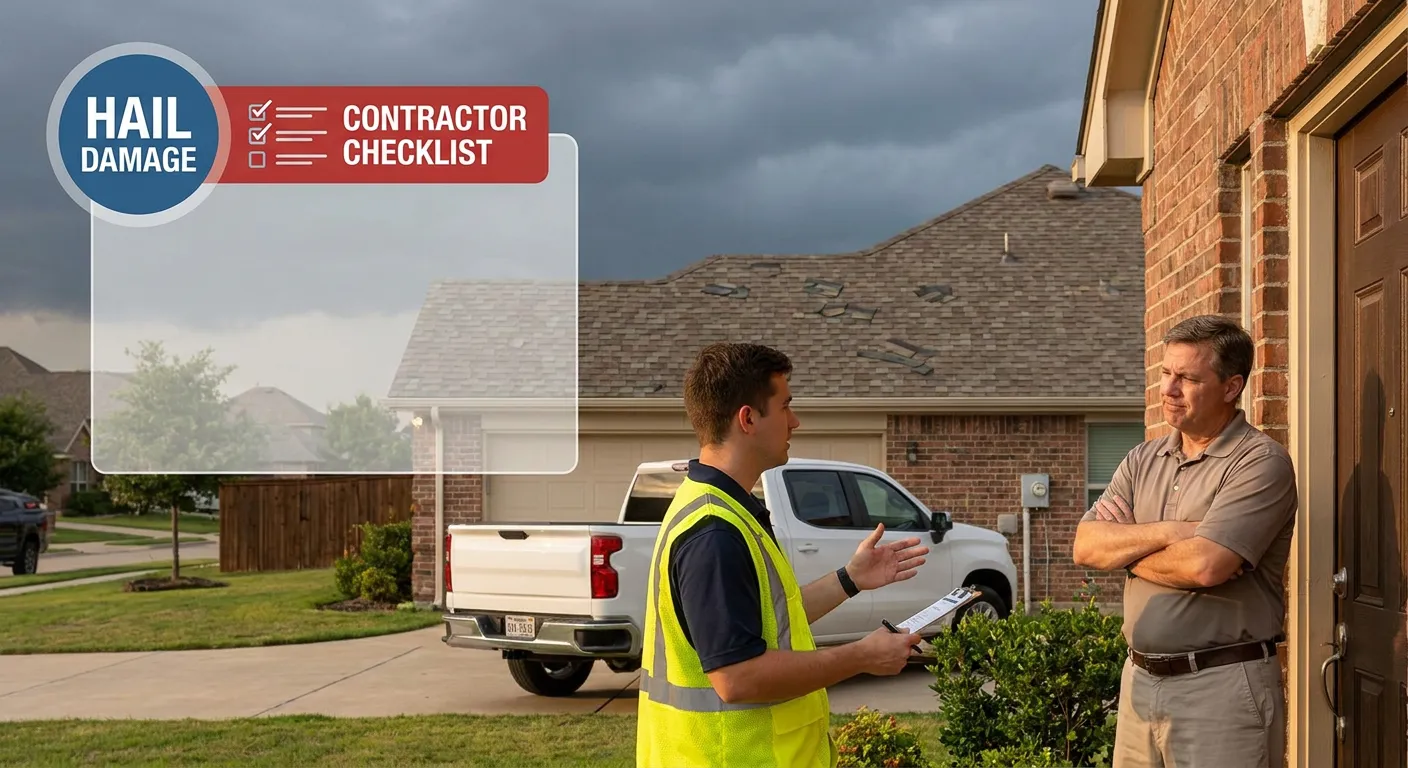
The DFW Homeowner's Guide to Hail Damage: What Size Hail Actually Damages a Roof?
The Physics of Hail Damage: Why Size Isn't the Only Factor
Living in the Dallas-Fort Worth Metroplex means dealing with some of the most volatile weather in the United States. From blistering summer heatwaves to sudden, violent spring supercells, North Texas weather keeps homeowners on their toes. Among all the weather events that sweep through North Texas, hail storms are arguably the most costly and anxiety-inducing.
Every spring and autumn, severe weather systems roll across Collin, Dallas, Denton, and Tarrant counties. Thunderstorms frequently bring everything from pea-sized drops to massive, softball-sized chunks of ice tumbling from the sky. When a major hailstorm hits a community like Frisco, McKinney, Southlake, or Plano, the immediate aftermath is filled with the sound of roaring chainsaws, emergency tarping crews, and ringing phones.
Once the storm passes and the blue skies return, DFW homeowners are left facing an unsettling question: Does my roof actually have damage, or did I get lucky this time?
It is easy to panic when you hear ice slamming against your windows and garage door. However, not every hailstorm demands a complete, top-to-bottom roof replacement. Conversely, some storms cause hidden, catastrophic structural damage that the untrained eye will completely miss from the ground. Understanding the relationship between hail size, shingle durability, and the specific mechanics of impact damage is the key to protecting both your home and your bank account.
To understand what happens to an asphalt shingle when hail strikes, you must look at the basic physics of the impact. While diameter is the most common metric used by meteorologists and news anchors to describe hail, it is only part of the equation. The total destructive capability of a hailstone is a combination of its size, weight, density, and the speed of the winds pushing it downward.
When a piece of ice forms inside a severe North Texas thunderstorm, it undergoes cycles of freezing and lifting within massive updrafts. This process can create solid, dense ice balls that behave like rocks thrown from the sky. A one-inch hailstone falling in calm winds behaves very differently than a one-inch hailstone driven by 60-mile-per-hour straight-line winds sweeping across the open plains of Denton or Collin County. Wind-driven hail strikes roofs at an angle, maximizing horizontal shear force and tearing at the edges of shingles rather than just compressing them.
Additionally, the age, temperature, and current condition of your roofing materials play a massive role in how well they withstand an impact. On a hot summer afternoon, asphalt shingles become highly flexible and pliable, meaning they might absorb impacts slightly better, though they can still suffer deep bruising. Conversely, older shingles that have been baked by years of intense Texas UV rays lose their volatile oils, becoming brittle and highly susceptible to cracking under even modest impacts.
The Hail Size Scale: What Happens to Shingles at Every Level?
To help you evaluate your risk after a North Texas storm, here is exactly how different sizes of hail typically impact standard residential asphalt roofing systems.
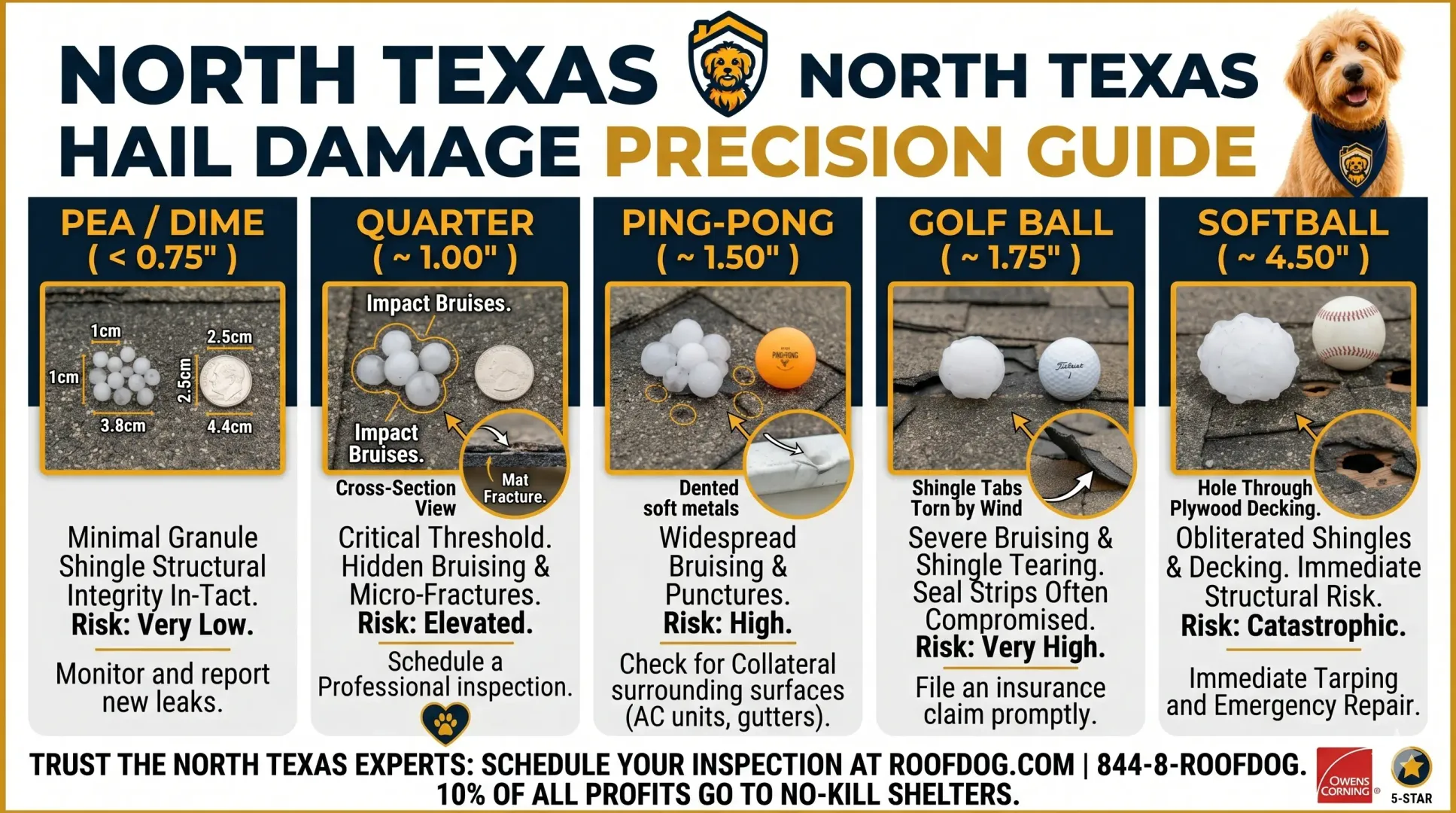
Pea-Sized to Dime-Sized Hail (1/4 Inch to 7/10 Inch)
Generally speaking, hail that is smaller than three-quarters of an inch rarely causes structural or functional damage to a modern asphalt shingle roof. If your home is hit by a brief flurry of pea-sized ice, your roof is likely completely fine, assuming it was installed correctly and isn't nearing the very end of its natural lifespan.
While this size of ice may knock loose a few superficial asphalt granules that were already nearing the end of their life, it lacks the kinetic energy required to fracture the fiberglass matting underneath the shingle. If you see this size of hail, you generally do not need to call for an emergency inspection unless you notice active interior water leaks.
Quarter-Sized Hail (1 Inch)
One-inch hail is universally considered the critical tipping point in the roofing and insurance industries. Once hail reaches the size of a standard U.S. quarter, it possesses enough mass and terminal velocity to cause measurable damage to standard 3-tab shingles and older architectural shingles.
At this size, the impact forces can easily fracture the fragile asphalt layer underneath the protective colored granules. While a brand-new, high-quality architectural roof might survive a 1-inch hail event with only minor granule loss, an older or lower-grade roof will frequently suffer real damage. When quarter-sized hail is reported in your specific neighborhood, scheduling a professional roof inspection is highly recommended to assess the baseline health of your system.
Half-Dollar to Ping-Pong Ball Sized Hail (1.25 Inches to 1.5 Inches)
When hail scales up to the size of a half-dollar or ping-pong ball, the probability of widespread roofing damage increases dramatically. At this size, the ice is heavy enough and falling fast enough to consistently compromise standard residential roofing materials.
Hail of this magnitude will reliably cause deep bruising, puncture older shingles, and easily break the brittle seals between shingle courses. It can also warp, dent, or puncture aluminum soft-metal components on your roof, such as ridge vents, turtle vents, box vents, and valley flashing. If your property experiences a storm with 1.5-inch ice, there is a very high probability that you will require localized roof repairs or a full roof replacement.
Golf Ball to Pool Ball Sized Hail (1.75 Inches to 2.25 Inches)
Golf ball-sized hail and larger is aggressively destructive. There is virtually no standard residential asphalt shingle on the market—outside of specialized, heavy-duty Class 4 impact-resistant materials—that can withstand a direct, sustained bombardment of golf ball-sized ice without suffering immediate, severe structural damage.
At nearly two inches in diameter, these heavy, dense chunks of ice will completely shatter the fiberglass backing mat of your shingles, split wood decking underneath in extreme cases, destroy skylights, shatter clay tiles, and warp heavy-gauge metal flashing. If a storm bringing golf ball-sized hail rolls over your home, you should bypass the wait-and-see method entirely and immediately contact a trusted local contractor for a comprehensive evaluation.
Baseball to Softball Sized Hail (2.75 Inches to 4.5 Inches)
Thankfully, hail of this gargantuan size is relatively rare, but when a supercell drops softball-sized ice over a residential zone in DFW, the results are catastrophic.
This level of severe weather does not just damage shingles; it obliterates them. It can punch holes entirely through the asphalt shingle, the underlayment, and the underlying plywood roof decking, creating immediate entry points for torrential rainwater. If your neighborhood is struck by baseball or softball-sized hail, your immediate priority should be securing emergency tarping services to mitigate secondary interior water damage to your ceilings, walls, and personal property.
Visualizing the Damage: Cosmetic vs. Functional Failures
One of the biggest points of confusion for DFW homeowners is understanding what actually constitutes valid, insurable hail damage. Many homeowners look up at their roof after a storm, see that all the shingles are still physically attached to the deck, and mistakenly assume that no damage occurred. This misconception can cause you to miss critical insurance filing windows, leaving you to pay out of pocket for a roof failure years down the road.
What is Cosmetic Hail Damage?
Cosmetic damage refers to visual alterations that do not compromise the roof's underlying ability to shed water or protect the home. For example, when hail strikes an old, oxidized shingle, it might clean away a small circle of surface dirt, algae, or loose granules, leaving a dark spot that looks alarming but hasn't actually harmed the integrity of the material.
On metal roofs or aluminum gutters, small, shallow indentations that do not crack the paint or compromise the structural seal are often classified as purely cosmetic by insurance companies. While cosmetic issues can affect your home's curb appeal, they rarely cause structural leaks.
What is Functional Hail Damage?
Functional damage occurs when an impact permanently alters the physical structure of the roofing material, directly shortening its lifespan or instantly destroying its water-shedding capabilities. In asphalt shingles, functional damage manifests in three primary ways:
1. The Direct Fracture (The "Star Burst" Pattern)

When a heavy hailstone strikes a shingle squarely, it forces the shingle downward against the rigid roof deck. This sudden compression causes the hidden fiberglass mat inside the shingle to split, crack, or fracture. On the surface, this often looks like a dark, circular depression where the granules have been completely blasted away, exposing the black, shiny asphalt layer underneath. Over time, these fractured areas expand, allowing water to seep directly through the shingle.
2. Shingle Bruising

Shingle bruising is the most insidious form of hail damage because it is incredibly difficult to spot from the ground or on a drone photograph. When hail hits a shingle, it can create a deep bruise without immediately tearing the top surface.
To find a bruise, a trained inspector must physically run their hand across the shingle, pressing down with their thumb. A healthy shingle feels completely firm and rigid. A bruised shingle feels soft, spongy, and giving—much like a bruised apple. This indicates that the internal asphalt matrix has completely collapsed underneath the surface. Within 6 to 24 months, the granules over that bruise will fall away, exposing the bare asphalt to the sun and triggering rapid, localized rot.
3. Delamination and Edge Tearing

Wind-driven hail can get underneath the exposed tabs of shingles, breaking the thermal self-sealing strip that binds the courses together. Once this factory seal is broken, the shingles lose their wind resistance. Subsequent storms can easily catch these loosened tabs, folding them upward, creasing them, or tearing them away entirely.
Hail Size Damage Reference Chart
| Hail Size | Diameter | Typical Damage Level | Action Required |
|---|---|---|---|
| Pea / Dime | < 0.75" | Minimal to none; superficial granule loss. | Monitor; no emergency action. |
| Quarter | ~ 1.00" | Critical Threshold. Potential fiberglass mat fractures on older roofs. | Schedule professional inspection. |
| Ping-Pong | ~ 1.50" | Widespread bruising, exposed asphalt, damaged soft metals. | File insurance claim likely. |
| Golf Ball | ~ 1.75" | Severe destruction, fractured backing mats, torn shingle edges. | Immediate inspection and replacement. |
| Softball | ~ 4.50" | Obliterated shingles, compromised decking, emergency leaks. | Emergency tarping and immediate replacement. |
The Collateral Damage Checklist: Inspecting from the Ground
Climbing onto a steep, multi-story roof after a severe storm is dangerous and should generally be left to licensed professionals who own the proper safety equipment. However, DFW homeowners can easily perform a highly effective preliminary assessment right from the safety of the ground.
By looking for "collateral damage"—signs that hail smashed into other elements of your property—you can quickly determine if the storm was powerful enough to compromise your shingles. Walk around your perimeter and check for the following telltale signs:
- The Downspout Granule Test: Walk to the exit points of your gutter downspouts. Do you see massive, thick piles of colored ceramic granules piled up on the grass or concrete? If the downspouts are choked with granules, it means a severe impact blasted the protective coatings off your shingles.
- Window Screens and AC Condensers: Check your window screens for tears, punctures, or distinct circular indents. Look through the metal grates of your exterior air conditioning condenser unit. If the thin aluminum cooling fins are heavily dented, flattened, or crushed, you can be certain that your roof took a violent beating.
- Garage Doors and Painted Siding: Walk down your driveway and view your garage door at an angle in the sunlight. Do you see shallow dings or dimples in the metal panels? Check any painted wood siding or trim for freshly chipped, circular rings where flying ice blasted the paint away.
- Mailboxes and Decking: If you have a plastic or thin metal mailbox, check it for fractures or heavy dents. Look at your backyard wooden deck or fence—fresh hail impacts will leave clean, bright circular spots where the ice stripped away years of accumulated dirt, stain, or weather-beaten gray patina.
If you check off two or more items on this collateral damage checklist, your property was almost certainly subjected to at least 1-inch or larger hail, making a professional roof inspection an absolute necessity.
How Local Insurance Adjusters Evaluate DFW Hail Damage
Understanding how an insurance adjuster thinks is your greatest advantage when filing a hail damage roof claim. Insurance adjusters do not just look at a roof, see that it looks a bit beat up, and approve a multi-thousand-dollar replacement check. They follow an incredibly strict, standardized scientific process to verify loss.
When an adjuster steps onto your roof, they will establish what is known in the industry as a "Test Square." A square is a standard roofing unit of measurement equal to a 10-foot by 10-foot section (100 square feet). The adjuster will typically draw a 10x10 square using chalk on the front, back, left, and right slopes of your roof.
Inside each individual test square, the adjuster will meticulously search for verifiable, functional hail hits. To qualify as a valid hit, the spot must exhibit both granule loss and a definitive fracture or deep bruise in the underlying fiberglass mat.
The threshold for a total roof replacement varies slightly between insurance providers, but the standard rule of thumb followed by major carriers in Texas is 8 to 10 verifiable hail hits within a single 100-square-foot test square. If multiple slopes meet or exceed this threshold, the adjuster will typically approve the claim for a complete roof replacement. For more on the claims process, read our complete guide to roofing insurance claims.
The Danger of the "Storm Chaser" Trap
In the hours following a publicized DFW weather event, residential neighborhoods are routinely flooded by out-of-state roofing companies, commonly referred to as "storm chasers." These operations track weather radar data, move into hard-hit suburban developments in Flower Mound, Keller, Allen, and Prosper, and knock on doors offering free inspections and high-pressure sales pitches.
While some of these traveling crews are legitimate, many are transient operations that lack permanent roots in North Texas. They often use aggressive tactics to manufacture or exaggerate damage, sometimes pressuring homeowners into signing legally binding Contingency Agreements before an insurance adjuster has even looked at the property. Read our detailed guide on how to avoid roofing scams after a DFW hailstorm.
Once they secure the insurance payout, they may install a low-grade, sub-standard roofing system using cheap labor, only to pack up and vanish to another state when the next major storm hits elsewhere. If your roof develops a leak two years later, your "lifetime warranty" is completely worthless because the company no longer exists locally. Always protect your investment by partnering with an established, locally owned, fully insured DFW contractor who has a physical brick-and-mortar office and verifiable local references. Learn how to choose a reputable roofing contractor.
Upgrading for the Future: Class 4 Impact-Resistant Shingles
If your roof has been compromised by a recent storm and you are facing a full replacement, you should not automatically default to installing the exact same builder-grade materials that were on your home before. A roof replacement is your premier opportunity to future-proof your property against the next inevitable North Texas supercell.
The single best upgrade a DFW homeowner can make is investing in Class 4 Impact-Resistant (IR) Shingles.
What Makes Class 4 Shingles Different?
To earn a UL 2218 Class 4 rating, a shingle must pass a rigorous, standardized scientific test. The test involves dropping a solid 2-inch steel ball from a height of 20 feet directly onto the shingle twice in the exact same spot. To pass, the shingle's backing mat must remain entirely uncracked, unbroken, and free of any tears or splits.
Standard architectural shingles are typically rigid, relying solely on their thickness for strength. Class 4 shingles, however, are engineered using specialized polymer-modified asphalt, often infused with Styrene-Butadiene-Styrene (SBS)—essentially a rubberized additive. This rubberized matrix gives the shingle incredible flexibility, allowing it to act like a trampoline. When a heavy piece of hail strikes a Class 4 shingle, the material flexes to absorb and dissipate the kinetic energy before bouncing back into shape without fracturing.
The Financial Benefit: Texas Insurance Discounts
While Class 4 impact-resistant shingles carry a higher upfront material cost compared to standard shingles, they frequently pay for themselves remarkably fast. Because the Texas Department of Insurance understands how effective these materials are at reducing catastrophic storm claims, state regulations encourage major insurance providers to offer substantial premium discounts to homeowners who install them. Learn more about how Texas insurance companies are changing coverage policies in 2026.
Depending on your specific carrier and policy type, upgrading to a Class 4 roof can slash your annual homeowner's insurance premiums by up to 20% to 30%. In the hail-prone DFW market, where insurance premiums have skyrocketed over recent years, these annual savings can easily cover the material upgrade cost within just a few years, all while giving you unparalleled peace of mind during the next severe weather warning. Explore our flexible financing options to make the upgrade affordable.
Action Plan: What to Do Immediately After a DFW Hail Storm
If a severe thunderstorm just rolled through your area and you suspect your home took a hit, follow this clear, structured action plan to protect your property and ensure a smooth, stress-free recovery:
1. Document the Event Immediately
The moment it is safe to step outside, grab your smartphone. Take photos or videos of the hail resting in your yard, on your patio furniture, or held in your hand next to a standard reference object like a quarter or a tape measure. Take clear photos of any immediate damage you see to your vehicles, windows, or landscaping. This establishes an undeniable, time-stamped visual record linking the storm event directly to your property address.
2. Check the Interior for Active Leaks
Walk through every room of your home, paying close attention to the ceilings, light fixtures, and walls on the top floor. Look for fresh water rings, bubbling paint, or active drips. Check your attic space with a flashlight if accessible. If you discover an active, severe leak, do not wait—contact a local roofer immediately for emergency tarping services to halt internal structural rot.
3. Secure a Trusted Local Inspection
Before you call your insurance company to file an official claim, always have a reputable, local, factory-certified roofing contractor perform a comprehensive, complimentary roof inspection.
Filing a claim that gets officially denied by an adjuster because there wasn't enough actual damage still counts as a "zero-dollar claim" on your permanent insurance record, which can negatively affect your future premiums. A trusted local contractor will provide an honest, objective evaluation, complete with photographic evidence, letting you know definitively if a claim is structurally warranted. Read more about whether you should file a claim or pay out of pocket.
4. File Your Insurance Claim with Professional Support
If your contractor uncovers clear, functional hail damage that exceeds your deductible, it is time to contact your insurance provider to open a claim. Provide them with the exact date of the storm and your documentation.
When the insurance adjuster schedules their official property visit, ensure your chosen roofing contractor is present on-site during the inspection. Your contractor's job is not to argue with the adjuster, but rather to act as your expert advocate—ensuring that all damaged areas, soft metals, and collateral items are pointed out and accurately accounted for on the adjuster's final scope of work. Learn more about what to expect in our guide on forensic roof inspections.
Don't Let Hidden Hail Damage Rot Your Investment
When a major North Texas storm passes, it is easy to look up at your roof, see that all your shingles are still attached, and assume you dodged a bullet. But as we have explored, hail damage is an insidious, often invisible threat. What begins as a minor, imperceptible bruise from a 1-inch quarter-sized hailstone can easily transform into a major interior leak after a few cycles of intense summer heat and winter freezing.
By understanding what size hail actually damages a roof, recognizing the critical difference between cosmetic blemishes and structural failures, and knowing how to spot collateral damage around your property, you can take complete control of your home's maintenance and recovery. For more information on what causes roofs to fail in North Texas, explore our homeowner guides.
Don't leave the integrity of your most valuable financial investment to guesswork. If your DFW neighborhood has recently experienced a severe weather event with quarter-sized hail or larger, protect your home by scheduling a professional, comprehensive roof inspection with a trusted local expert today. Taking proactive action now ensures your home remains safe, dry, and secure, no matter what wild weather the North Texas skies decide to drop next.
You Might Also Need
- Schedule Your Free Roof Inspection →
- Professional Roof Inspection →
- Roof Replacement Services →
- Hail Damage Repair in DFW →
- Roof Insurance Claim Assistance →
- Roof Repair Services →
- Emergency Tarping Services →
- Flexible Financing Options →
- Complete Guide to Roofing Insurance Claims →
- How to Choose a Roofing Contractor →
- What Causes Roofs to Fail in North Texas →
- Class 4 Impact-Resistant Shingles →
- How to Avoid Roofing Scams →
- Should You File a Claim or Pay Out of Pocket →
- Forensic Roof Inspections →
- How Texas Heat Destroys Shingles →
- Texas Insurance Coverage Changes 2026 →
- Frisco Roofing Services →
- McKinney Roofing Services →
- Southlake Roofing Services →
- Plano Roofing Services →
- Denton Roofing Services →
- Flower Mound Roofing Services →
- Keller Roofing Services →
- Allen Roofing Services →
- Prosper Roofing Services →
Need a Roof Inspection?
Get expert advice and a free estimate from North Texas's trusted roofing professionals.
Schedule Free Inspection